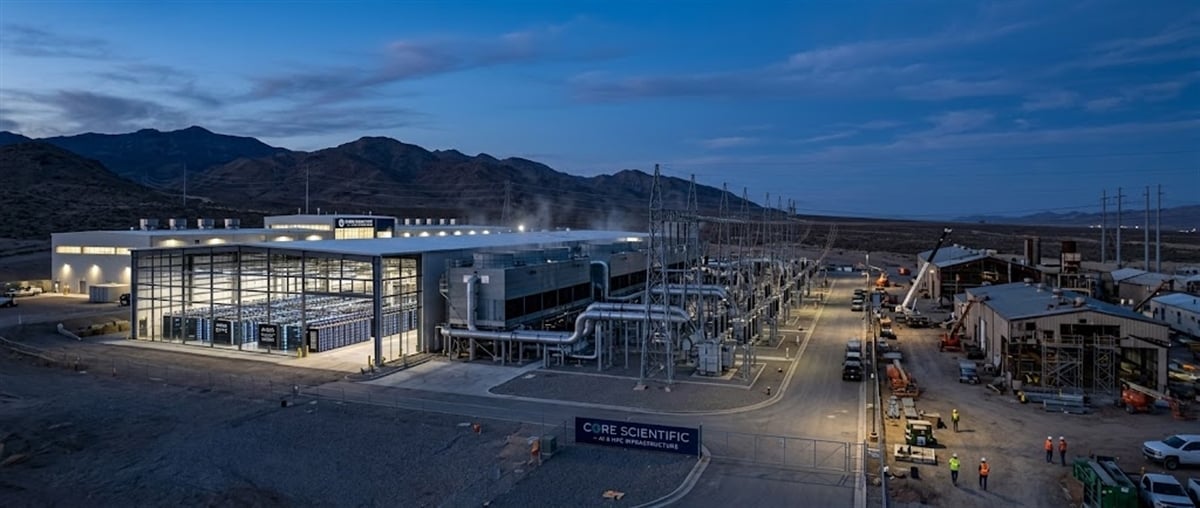
Semiconductors are essentially useless without the raw power required to cool and operate them. As chip architects push the physical boundaries of modern processing, the primary bottleneck constraining artificial intelligence (AI) deployments is no longer fabrication capacity but the raw electrical generation and the highly specialized data center real estate required to house the infrastructure.
Advanced Micro Devices (NASDAQ: AMD) is directly confronting this macroeconomic headwind by vertically integrating its physical supply chain.
AMD is aggressively https://investors.corescientific.com/news-events/press-releases/detail/138/core-scientific-and-amd-announce-infrastructure-partnership with Core Scientific (NASDAQ: CORZ).
Core Scientific, a legacy cryptocurrency miner currently transforming its physical operations, has agreed to allocate up to 2.5 gigawatts of high-density colocation infrastructure to support end-user deployments of artificial intelligence solutions.
By converting volatile digital asset mining grids into premium computing real estate, this structural rotation could result in a valuation recalibration across the infrastructure sector.
Replacing Hash Rates With Long-Term Colocation Revenue
The foundational layer of this agreement rests on a 530-megawatt deployment across five Core Scientific sites.
Instead of relying on the cyclical model of generating digital currency, where revenue fluctuates minute by minute based on global hash rates and asset prices, this capacity is secured through 15-year institutional lease agreements. These agreements also include three consecutive five-year extension options.
This structural shift transforms the physical footprint of a crypto miner into a long-duration contracted-revenue platform that could produce more predictable cash flows.
For Core Scientific, this initial deployment tranche establishes an estimated $14 billion in potential base contracted revenue. The financial impact of this operational pivot is evident in the Q2 2026 earnings data. Total quarterly revenue reached $164.2 million, anchored predominantly by colocation revenue which surged to $136.7 million. That marks a robust expansion from just $10.6 million in colocation revenue generated during Q2 2025.
To mitigate immediate counterparty risk within this initial rollout, the 530-megawatt capacity includes a 152-megawatt high-density colocation allocation specifically carved out for Neocloud. Neocloud will be operating alongside the primary 377-megawatt lease for Advanced Micro Devices. This day-one tenant diversification provides a more stable revenue floor as Core Scientific navigates the intensive site retrofitting process.
While Core Scientific recorded a $1.15 billion GAAP net loss for the quarter, it is crucial to note that this was primarily driven by non-cash fair value adjustments on outstanding warrants following recent stock price appreciation. Adjusted EBITDA remained fundamentally healthy at $41.1 million.
Sweat Equity: Deploying Megawatts for Shares
Execution risk in the data center space remains heavily anchored to capital expenditure. Transitioning sites from rudimentary mining operations to high-density colocation facilities requires significant capital investment, as evidenced by Core Scientific's recent $797.5 million in quarterly capital expenditures.
To align AMD’s potential equity participation with the capacity covered by the partnership, the partnership employs an intricate equity mechanism. AMD received market-priced warrants to purchase 30 million shares of Core Scientific common stock at a strike price of $23.47 per share. These warrants do not vest arbitrarily. They operate on a strict, execution-based schedule, unlocking 12,222 shares for every megawatt of critical IT load successfully executed.
Tying equity realization directly to physical deployment enables semiconductor developers to secure essential operating environments for hardware such as the Instinct GPU and EPYC CPU lines without absorbing the full cost of the infrastructure build-out upfront.
From an investor perspective, this mechanism helps de-risk Core Scientific's heavy capital requirements while helping deployment speed and vertical integration for AMD.
The 2028 Power Play
While the initial leases establish a future deployment base beginning in 2027, the broader market signal lies in the expansion framework.
The agreement charts a pathway to a maximum of 2.5 gigawatts, relying on a formalized reservation right for an additional 1,925 megawatts of infrastructure.
Advanced Micro Devices holds the right to execute this expansion option through Dec. 28, 2028.
Reserving the right to lease nearly two gigawatts of future capacity acts as a strategic macro hedge against escalating global power grid bottlenecks. Building a new 500-megawatt data center from scratch can take years to complete because of grid-interconnection, permitting, equipment-procurement, and construction requirements. Bitcoin miners already have the heavy electrical infrastructure, such as substations, industrial transformers, and high-voltage transmission lines, enabling rapid retrofitting.
The broader semiconductor sector continues to navigate deep ultraviolet lithography supply chain constraints and elevated valuation multiples.
AMD is currently experiencing pre-earnings consolidation near $430, trading at a trailing price-to-earnings ratio approaching 140 ahead of the August earnings call.
Anslysts currently expect AMD to report earnings per share (EPS) of $1.14 on $10.5 billion in revenue. In this environment of elevated expectations, guaranteed energy access commands a heavy institutional premium.
Why Legacy Crypto Grids Command Premiums
The commercial viability of repurposing cryptographic infrastructure is moving swiftly from a speculative narrative to a contracted baseline revenue stream.
Preceding infrastructure conversions of similar scale are currently modeled at 80% to 85% profit margins on annualized colocation GAAP revenue.
Applying those margin profiles to a $14 billion contracted-revenue backlog fundamentally changes the valuation mechanics of Core Scientific, which currently trades at roughly 18x sales.
The market is slowly pricing in this reality, as evidenced by the recent 8.3% drop in short interest for Core Scientific during the first half of July. However, short interest remains about 20% of the float. Institutional positioning points toward an aggressive repricing of future cash flows, and analysts are issuing updated price targets into the $25 to $38 range.
Options flow data for AMD also indicates highly concentrated institutional positioning ahead of its Aug. 4 earnings release, with the $500 strike calls heavily weighted, suggesting market confidence in AMD's strategic direction despite routine insider selling.
A sum-of-the-parts valuation may reveal overlooked value in distressed or undervalued digital asset mining companies. When legacy crypto grids are viewed through the lens of secured energy access, equipped with existing substations and commercial power purchase agreements, they begin to look less like speculative hardware plays and more like highly strategic real estate.
Investors may want to add transitioning infrastructure providers to their watchlists, as secured energy access could provide a runway for sustained margin expansion regardless of broader cryptocurrency volatility.
The article "Mining For Megawatts: AMD's Billion-Dollar Grid Grab" first appeared on MarketBeat.