'I've noticed myself that I'm walking much slower in these past two days," Yo said. Those who knew Yo would describe her as someone who does everything quickly -- always first to arrive, first to act, first to speak.
Speed, for her, had long felt like a virtue. But it had quietly cost her: a careless remark to a close friend, words spoken before they were weighed up, a habit of rushing off from lunch before anyone else had finished eating. Slowly, she started making small adjustments. She breathed before responding. She waited for friends at the table.
Yo is among 33 young people aged 16 to 20 from across Thailand who took part in a mental health and psychosocial first aid workshop organised by Unicef Thailand, the Department of Children and Youth, Host International Thailand and International Detention Coalition with support from the European Union.
They share one thing in common: they are children in the context of migration -- including children of migrant workers, stateless youth, undocumented children and refugees living in Thailand. Most have grown up in the country and speak Thai.
Held over three days at a leafy ashram in Nakhon Nayok, the workshop was designed not to teach rules, but to create space for reflection, connection and self-discovery.
Children in the context of migration often face unique challenges. Displacement, family separation, insecure legal status, and limited access to services can leave them vulnerable to chronic stress, anxiety and social isolation.
In Thailand, while access to education and healthcare for migrant and stateless children has improved, mental health and psychosocial support is only beginning to be integrated into child protection systems. The workshop sought to fill part of that gap, helping participants manage stress and better understand their emotions, and support peers in distress.
The programme began by inviting participants to reflect on the differences they brought into the room -- from religion, gender, and ethnicity to experiences of migration and belonging.
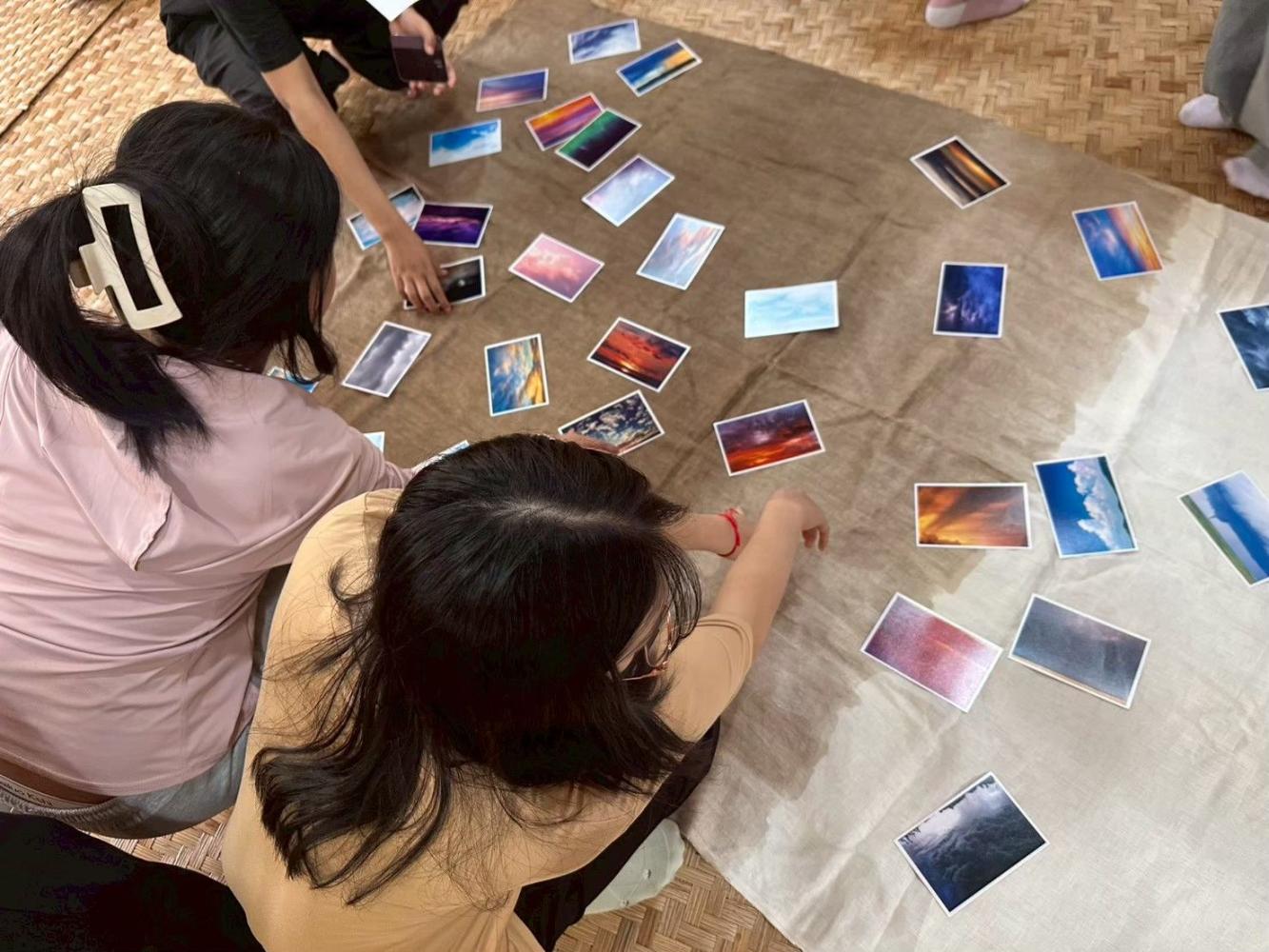
Coming from Vietnam, Myanmar, Cambodia, Laos, Karen, Shan and Mon communities, they shared hopes, worries, and personal stories through conversation, colours, images, and creative exercises.
The second day turned inwards. Through breathing and grounding exercises, movement-based activities, and games that relied on gestures rather than words, participants explored mindfulness, trust, and self-awareness.
There are around half-a-million children in the context of migration in Thailand. Over 150,000 are enrolled in Thai schools, where they receive a G-code student ID card granting them the right to education and reside in the country -- but little else.
For those without any ID card at all, access to public services is almost nonexistent. It is within this landscape that workshops like this one take on particular significance.
For Khaimook, another of the participants, the workshop offered a lesson about rootedness. Born in Thailand but raised in Myanmar after her family moved when she was a toddler, she returned to pursue a university education and found her Thai lacked the fluency she hoped for. She was relieved to discover she was not alone.
"Everyone keeps practising. If they could succeed, so can I."
What stayed with her most was a grounding exercise, in which participants stood firm while a partner gently pushed or pulled them.
"Being stiff can make you strong," she reflected, "but through this exercise, I learned that when we are grounded and have a strong foundation, we can be not only strong but also resilient."
Keng, from Chiang Mai, is preparing to study economics at Rajabhat University. As a registered stateless person with a non-Thai ID card, she faced restrictions throughout school. In high school, she was unable to join a science programme because it required travel for workshops and competitions.
That experience shaped how she viewed the workshop's boundary exercise. A friend had long teased her about her boyfriend despite being asked to stop.
"If we cross someone's line, we should apologise," she said. The workshop helped her realise that next time, she could speak up and expect her boundaries to be respected.
Can, 19, studies logistics at a technical college in Mae Sot. Getting to the workshop alone had been an ordeal: travelling from Mae Sot required preparing documents days in advance, multiple trips to collect approvals, and costs that added up quickly. He arrived carrying those pressures alongside the ordinary ones of a young person.
What he found most calming was a clay modelling session.
"The clay let me be quietly with myself and focus, until I could feel its softness," he said. He thought he might try drawing or listening to music more when he returned home.
Pimsiri Ruangjiranan, one of the facilitators, said the workshop was focused on self-knowledge they could carry forward -- and the effects showed up sooner than expected. She described a girl who, during the second day, answered a call from her younger sister and found herself responding in a way she wouldn't have before the camp.
"Children on the move often don't have a strong foundation because they've had to keep moving," Pimsiri said. "But if they can grow through that, they become very strong."
Parinya Boonridrerthaikul, a child protection officer at Unicef, said.
"The tools and techniques introduced during the camp can be applied well beyond the camp setting."
She spoke of a ripple effect she hoped would follow the participants home.
"Our ultimate goal is for these young participants to use these skills to support their friends within their communities. This is particularly meaningful because children in these communities often have limited access to opportunities that promote emotional well-being and personal development."
Back at the ashram on the final afternoon, Yo was thinking about lunch. Not about being first to finish, but about waiting.
"If my friends are still eating, I will just sit and wait," she said. "We have a full hour for lunch break. There's no need to rush."
It was a small thing. But in a life defined by the need to keep moving and act before opportunities slipped away, the idea of simply sitting and waiting carried an unexpected power.
For the first time, stillness felt like something she was allowed to choose.