Closing summary
We’re wrapping up our live coverage of the Middle East crisis for now but we have a full report on the latest, and here’s a recap of the day’s events. Thanks for joining us.
-
Donald Trump announced Israel and Hezbollah had agreed to “stop shooting” at each other in a mutual de-escalation. Hezbollah had pledged through intermediaries not to attack Israel, and Israeli prime minister Benjamin Netanyahu had agreed to pull back any troops preparing to attack Beirut, the US president said.
-
Lebanon’s embassy in Washington said the agreement would not end the conflict but that it called for Israel to refrain from strikes on Beirut and its southern suburbs controlled by Hezbollah, while the Iran-aligned group would halt its attacks on Israel.
-
Netanyahu said Israel would continue military operations in southern Lebanon, where ground forces are pushing their deepest incursion in 25 years.
-
Hostilities in southern Lebanon later appeared to continue, with Hezbollah reportedly claiming several attacks on Israeli targets in the south late on Monday. The Israeli military said early on Tuesday it had intercepted two projectiles that crossed from Lebanon into northern Israel, with no injuries reported.
-
Hezbollah lawmaker Hassan Fadlallah said the militia would support a full ceasefire across all of Lebanon as a precursor to the withdrawal of Israeli troops.
-
Lebanon said it would seek to expand the ceasefire in talks with Israel in Washington DC on Wednesday.
-
Iranian state media said Tehran was halting indirect peace talks with the US and might end a ceasefire that has largely held since early April, citing the war in Lebanon.
-
Trump later told CNBC the peace talks had “started to get very boring” and that he “couldn’t care less” if they were over. However, he also told US ABC News he expected there would be a deal with Tehran “over the next week” to extend the truce and reopen the strait of Hormuz.
-
The head of Iran’s Revolutionary Guards Quds Force threatened to expand its blockade of the strait of Hormuz to the Bab El Mandeb strait, another chokepoint at the mouth of the Red Sea.
-
Oil prices rose 4% on Monday amid the heightened tensions.
-
UN chief António Guterres said peacekeepers would be needed in Lebanon after the mandate of the current mission expired at the end of this year – an option likely to face opposition from the US and Israel.
-
A team of 14 UN experts issued a “stark warning about surging Israeli settler terror” in the occupied West Bank and east Jerusalem and the “existential risk” it posed to Palestinian communities there.
With news agencies
Updated
When Hussain Alawieh used to take tourists to Beaufort Castle, they would marvel at the view. The ancient hilltop fort still offered the same sweeping panoramic views of south Lebanon and the Litani River that empires fought over for a millennia.
On Sunday, the view from the castle was obscured by white phosphorus smoke, the toxic incendiary munition providing a smoke screen for advancing Israeli soldiers. Out of the fog rose an Israeli flag, and the castle – for the first time in 26 years – was once again conquered.
In the age of drones and surveillance blimps, the value of the ancient hilltop fort is diminished. But to both Israelis and Lebanese, its capture carried psychological weight in a conflict that for six weeks had ground to a deadlock.
See the full story here:
Further to the last post: Concerns over Unifil’s exit come as Israeli troops are occupying southern Lebanon and as Israel and Lebanon are holding direct negotiations seeking to end their decades of hostilities.
Their next round of talks is scheduled for Tuesday and Wednesday in Washington DC, with Lebanese negotiators reportedly hoping to widen the scope of areas that will not be attacked in the country as they seek a complete ceasefire.
Unifil currently counts about 7,500 peacekeepers from nearly 50 countries, deployed in south Lebanon near the Blue Line. The force has been a buffer between Lebanon and Israel since 1978 although its presence has not prevented repeated outbreaks of conflict.
Several Lebanese sources told AFP that Beirut, which has pledged to disarm Hezbollah, supports maintaining a UN presence after Unifil’s departure.
Lebanon’s ambassador to the UN, Ahmad Arafa, thanked UN chief António Guterres for his report and said:
Recent developments have only heightened Lebanon’s urgent need for continued UN and international assistance, specifically to facilitate an Israeli withdrawal on the one hand, and to enable the state to extend its authority over its entire territory on the other.”
Several members of the security council also support replacing Unifil, particularly China and Russia.
Updated
UN secretary general António Guterres has said peacekeepers will be needed in Lebanon after the mandate of the current mission expires at the end of this year – an option likely to face opposition from the US and Israel.
Last August the UN security council – under US pressure – decided to end the mandate of the UN interim force in Lebanon (Unifil) on 31 December 2026. But it asked Guterres to propose options by 1 June to allow UN peacekeepers to remain in Lebanon, particularly to monitor the Blue Line, which stretches for 120km (75 miles) and marks the de facto border between Lebanon and Israel – now the middle of the Israel-Hezbollah war.
In a report to the security council on Monday, Guterres proposes three options ranging from nearly 2,000 to more than 5,500 UN personnel to monitor the ceasefire and support the Lebanese armed forces.
The report, cited by Agence France-Presse, says:
Under all proposed options, a uniformed United Nations presence working to facilitate de-escalation, dialogue, liaison and coordination, and support for the Lebanese Armed Forces, would be necessary... towards the overarching objective of a long-term solution to the conflict.”
Updated
UN experts warn against 'surging Israeli settler terror'
A team of UN experts has issued a “stark warning about surging Israeli settler terror” in the occupied West Bank and east Jerusalem and “the existential risk it poses to Palestinian communities’ presence on the land”.
The group of 14, including the UN’s special rapporteur for Palestine, Francesca Albanese, cited a sharp increase in the number of Palestinian casualties in settler attacks this year, saying at least 13 had been killed and close to 500 injured in five months amid the “settler brutality”.
The experts said in a statement:
Relentless attacks by the settler-colonial movement, carried out with the support and acquiescence of the Israeli State, have become a daily terror in Palestinian lives, sowing fear, uncertainty and profound insecurity that inevitably compels the forcible displacement of the indigenous population.
The escalating violence, carried out with full impunity, serves as an instrument of coercion in the hands of the occupying power, facilitating ethnic cleansing.”
The recent escalation of regional hostilities had drawn international attention away from the realities in the occupied territories, the UN team said, and the “displacement of people has slipped further from sight”.
Updated
Oil prices surge amid tensions
Oil prices have jumped after the latest fighting to threaten the US-Iran ceasefire – but Wall Street doesn’t seem too concerned, with US stocks rising to more records.
The S+P 500 added 0.3% on Monday to its prior all-time high set on Friday, the Dow Jones Industrial Average rose 0.1% and the Nasdaq composite climbed 0.4% to also set records.
A slight majority of US stocks actually fell, including companies with big fuel bills hurt by higher oil prices, such as airlines, after the price for a barrel of Brent crude oil climbed 4.2% to settle at $94.98.
That clawed back a chunk of Brent’s loss from last week and means it is still well above its price of about $70 before the war, the AP reports.
Updated
Rockets fired at northern Israel, says IDF
The Israeli military says it has intercepted two rockets launched from Lebanon into Israel territory.
The IDF also said that after warning a hostile aircraft had infiltrated northern Israel, the suspected target had fallen in Israeli territory near the Lebanese border.
There were no casualties, the military posted on X.
Alerts for rocket and missile fire had earlier been activated, it said.
Updated
Hezbollah claims attacks on Israeli targets after Trump statement
Hezbollah claimed several attacks on Israeli targets in south Lebanon late on Monday, hours after Donald Trump said the Iran-backed militia had agreed that “all shooting will stop”.
In one statement, Hezbollah said that in the town of Hadatha, its fighters targeted a Merkava tank with an attack drone, and Israeli troops with “barrages of rockets and artillery shelling”.
In another statement it said its fighters subsequently attacked two Israeli tanks in the same area.
In a third of the statements – which like the others also indicated an attack time of after 11pm (2000 GMT) – Hezbollah said its fighters targeted a Merkava tank in the town of Bayada “with a guided missile”, reports Agence France-Presse.
As mentioned earlier, Hezbollah MP Hassan Fadlallah said the group supported a “full ceasefire on all Lebanese territory”, calling it a precursor to Israeli troops withdrawing from Lebanon.
Before that the Lebanese presidency said Hezbollah had accepted “a reciprocal cessation of attacks”, but Israeli prime minister Benjamin Netanyahu said the IDF would “continue to operate as planned” in southern Lebanon.
Updated
Iran’s chief negotiator and speaker of parliament, Mohammad Bagher Ghalibaf, has said that if “Israeli aggression against Lebanon continues, we will not only halt the path of negotiations, but we will also be in direct confrontation with the enemy”.
Ghalibaf said he had spoken to Nabih Berri, the speaker of parliament in Lebanon, and offered his support.
Earlier in the day Berri reportedly told the Trump administration that Hezbollah was ready for a full and immediate ceasefire with Israel.
Updated
More now from Donald Trump’s comments to US ABC News in which he said he expected there would be a deal with Tehran “over the next week” to extend the truce and reopen the strait of Hormuz.
“There was a little glitch today, but I turned that one around very quickly, as you probably noticed earlier,” he said. The glitch, according to Trump, was that Iran was upset about Israel’s attacks on Lebanon, the network is reporting. He continued:
So I spoke with Hezbollah, and I said no shooting, and I talked to Bibi [Israeli prime minister Benjamin Netanyahu] and said ‘no shooting’ and they both stopped shooting each other.”
Trump said a peace agreement with Iran could be “even better than a military victory”, the ABC quotes him as saying on Monday.
“It’s not a simple thing. You’re talking about a real large country … making a deal. Tremendous hostility, really.
So it’s not an easy thing for them. It’s actually not easy from our standpoint either. But we’re getting what we need to get.”
As for when the memorandum of understanding to reopen the strait would be completed and agreed to, Trump said: “I think you’re talking about over the next week.” He said he had not agreed to it yet because “I still have to get a few more points”, the report says.
Updated
Trump urges Israel and Hezbollah to stop fighting 'for eternity'’
Donald Trump has urged Israel and Hezbollah to stop fighting “for ETERNITY”, reiterating that he spoke to both parties on Monday and they agreed to stop shooting at each other.
He wrote on his Truth Social platform:
I had a conversation with Bibi Netanyahu today, asking him not to go into a major raid of Beirut, Lebanon. He turned his Troops around. Thank you Bibi! I also had a conversation with Representatives of the Leaders of Hezbollah, and they agreed to stop shooting at Israel, and its soldiers. Likewise, Israel agreed to stop shooting at them. Let’s see how long that lasts — Hopefully it will be for ETERNITY!
Trump says he thinks there will be an Iran deal 'over the next week'
Meanwhile, Donald Trump has told ABC News that he thinks there will be a deal with Iran to extend the ceasefire and reopen the strait of Hormuz “over the next week“, according to a post from the outlet on X.
It comes after the US president claimed on his Truth Social platform earlier that “talks are continuing, at a rapid pace, with the Islamic Republic of Iran”.
But, as we’ve been reporting, Iranian state media reported on Monday that Tehran had suspended message exchanges with Washington amid Israel’s continued assault on Lebanon.
Trump’s latest comments also appear at odds with what he has told other outlets on Monday, including that he “couldn’t care less” if talks with Iran are over, and “it’s fine if they’re done talking.”
As my colleagues note in this report, both Israeli officials and Hezbollah have made statements that cast doubt on the durability on the agreement announced by Donald Trump.
The Hezbollah MP Hassan Fadlallah said the group refused a partial truce offer to spare Beirut in exchange for an end to Hezbollah attacks on Israel.
While, in a statement on X, Benjamin Netanyahu said he told Trump that Israel would attack Beirut if Hezbollah did not stop attacking Israel and its citizens, adding that Israel will continue to operate “as planned” in southern Lebanon.
Both Israel and Hezbollah continued attacking each other in south Lebanon after Trump’s statement.
Israel carried out airstrikes outside Nabatieh, while Hezbollah said it struck a group of Israeli soldiers outside Beaufort Castle.
Updated
Hezbollah supports ‘full ceasefire’ on all Lebanese territory, says MP
Hezbollah MP Hassan Fadlallah has said that the group supports a “full ceasefire on all Lebanese territory”.
The ceasefire would be a precursor to the withdrawal of Israeli troops from Lebanon, Fadlallah added in comments made to the al-Manar broadcaster, as reported by Al Jazeera.
Earlier, the Lebanese presidency said that Hezbollah had accepted “a reciprocal cessation of attacks”, but Israeli prime minister Benjamin Netanyahu said the IDF would “continue to operate as planned” in southern Lebanon.
Itamar Ben-Gvir, Israel’s minister of national security, has urged Benjamin Netanyahu to tell Donald Trump “no” – and to strike Hezbollah anyway.
Writing on X, he said:
Mr Prime Minister,
You said that a strong prime minister tells the President of the United States – ‘yes’ when possible, and ‘no’ – when necessary.
This is the time to tell our friend, President Trump – ‘no’.
Now is the time to do what is required and necessary to strike Hezbollah, to unleash the hands of our fighters, and to restore security to the north.
Updated
Netanyahu says Israel will strike Beirut if Hezbollah doesn't stop attacks and will continue operations in southern Lebanon
And now we have Israeli prime minister Benjamin Netanyahu’s response.
Netanyahu said that he told Donald Trump that his country would strike Beirut if Hezbollah doesn’t stop attacking Israel.
“I spoke this evening with President Trump and told him that if Hezbollah does not cease attacking our towns and our citizens, Israel will strike terrorist targets in Beirut,” Netanyahu said, according to a statement released by his office.
He added: “Our position on this remains unchanged. At the same time, the IDF will continue to operate as planned in southern Lebanon.”
Updated
Lebanon's US embassy says Hezbollah accepted US proposal on 'mutual cessation of attacks'
But before I bring you that, we have a statement from the Lebanese embassy in Washington, via the X account of office of Joseph Aoun, the president of Lebanon.
“The Lebanese authorities [have] received confirmation of Hezbollah’s agreement to the US proposal, which calls for a reciprocal cessation of attacks,” the statement reads.
“Under the proposed arrangement, Israeli strikes on Beirut’s southern suburbs would cease in exchange for Hezbollah refraining from carrying out attacks against Israel, with the ceasefire framework to be expanded to encompass all Lebanese territories.”
The statement added that Donald Trump held a call with Lebanon’s ambassador to the US, Nada Maawad, and informed her “that he had obtained the approval of Israeli prime minister Benjamin Netanyahu for the proposed arrangement”.
“Ambassador Maawad relayed the outcomes of the discussions to President Aoun, who in turn notified Hezbollah of them,” it goes on. (It’s unclear if this is what Trump was referring to when he said he had had a “very good call” with Hezbollah “through highly placed representatives”.)
Referring to upcoming negotiations between Israel and Lebanon, the statement ends: “The scheduled negotiation meetings on Tuesday and Wednesday are set to convene to discuss this progress and build upon it.”
Updated
We’re now getting lines through from Hezbollah via Reuters regarding Trump’s announcement a short while ago that Israel and the Lebanon-based militant group have agreed not to attack each other. I’ll bring you more details here as I get them.
Further to that, Iraqi officials have told Reuters that the cargo vessel was actually struck twice, once by a drone.
The second explosion struck the same vessel and was the result of a drone attack, according to an initial assessment, they said.
The fire onboard the vessel was later brought under control, they added.
“As we were assessing the damage from the first explosion, we heard a drone hovering overhead, followed by a powerful blast that sparked a fire on the tanker,” an Iraqi maritime patrol member told Reuters.
No one has claimed responsibility for the attack and no information on the identity of the vessel was available.
Updated
Earlier, a cargo vessel experienced a “large explosion” after being hit by a projectile in the Gulf, according to UK Maritime Trade Operations (UKMTO).
UKMTO said the incident happened at around 2pm UK time, around 40 nautical miles southeast of the port city of Umm Qasr in southern Iraq.
The vessel was hit by an “unknown projectile” on its starboard side, causing a “large explosion”, it said. Authorities are investigating the incident.
Updated
Earlier, Israel’s defence ministry claimed that France has banned Israeli government representatives from attending the Eurosatory defence exhibition in Paris this month.
France also reportedly banned Israeli weapons makers from exhibiting any systems other than air defence products, “with offensive systems explicitly excluded”.
“This is a disgraceful decision, one that reeks of political and commercial calculation, and regrettably, it comes as no surprise,” Israel’s defence ministry said in a statement.
On Sunday, French president Emmanuel Macron requested an emergency UN security council meeting amid Israel’s advance further into southern Lebanon.
“Nothing can justify the continuation of Israeli military operations in Lebanon and an ever-deeper occupation of Lebanese territory,” foreign minister Jean-Noël Barrot told the French broadcaster BFMTV.
Trump claims talks with Iran 'continuing at a rapid pace'
In a second Truth Social post, the US president claimed that “talks are continuing, at a rapid pace, with the Islamic Republic of Iran”.
This is despite earlier reports that Tehran had suspended message exchanges with Washington over Israel’s continued attacks in Lebanon.
As Israel threatens to bomb Beirut (or perhaps not - see my last post) and the US and Iran trade missile strikes, Donald Trump has insisted it will “all work out well in the end” and urged his critics to “sit back and relax”.
So are we any closer to a deal? In today’s edition of The Latest podcast, Lucy Hough speaks to diplomatic editor Patrick Wintour.
Trump says Israel will not send troops to Beirut after call with Netanyahu
Further to that, Donald Trump has said that Israel will not send troops to Beirut following a call with Benjamin Netanyahu.
“I had a very productive call with Prime Minister Bibi Netanyahu, of Israel, and there will be no Troops going to Beirut, and any Troops that are on their way, have already been turned back,” Trump wrote in a post on Truth Social.
He added that he also had a “very good call” with Hezbollah through representatives and that “they agreed that all shooting will stop”.
“Israel will not attack them, and they will not attack Israel,” he said.
I’ll bring you any comment from Israel and Hezbollah as I get it. If Trump has actually spoken to Hezbollah and not one of its allies, that would be unprecedented.
Updated
Trump says he 'couldn't care less' if talks with Iran are over
More from Donald Trump now, who has told CNBC that he “couldn’t care less” if negotiations with Iran are over.
Shrugging off the possible collapse of peace negotiations, the US president said: “I don’t care if they’re over, honestly.”
“I really don’t care. I couldn’t care less,” Trump went on, adding that he thought the protracted talks “started to get very boring”.
“If they’re over, they’re over. If they’re not, you know, I think they took too much time. Frankly, I thought they started to get very boring,” he said.
As we’ve been reporting, this comes after Iran halted message exchanges with the US amid Israel’s ongoing assault on Lebanon.
Iran’s foreign minister Abbas Araghchi said earlier on Monday that the ceasefire between Iran and the US “is unequivocally a ceasefire on all fronts, including in Lebanon. Its violation on one front is a violation of the ceasefire on all fronts.”
Reuters reported that Trump later held a phone call with Israeli prime minister Benjamin Netanyahu (I’ll bring you more on that as I get it).
Trump also told CNBC – as he has said many times before – that he is not worried about oil prices, which spiked following Iran’s announcement earlier on Monday.
“I think the oil will be dropping like a rock in the very near, you know, the very near distance,” he said.
Iran warns northern Israel residents to flee if Israel carries out attacks on Beirut
Further to that last post, Iran earlier threatened to attack northern Israel if Israel hits Beirut again with strikes.
Iran’s central military command warned residents in the area to leave to avoid being harmed in the event that Israel carries out its planned attacks on Beirut’s southern suburbs.
The Israeli prime minister, Benjamin Netanyahu, and his defence minister, Israel Katz, said earlier on Monday that they had instructed the military to strike “terrorist targets” in the southern suburbs for what they described as “repeated and ongoing violations of the ceasefire by Hezbollah”.
The Israeli military subsequently issued an evacuation order for residents of Beirut’s southern suburbs – as they have done repeatedly over the last three months - prompting residents to flee en masse, with roads leading out of the area choked with cars.
Updated
Trump says he was not told by Iran about suspension of talks
Donald Trump has told NBC News that he had not been informed of Tehran’s decision to suspend talks with Washington ahead of time but that, “I think it’s fine if they’re done talking.”
“It’s an appropriate thing to say, because they’re better negotiators than they are fighters,” he said in a brief phone call. “But they haven’t informed us of that.”
“It doesn’t mean we’re going to go and start dropping bombs all over there,” the US president added. On Friday, he said he would soon decide on a proposed deal to extend the fragile ceasefire that has been in place since early April. “We’ll keep the blockade,” he said.
He added: “If they don’t want to talk, that’s okay with me. I think it’s fine. I don’t particularly want to talk either. I think we’ve been talking too much, if you want to know the truth. I think going silent would be very good, and that could be for a long time.”
Earlier, Iran’s semi-official Tasnim news agency reported that Tehran had said there would be no peace talks with the US until its demands on the cessation of Israeli operations in Lebanon and Gaza are met.
Tehran’s negotiating team was pulling out of message exchanges through mediators with Washington over Israel’s ongoing offensive in Lebanon, Tasnim reported.
Tasnim further reported that Iran and its proxies will look to completely block the strait of Hormuz. It said it will also look to “activate” other fronts, including the Bab el-Mandem strait, which sits off the coast of Yemen.
The Iranian foreign minister, Abbas Araghchi, said “unequivocal violation of the ceasefire on one front is a violation of the ceasefire on all fronts” and the US and Israel would be held responsible.
Thousands of Beirut residents fled their homes on Monday after Benjamin Netanyahu instructed the Israeli military to bomb the city’s southern suburbs. The Israeli prime minister had vowed on Sunday to push even further into the country, where the IDF is already occupying large swathes of the south.
Iran’s military central command warned residents of northern Israel to leave in the event that Israel carried out such attacks on Beirut or its southern suburbs.
Updated
The day so far
-
Iran’s Revolutionary Guards threatened to open “new fronts” and keep the strait of Hormuz closed over Israel’s offensive in Lebanon, state media reported. “Iran considers crossing the red lines in Lebanon and Gaza to mean direct war,” state TV quoted the Guards’ intelligence organisation as saying.
-
Israel has issued evacuation orders to residents of seven villages in southern Lebanon, including Houmine al-Faouqa, Bnaafoul, Arab Salim, Roumine, Aazze, Arki and Jbaa. “Out of concern for your safety, you must evacuate your homes immediately and move away from the villages and towns by a distance of at least 1000 meters to open areas,” IDF Arabic language spokesperson, Avichay Adraee, said in a post on X.
-
The Lebanese parliament speaker has told the US that Hezbollah is ready for a full and immediate ceasefire with Israel and pledged to guarantee its implementation. Nabih Berri informe the Trump administration on Sunday, Berri’s top adviser Ali Hamdan told Axios.
-
Israel’s defence minister said there would be “no calm in Beirut” if Hezbollah attacks continued and vowed to establish a military-controlled zone in the area of south Lebanon’s Litani River. “The Dahiyeh in Beirut is no different from the communities in northern Israel – if there is no calm in the north, there will be no calm in Beirut,” Israel Katz said in a statement released by his office, referring to Lebanese capital’s southern suburbs, a Hezbollah stronghold where he and Israeli PM Benjamin Netanyahu had earlier ordered strikes.
-
Oil prices jumped and equities slid on Monday as Middle East peace talks stumbled and tensions mounted between Iran and the United States. Crude futures shot more than 5% higher as an Iranian news agency announced Tehran had suspended the negotiations with the United States via mediators, AFP reported.
-
Israeli airstrikes overnight on southern Lebanon left six people dead, including a Syrian citizen in a village near the city of Nabatiyeh, AP reports, citing Lebanon’s state-run National News Agency. The Israeli military meanwhile said it had intercepted two projectiles launched from Lebanon toward Israeli territory, as well as a suspicious aerial target in the area where Israeli soldiers are operating in southern Lebanon. No injuries were reported, the military said.
-
The ceasefire already in place between Iran and the United States is unequivocally a ceasefire on all fronts, including in Lebanon, Iran’s top diplomat said on Monday after Israeli prime minister Benjamin Netanyahu ordered attacks on the Hezbollah-controlled southern suburbs of Beirut. “Violation on one front is a violation of the ceasefire on all fronts. The US and Israel are responsible for the consequences of any violation,” foreign minister Abbas Araqchi wrote on X.
-
Hezbollah said its fighters were still battling Israeli troops near south Lebanon’s Beaufort castle, a day after Israel said it seized the fortress and troops raised the Israeli flag there. In a statement issued by Hezbollah’s operations room, the group said its fighters were in a “battle of attrition against forces of the Israeli enemy army who are present in the area”.
-
US forces intercepted two Iranian ballistic missiles targeting American forces based in Kuwait late on Sunday, the US military said on Monday. It added that no American personnel were harmed.
-
The European Union on Monday urged Israel to halt its military operation in Lebanon, after Israel seized the strategic Beaufort Castle and said it would resume strikes on southern Beirut. “We call on Israel to stop its military escalation in Lebanon and to respect Lebanon’s sovereignty and territorial integrity,” EU spokesman Anouar El Anouni said.
-
A cargo vessel transiting the Gulf about 40 nautical miles southeast of Umm Qasr, Iraq, has been hit by an unknown projectile on its starboard side, causing a large explosion, United Kingdom Maritime Trade Operations (UKMTO) said. UKMTO said it was unaware of any immediate environmental impact.
-
Iranian president Masoud Pezeshkian promised Japan to enable the passage of its ships through the strait of Hormuz, which has been mostly closed since the start of the Middle East war in February. “We will try to provide a smooth and easy passage for Japanese ships,” Pezeshkian told Japanese prime minister Sanae Takaichi during a phone conversation, according to the presidency.
-
US forces have helped dozens of commercial vessels through the strait of Hormuz in recent weeks, according to the New York Times, citing US officials. US Central Command has guided around 70 commercial ships through the strait over the last three weeks, one of the officials said, speaking on condition of anonymity.
Updated
Iran Guards threaten 'new fronts' over Israel's Lebanon offensive
Iran’s Revolutionary Guards threatened to open “new fronts” and keep the strait of Hormuz closed over Israel’s offensive in Lebanon, state media reported on Monday.
“Iran considers crossing the red lines in Lebanon and Gaza to mean direct war,” state TV quoted the Guards’ intelligence organisation as saying.
It added:
In return, it is determined to carry out defensive operations by taking meaningful actions and opening new fronts, in addition to preserving the strait of Hormuz equation.
Updated
When Hussain Alawieh used to take tourists to Beaufort Castle, they would marvel at the view. The ancient hilltop fort, captured nearly 1,000 years earlier by Crusaders, still offered the same sweeping panoramic views of south Lebanon and the Litani River that empires fought over for a millennia.
On Sunday, the view from the castle was obscured by white phosphorus smoke, the toxic incendiary munition providing a smoke-screen for advancing Israeli soldiers. Out of the fog rose an Israeli flag, and the castle, for the first time in 26 years, was once again conquered.
In the age of drones and surveillance blimps, the value of the ancient hilltop fort is diminished. But to both Israelis and Lebanese, its capture carried psychological weight in a conflict that for six weeks had ground to a deadlock.
“The raising of the Israeli flag and the flag of the Golani Brigade above the castle caused a shock to me and to all southerners and Lebanese people,” said Alawieh, a tour guide based in south Lebanon.
The castle, Alawieh explained, was a symbol of steadfastness and of resistance in south Lebanon. Its thick stone walls helped its survive Israeli aerial bombing in the 1980s when it was used as a base by the Palestinian Liberation Organisation, and again, when Israel carried out a detonation in the castle upon its withdrawal in 2000.
“Raising the Israeli flag above it is intended to send a message of psychological domination and defeat to the population, conveying that the ‘sites you considered impregnable have fallen,’” said Alawieh.
The capture of the castle came as Israel’s invasion of south Lebanon lurched forward once again. The pace of the war in Lebanon had slowed since a supposed ceasefire on 17 April. With much of south Lebanon declared a no man’s land by Israel, it was impossible to tell what was happening on the battlefield.
The Lebanese parliament speaker has told the US that Hezbollah is ready for a full and immediate ceasefire with Israel and pledged to guarantee its implementation.
Nabih Berri informed the Trump administration on Sunday, Berri’s top adviser Ali Hamdan told Axios.
Updated
Iran’s state TV said on Monday that the probability of the ceasefire between Iran and the United States ending is high if Israeli attacks on Lebanon do not stop.
State TV did not give further details.
A cargo vessel transiting the Gulf about 40 nautical miles southeast of Umm Qasr, Iraq, has been hit by an unknown projectile on its starboard side, causing a large explosion, United Kingdom Maritime Trade Operations (UKMTO) said on Monday.
UKMTO said it was unaware of any immediate environmental impact.
Oil prices jumped and equities slid on Monday as Middle East peace talks stumbled and tensions mounted between Iran and the United States.
Crude futures shot more than five percent higher as an Iranian news agency announced Tehran had suspended the negotiations with the United States via mediators, AFP reported.
The United States and Iran had traded strikes over the weekend and Tehran had insisted that any deal to end the war must cover Israel’s escalating offensive into Lebanon.
The report by the Tasnim news agency cited the breakdown of the ceasefire and clashes in Lebanon as the reasons for the halt in suspending dialogue.
Iranian president Masoud Pezeshkian on Monday promised Japan to enable the passage of its ships through the strait of Hormuz, which has been mostly closed since the start of the Middle East war in February.
“We will try to provide a smooth and easy passage for Japanese ships,” Pezeshkian told Japanese prime minister Sanae Takaichi during a phone conversation, according to the presidency.
Iran says no peace talks with US until Israeli operations cease
Iran says there will be no peace talks with the US until its demands on the cessation of Israeli operations in Lebanon and Gaza are met, according to the IRGC-affiliated Tasnim news agency.
Tasnim reported that Iran’s negotiating team is pulling out of message exchanges through mediators with the US over Israel’s offensive in Lebanon.
Tasnim further reported that Iran and what it called its “resistance front”, or proxies, will look to completely block the strait of Hormuz. It said it will also look to “activate” other fronts, including the Bab el-Mandem strait, which sits off the coast of Yemen, across the Arabian peninsula from the strait of Hormuz.
The Houthis, an Islamist armed group that controls large parts of Yemen, are allies of Iran – they have previously targeted shipping in the Red Sea and likely the “resistance” referred to by Iran in the statement.
Updated
Hezbollah says it is still fighting Israeli troops near Beaufort castle
Hezbollah said its fighters were still battling Israeli troops near south Lebanon’s Beaufort castle, a day after Israel said it seized the fortress and troops raised the Israeli flag there.
A statement issued by Hezbollah’s operations room, said its fighters were in a “battle of attrition against forces of the Israeli enemy army who are present in the area”, AFP reports.
Earlier today Israel’s defence minister, Israel Katz, said Israel intends to create a buffer zone around the Litani area of Lebanon. Israel held Beaufort castle from 1982 until 2000, using it as a base until its forces withdrew from Lebanon.
Updated
US forces intercepted two Iranian ballistic missiles targeting American forces based in Kuwait late on Sunday, the US military said on Monday.
It added that no American personnel were harmed.
Cars sit in traffic on a highway as residents flee following an Israeli threat to strike Dahiyeh, Beirut’s southern suburbs, Lebanon.
The European Union on Monday urged Israel to halt its military operation in Lebanon, after Israel seized the strategic Beaufort Castle and said it would resume strikes on southern Beirut.
“We call on Israel to stop its military escalation in Lebanon and to respect Lebanon’s sovereignty and territorial integrity,” EU spokesman Anouar El Anouni said.
The ceasefire already in place between Iran and the United States must unequivocally apply on all fronts, including in Lebanon, Iran’s top diplomat said on Monday after Israeli prime minister Benjamin Netanyahu ordered attacks on the Hezbollah-controlled southern suburbs of Beirut.
“Violation on one front is a violation of the ceasefire on all fronts. The US and Israel are responsible for the consequences of any violation,” foreign minister Abbas Araqchi wrote on X.
Updated
Israel has issued evacuation orders to residents of seven villages in southern Lebanon, including Houmine al-Faouqa, Bnaafoul, Arab Salim, Roumine, Aazze, Arki and Jbaa.
“Out of concern for your safety, you must evacuate your homes immediately and move away from the villages and towns by a distance of at least 1000 meters to open areas,” IDF Arabic language spokesperson, Avichay Adraee, said in a post on X.
Israel has stepped up its offensive against Hezbollah in Lebanon, capturing the strategic hilltop Beaufort castle yesterday and ordering strikes on Beirut’s southern suburbs today. Israel plans to “turn the Litani area into a zone under IDF security control, free of weapons and terrorists,” Israel’s defence minister Israel Katz said.
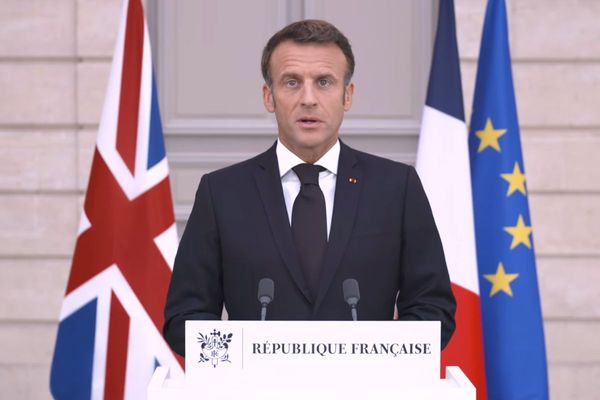
French president Emmanuel Macron has said France is ready to support US-Iran ceasefire talks, following a phone call with US president Donald Trump last night.
In a post on X, the French president said: “Last night, I spoke with President Trump about the situation in the Middle East. I commended the determined efforts he is leading to quickly reach an agreement between the United States and Iran, which represents a unique opportunity to build a new security framework involving all concerned parties, in order to enable a lasting stabilization of the region.
“I indicated that we are ready to fully support these efforts and to take our full part in their implementation. This is the purpose of the international mission that we have built with the British and our partners, ready to be deployed as soon as an agreement is concluded in order to contribute to securing maritime traffic in the Strait of Hormuz.
“We are also prepared to bring our expertise and capabilities to the broader negotiations that must open, particularly on the nuclear aspect of an agreement. Finally, I commended President Trump’s commitment to the sovereignty and territorial integrity of Lebanon, and emphasized the importance of a robust ceasefire and our collective support for the Lebanese authorities.”
Yesterday France called for an emergency UN security council meeting following Israel’s stepped up offensive in Lebanon. That will take place later today.
Israel defence minister says 'no calm in Beirut' unless Hezbollah stops attacks
Israel’s defence minister said there would be “no calm in Beirut” if Hezbollah attacks continued and vowed to establish a military-controlled zone in the area of south Lebanon’s Litani River.
“The Dahiyeh in Beirut is no different from the communities in northern Israel – if there is no calm in the north, there will be no calm in Beirut,” Israel Katz said in a statement released by his office, referring to Lebanese capital’s southern suburbs, a Hezbollah stronghold where he and Israeli PM Benjamin Netanyahu had earlier ordered strikes.
“At the same time, the IDF continues to operate with fire and manoeuvre against Hezbollah terrorists and infrastructure in Lebanon ... in order to push threats away from IDF forces and from the residents of the State of Israel, and to turn the Litani area into a zone under IDF security control, free of weapons and terrorists,” Katz added.
An AFP correspondent saw families with small children packed onto scooters with just a bag or two leaving Beirut’s southern suburbs, while others fled in cars carrying belongings including pillows and bags, after Israel ordered strikes on the Hezbollah stronghold in Beirut’s capital.
Hadi, a 24-year-old, said he had hoped for some stability in the area during the truce.
“That feeling did not last long ... Our fears intensified this morning after I received a series of messages about orders to bomb the southern suburbs, which caused widespread panic, and we immediately left the area,” he told AFP over the phone.
Beirut’s southern suburbs, Dahiyeh, have been struck twice since 8 April, when a series of Israeli attacks across Lebanon killed hundreds.
The Israeli order comes a day after its troops seized the Beaufort castle, which commands sweeping views of south Lebanon, as the military expands its ground operations.
Kuwait foreign ministry condemns Iran drone and missile attacks
Kuwait’s foreign ministry has condemned Iranian missile and drone attacks, as sirens sounded across the country earlier this morning. Kuwait is a US ally that hosts US bases and installations on its territory. Iran’s Revolutionary Guards told state media they had targeted an airbase used by the US military from which attacks on Iran had originated.
“The Ministry of Foreign Affairs reiterates the State of Kuwait’s condemnation and denunciation, in the strongest terms, of the heinous and repeated Iranian attacks, which represent a dangerous escalation and a direct assault on the security and stability of the State of Kuwait, as well as a flagrant violation of the rules of international law, the United Nations Charter, and Security Council Resolution 2817 of 2026, not to mention the grave threat they pose to the safety of civilians and vital facilities in the country,” the ministry said in a post on X.
“The continuation and repetition of these aggressions undermine efforts aimed at de-escalating tensions and threaten security and stability in the region, emphasising the State of Kuwait’s categorical rejection of these aggressive practices.”
Updated
Iran’s chief negotiator has said the US are not complying with the ceasefire following US strikes strikes on Iran over the weekend.
“The naval blockade and escalation of war crimes in Lebanon by the genocidal Zionist regime are clear evidence of US noncompliance with the ceasefire,” Mohammad Bagher Ghalibaf said in a post on X. “Every choice has a price, and the bill comes due. It will all fall into place.”
Iran responded to the US strikes by targeting Kuwait with drones and missiles.
Israeli airstrikes overnight on southern Lebanon left six people dead, including a Syrian citizen in a village near the city of Nabatiyeh, AP reports, citing Lebanon’s state-run National News Agency.
The Israeli military meanwhile said it had intercepted two projectiles launched from Lebanon toward Israeli territory, as well as a suspicious aerial target in the area where Israeli soldiers are operating in southern Lebanon. No injuries were reported, the military said.
Hezbollah said it carried out rocket and missile attacks on northern Israel on Sunday.
Israel continued to strike the city of Tyre in the south of Lebanon over the weekend.
An Israeli strike near a hospital in the city wounded 13 staffers, the Lebanese health ministry said.
Israel put widespread evacuation warning in place in Lebanon, including for Tyre. A few thousand people remain in the small old city, with some sleeping in their cars.
Photos show the aftermath of strikes on the city after Israel stepped up its offensive over the weekend.
US forces have helped dozens of commercial vessels through the strait of Hormuz in recent weeks, according to the New York Times, citing US officials.
US Central Command has guided around 70 commercial ships through the strait over the last three weeks, one of the officials said, speaking on condition of anonymity. The officials said that most of the vessels had turned off their transponders to avoid detection.
The officials declined to say what type of vessels were going through and what route they took. Ships passing near Iran without obtaining Iranian approval face the threat of attack. Shipping analysts said the US-guided crossings appear to follow routes that are closer to Oman.
Before the war, well over 100 commercial ships a day passed through the strait. Because US-guided crossings take place with transponders turned off, shipping analysts said they could not independently verify how many passages have taken place.
Iran’s foreign ministry spokesperson Esmaeil Baqaei said there were currently no exchanges with the United States over the details of Tehran’s nuclear programme.
“We know when it is necessary to act on nuclear matters. No negotiations have taken place on the details of the nuclear file. At this stage, our priority is ending the war,” foreign ministry spokesman Baqaei said in a weekly press briefing.
Iran foreign ministry says ceasefire in Lebanon remains condition for US deal
Iran’s foreign ministry said that a ceasefire in Lebanon remains a key condition for any deal with the United States.
“We insist that a ceasefire in Lebanon is an essential condition for any deal aimed at ending the war,” said foreign ministry spokesman Esmaeil Baqaei in a weekly press briefing, as Israel expands its offensive in Lebanon.
A delay in the diplomatic process to end the US-Iran war can be explained by a lack of trust, Washington’s contradictory positions and Israel’s attacks on Lebanon, Baqaei said.
“Negotiations have started amid severe suspicion and mistrust, and the exchange of messages is taking place in this atmosphere,” he said.
“The other party is constantly changing its views and putting forward new or contradictory demands ... it is natural that this situation will prolong negotiations,” he said, adding that Tehran viewed Israeli actions in the region, including in Lebanon, as inseparable from the US.
Referring to strikes by the US on Iran overnight, Baqaei said “US aggressive action” is a violation of the ceasefire and it led to Iran to target positions in Kuwait from which the US attack originated. He said Iran will “take whatever measures we deem necessary to defend Iran’s national security,” AFP reported.
Israel PM says strikes ordered on Beirut’s southern suburbs
Israel’s prime minister Benjamin Netanyahu and defence minister Israel Katz on said they had ordered strikes on the Dahiyeh suburb of Beirut. Dahiyah is Hezbollah’s stronghold in the Lebanese capital.
“In light of the repeated violations of the ceasefire in Lebanon by the terrorist organisation Hezbollah and the attacks on our cities and citizens, prime minister Benjamin Netanyahu and defence minister Israel Katz have instructed the IDF to strike terror targets in the Dahiyeh district of Beirut,” a joint statement from Netanyahu and Katz said.
Updated
As Iran struck Kuwait, it released a video showing footage of the ballistic missile launch.
The start of the video includes a close-up of what looks to be a sticker on the body of a missile depicting a bruised US president Donald Trump, on the phone asking for help, and overlaid on a “closed” Strait of Hormuz. The caption reads: “Until the last American soldier leaves the region.”
The video has been shared on channels affiliated with the Iranian regime, including on the official IRGC Telegram.
The UN security council is set to hold an emergency meeting on Monday to address the fighting in Lebanon.
The meeting was requested by France, whose president Emmanuel Macron said “nothing justifies the major escalation under way in south Lebanon”, calling for an end to fighting.
Lebanon was dragged into the Middle East war on 2 March when Hezbollah fired rockets towards Israel in retaliation for the US-Israeli killing of Iran’s supreme leader. A truce to halt the fighting between Israel and Hezbollah began on 17 April, but has never been observed. Both sides accuse each other daily of violating the ceasefire and justify their attacks by the other’s alleged breaches.
Over the weekend, Benjamin Netanyahu vowed to push deeper into Lebanon and called Sunday’s operation a “dramatic shift” in the campaign against Hezbollah.
Multiple media outlets have reported that on Sunday, US secretary of state Marco Rubio spoke with Lebanese President Joseph Aoun and Israeli prime minister Benjamin Netanyahu about the ongoing diplomatic negotiations and asserted that Hezbollah must be the first to cease its attacks.
Lebanon’s president Joseph Aoun has said that his country is facing “a vicious and reprehensible Israeli aggression”, after Israel stepped up its offensive against Hezbollah with the capture of the medieval Beaufort Castle.
Aoun condemned the Israeli offensive in a post on X and pledged to “work to end the suffering of the Lebanese people, and people in the south in particular”.
European leaders have condemned Israel’s expanding incursion into Lebanon, after Israel’s prime minister, Benjamin Netanyahu, vowed to push even deeper into the country.
Israel says it is targeting Hezbollah, which has a strong political presence in southern Lebanon and has launched thousands of missiles and drones into northern Israel. Israel’s campaign has forced more than a million people from their homes, while 3,300 people, including dozens of children, have been killed.
Oil prices rose about 2% in Asia on Monday, as the lack of progress in negotiations between the US and Iran kept traders on edge.
The fresh attacks between the US and Iran nudged Brent up 2.1% to $93.02 a barrel, while US crude added 2.6% to $89.61.
Trump is under pressure to reopen the strait of Hormuz and get petrol prices down ahead of the November midterm elections, as US voters show increasing frustration over rising prices. At the same time, he faces a potential backlash from Iran hawks in his own party over any concessions to Tehran.
The two sides remain at odds on several other issues, such as Tehran’s demands for the lifting of sanctions and the release of tens of billions of dollars of Iranian oil revenues frozen in foreign banks.
Without a sustained diplomatic agreement – and with tensions in the strait of Hormuz still high – we’re likely to see continued violations of the ceasefire, says Danny Citrinowicz, the former head of an Iran branch of Israeli military intelligence.
Citrinowicz, now a nonresident fellow at the Atlantic Council, says that neither the US, nor Iran, appear to be seeking a return to open war, but risk “a crisis neither side originally intended” if these confrontations and miscalculations continue.
In other words, the greatest danger may not be a deliberate decision to go to war, but a gradual escalation driven by recurring incidents in an increasingly volatile environment.”
The exchange of strikes between the US and Iran reflects the fragility of the current ceasefire, which has seen repeated violations even as American and Iranian officials try to negotiate a deal to extend it.
Iran has maintained its chokehold on the strait of Hormuz, disrupting global energy supplies as a fifth of all oil and natural gas traded once passed through the narrow mouth of the Persian Gulf. The US continues to enforce its own blockade on the strait, as it pressures Tehran to reach an agreement.
Both sides insist that they are continuing to negotiate, particularly over Iran’s stockpile of highly enriched uranium. Donald Trump met with advisers on Friday but has yet to decide on whether to move ahead with a deal to extend the ceasefire and reopen the strait. Iran has said the deal had not been finalised.
A trickle of ships have made it out of the strait, but pressure continues on global energy supplies, as well as chemical fertiliser which has led to fears of food shortages. The Gulf region produces 30% of globally traded chemical fertilisers.
Iran 'really wants to make a deal', says Trump, and war 'will all work out well'
Donald Trump has said “Iran really wants to make a deal”, in a new post on Truth Social, while also taking aim at critics of his efforts to secure an agreement with Tehran.
Don’t the Dumocrats, and various seemingly unpatriotic Republicans, understand that it is MUCH tougher for me to properly do my job and negotiate, when political hacks keep negatively “chirping,” at levels never seen before, over and over again, that I should move faster, or move slower, or go to war, or not go to war, or whatever. Just sit back and relax, it will all work out well in the end - It always does!
The US president’s post makes no mention of the attack on Kuwait, or the US strikes on Iran over the weekend.
Updated
European leaders have condemned Israel’s expanding incursion into Lebanon, after its military captured the medieval Beaufort castle and Israel’s prime minister, Benjamin Netanyahu, vowed to push even deeper into the country.
France’s president Emmanuel Macron called for an end to fighting, saying “nothing justifies the major escalation under way in south Lebanon”. The country’s foreign minister, Jean-Noel Barrot, has requested a meeting of the UN security council for Monday.
The foreign ministers of the UK and Germany joined France in condemning the new operation. Britain’s Yvette Cooper called for the ceasefire that has been in place between Israel and Iran-backed Hezbollah since April to be respected. The US-brokered truce to halt the fighting between both sides has rarely been observed.
Netanyahu has called Sunday’s capture of Beaufort castle a “dramatic shift” in the campaign against Hezbollah. Israeli forces used the Beaufort castle, also known as Qalaat al-Shaqif, as a base during their previous two-decade occupation of southern Lebanon that ended in 2000.
The castle offers views across Lebanon and into northern Israel. It was built as a crusader castle around the 12th century and later occupied by Saladin’s Jerusalem army, the Ottomans, the French and the Palestinian Liberation Organisation.
Netanyahu noted the historic significance of the castle, which the military first seized in 1982, calling it a “symbol of a heroic battle for our fighters.”
But some experts have questioned the strategic significance of the capture, and said its capture amounted to little more than a public relations coup.
The military’s presence there will not solve the issue with Hezbollah, Orna Mizrahi, a former deputy director in Israel’s national security council, told the Associated Press. “We are damaging them in the operations, but in parallel we need to pursue a political and diplomatic solution,” Mizrahi said.
Israel has said an “aerial target that was fired from Lebanese territory” was intercepted early on Monday.
The IDF said the interception happened after alerts sound across “several areas in northern Israel.”
Israel has in recent days expanded its incursion into southern Lebanon, as part of its ongoing war against Iran-backed Hezbollah. The continuing operations have displaced more than a million people and left thousands dead, and come despite a nominal ceasefire that has been in place between the two sides since April.
In its Monday morning statement announcing the weekend strikes on Iran, US central command (Centcom) said that the action was in response to the “shootdown of a U.S. MQ-1 drone”.
On Sunday, Iran’s Islamic Revolutionary Guard Corps (IRGC) said it had shot down an MQ-1 drone over its “territorial waters”.
The statement, reported by Iranian media, described the drone as “hostile”, and said it was shot down after it crossed over into Iran’s territorial waters.
Centcom said on Monday that the US drone was operating “over international waters.”
The latest exchange of fire between the US and Iran marks the third major violation of a ceasefire that was agreed by both sides in April.
That deal was reached after almost six weeks of violent conflict that began when the US and Israel launched strikes on Iran in February, killing the country’s supreme leader Ayatollah Ali Khamenei.
Since then, the truce has largely held, while the Trump administration has used a blockade on ships in the strait of Hormuz to pressure Iran into agreeing to a more permanent peace agreement that would reopen the vital waterway and address concerns over Tehran’s nuclear program.
However on 7 May, the US and Iran exchanged fire, testing the strength of the ceasefire. Iran accused the US of violations by targeting two ships in the strait of Hormuz and attacking civilian areas, while the US insisted it struck in retaliation, after three US destroyers were targeted.
Then last week, the US said it had targeted missile launch sites and boats attempting to lay mines.
On both previous occasions, the US insisted that the action carried out was limited, and did not indicate the ceasefire with Iran was over.
Iran’s Islamic Revolutionary Guards Corps (IRGC) has said it targeted an airbase used by the US to launch an attack on Sirik Island in southern Iran, according to a statement in Iranian media.
Sirik Island is located in the strait of Hormuz. The IRGC said the US was targeting a telecoms tower on the island.
More from the Kuwaiti army, which has announced that its air defences are intercepting missile and drone attacks.
The General Staff of the Army wishes to advise that any sounds of explosions heard are the result of air defense systems intercepting these hostile attacks.”
Kuna, the state news agency, reported that air raid sirens were ringing across the Gulf nation.
US says Iranian radar and command and control sites struck over the weekend
US central command (Centcom) has said that it struck targets in Iran over the weekend, in a statement that came just minutes after Kuwait announced it was under attack.
Labelling their actions “self-defence”, the US said it hit Iranian “radar and command and control sites for drones in Goruk, Iran and Qeshm Island”.
Centcom said the attack was in response to “aggressive Iranian actions”, including the “shootdown of a U.S. MQ-1 drone that was operating over international waters.”
The US strikes mark the third time that the ceasefire between Iran and America has been violated since it was agreed in early April. On both previous occasions, Tehran and Washington played down the significance of the exchange of strikes and the truce was able to continue.
The latest action comes amid a flurry of diplomatic wrangling between the Trump administration and Iran’s leadership to secure a lasting ceasefire and return shipping to the strait of Hormuz.
Updated
Summary
Hello and welcome to the Guardian’s continuing coverage of the crisis in the Middle East.
The Kuwaiti military has said that the country’s air defences are currently intercepting hostile missile and drone attacks, after the US said it conducted strikes on radar and control sites in Iran over the weekend. Kuwaiti state media reported that sirens were sounding across the country on Monday morning.
Minutes after Kuwait reported coming under attack, US central command (Centcom) said it had conducted “strikes on Iranian radar and command and control sites for drones” over the weekend.
The measured and deliberate strikes occurred on Saturday and Sunday in response to aggressive Iranian actions that included the shootdown of a U.S. MQ-1 drone that was operating over international waters. U.S. fighter aircraft swiftly responded by eliminating Iranian air defenses, a ground control station, and two one-way attack drones that posed clear threats to ships transiting regional waters.”
Kuwait was one of a number of Gulf countries to face weeks of reprisal attacks from Iran, after the US and Israel launched their war in February. A ceasefire reached between the US and Iran in April has since largely held.