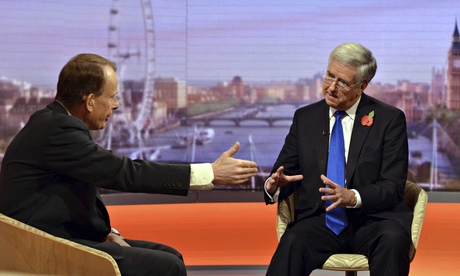
Michael Fallon has been forced by Downing Street to take to the airwaves to withdraw his claims that British towns are being “swamped” by immigrants and their residents are “under siege”.
The defence secretary said on television and radio that he had been “careless” and had used words he “would not usually use” when defending David Cameron’s plans for a renegotiation with the EU over the freedom of movement of workers.
However, he stood by the thrust of his argument – that mass immigration from Europe is putting pressure on local services in many British towns.
The decision to send Fallon back on the airwaves will be seen as further evidence of the chaos in Downing Street as Cameron and his advisers attempt to redefine the Tories’ policy over the EU and immigration while under huge political pressure from the UK Independence party. The anti-federalist party is expected to win the Rochester and Strood byelection next month and is threatening to help unseat dozens of Tory backbenchers in next year’s general election.
It also acknowledges the toxicity of the word “swamped” which Fallon told Sky News on Monday he should not have used.
On Sunday morning, using language reminiscent of Margaret Thatcher in the 1970s, Fallon said that in some areas of the UK large numbers of migrant workers and foreign people claiming benefits should be subject to some form of restraint or risk dominating the local population.
The disarray in the Conservative party was highlighted again on Sunday when the environment secretary, Liz Truss, said that Britain needed EU migrants to fill unskilled jobs in the agricultural sector.
Fallon made his comments after being forced to deny that Cameron’s efforts to renegotiate the UK’s relationship with Europe were foundering. The German chancellor, Angela Merkel, has spelled out her opposition to stopping the free movement of workers, telling the Sunday Times she was opposed to fundamental change.
Fallon told Sky News: “The Germans haven’t seen our proposals yet and we haven’t seen our proposals yet, and that’s still being worked on at the moment, to see what we can do to prevent whole towns and communities being swamped by huge numbers of migrants. In some areas of the UK, down the east coast, towns do feel under siege, [with] large numbers of migrant workers and people claiming benefits, and it’s quite right we look at that.”
Ed Davey, the Liberal Democrat energy secretary, criticised Fallon’s remarks, saying they were “more based on the Conservative concerns of the Ukip threat in the Rochester byelection” than the facts.
Ukip also accused Fallon of resorting to “intemperate language” and compared his words to the Conservative-inspired policy to drive vans through minority-ethnic communities urging immigrants living in the UK illegally to return home.
“Can you imagine what would have been said if we had said that?” said Steven Woolfe, Ukip’s immigration spokesman.
The shadow foreign secretary, Douglas Alexander, said Fallon’s comments reflected “the desperation of the Conservative party”. “You have got to be responsible always in the language that you use around issues of immigration,” he told Sky News. “Of course there are challenges, I recognise that, but I think that embodies part of the problem at the moment.”
His words followed David Cameron’s pledge to make changes to the principle of freedom of movement of workers within the union – a “red line” in a mooted renegotiation of the UK’s membership terms.
The prime minister is said by aides to be preparing a manifesto pledge to introduce quotas for low-skilled migrants from the EU. Before the last general election Cameron promised to bring net annual immigration down to tens of thousands but has failed to get anywhere near the target.
Some senior Conservatives want to impose a quota on “time-limited national insurance numbers” to limit the numbers of people able to move to Britain for work. Others want an “emergency break” to limit numbers coming from countries that suffer an economic collapse.
In an interview with the Sunday Times, Merkel appeared to dismiss the prospect of radical change. “Germany will not tamper with the fundamental principles of free movement in the EU,” she said.
Before Fallon withdrew his words, Truss was asked on the BBC’s Sunday Politics if Britain needed EU migrants to fill unskilled jobs in the agricultural sector. “I accept we do, yes,” she said. “I’m an MP in Norfolk, and there is an element of migrant workforce, that’s very true.”
The row comes after a difficult few days for Cameron, during which he was ambushed at a Brussels summit with a demand to pay an extra £1.7bn in EU funds. Cameron responded furiously to the bill. Under pressure to react from Tory Eurosceptic backbenchers, he insisted it would not be paid by the deadline of 1 December and said the dispute risked pushing the UK closer to the exit door.
The shadow Europe minister, Pat McFadden, claimed Cameron had shifted from his Bloomberg address in January 2013, in which he pledged to reform the EU and then argue to stay in.
“It now looks as though the prime minister, partly out of fear of Ukip, partly out of fear of his own backbenchers, is by default setting himself on a path where he may end up arguing that it’s better for the UK to come out,” he said.
The Tories have faced criticism before for the use of the word “swamped”. In 1978, Margaret Thatcher said people feared being swamped by immigrants from the new Commonwealth and Pakistan. She was elected the following year.
In 2002, the then Labour home secretary, David Blunkett, provoked a storm when he said some schools were being swamped by the children of asylum seekers.
Ukip will seek to capitalise on a surge in support by targeting 100 seats at the general election, it has emerged. Paul Sykes, the party’s biggest donor, has indicated he will hand over another £1.5m to help widen its ambitions.
A poll found nearly a third of the public would vote for Ukip if they thought the party could win in their area. Overall, the research by Opinium for the Observer put the party on 18% support.