A police chief has issued a lengthy statement defending officers after a video showing them embroiled in a heated exchange over a stop-and-search procedure was seen by millions on Facebook. Metropolitan Police commander Simon Letchford took the unusual step of issuing a long defence of police action, saying officers acted in a “fair and proportionate manner” when they searched a man in Norwood, south-east London.
Video footage shared on Facebook shows the man, who is black, argue with officers while a crowd of onlookers shout “racist” and “no reason”. The man is handcuffed and led away by police. He was later released without charge. The video has now been viewed more than 1.1 million time.
Police said two local officers attended the scene after a member of the public called police to report their belief that drugs were being sold to young people on the high street. But Adrian Medford, who uploaded the video to Facebook, said his friend had given his daughter 50p to go to the shop when he was searched.
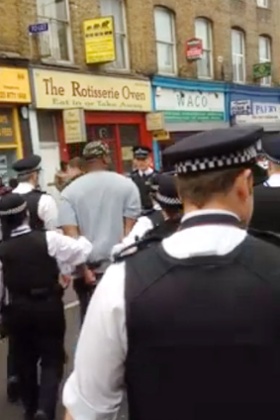
Medford told BBC Trending he filmed the incident and uploaded it because he thought the police “were totally out of order”.
Her Majesty’s Inspectorate of Constabulary warned in March that police forces have made too little progress on improving their use of stop-and-search powers, with too many officers lacking any understanding of their impact on the lives of young black people.
In a blog post issued by Scotland Yard, Letchford said two local officers attended and as they conduct a stop-and-search a crowd quickly built up and there was “a fair amount of abuse directed at the officers”. Other units were called because of the situation. The commander said: “The man was handcuffed and moved away so the search could be conducted away from the crowd, but he was not arrested and he was not taken to a police station. No drugs were found, the man was released and the crowd dispersed.”
He said that because the incident was filmed and uploaded to social media, more than one million people have seen it “without the background knowledge that it all started with a credible call from a concerned member of the public that they thought drugs were being sold to young people in their community”.
Having watched the film, he said he has “no reason to be concerned about how the officers acted”, adding: “The situation became difficult, but they did what they needed to do in a fair and proportionate manner, considering the information they had.”
He rejected suggestions that the exchange echoed the situation in the US city of Baltimore, where relations between police and the community have threatened to unravel in recent weeks. “Of course tensions between the police and public are a concern and there is more to be done, but I am also proud of the progress we have made,” Letchford said. “Hopefully blogposts like this go some way to explaining why we need to police the city the way we do.”
He added: “There is no easy answer when it comes to difficult policing decisions. However, I welcome scrutiny, and when we get it wrong – and I don’t think we did here – then we will be judged on how we respond. I just hope that what is viewed by the public on social media is done so with context, and as many facts as possible.”