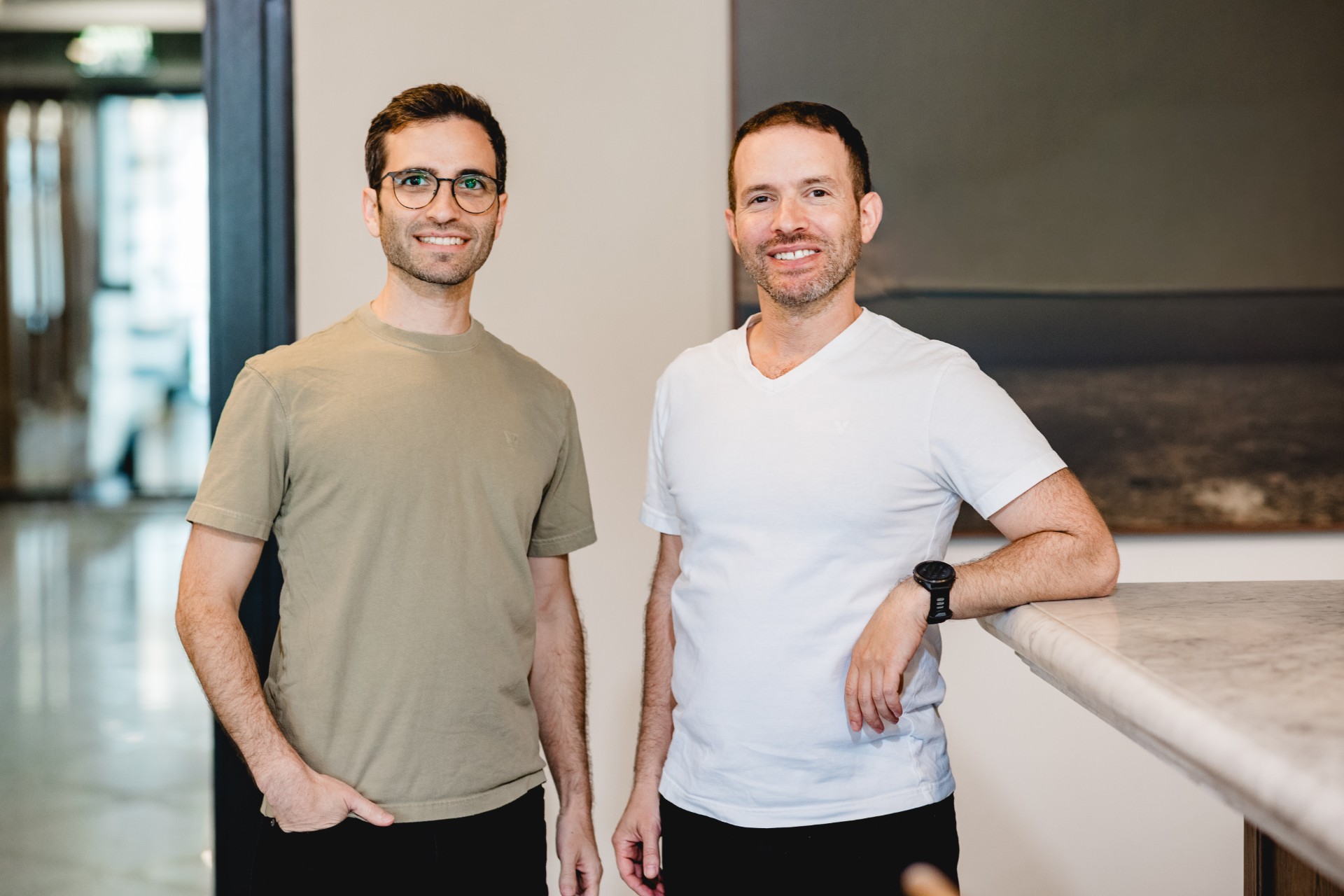
Lazer Cohen, 41, had spent 15 years building other people’s companies. His younger brother Gavriel, 36, had spent a decade writing code. Together, they’d quietly bet on each other — their parents included, having invested in the brothers’ earlier AI marketing agency venture before NanoClaw existed.
When Gavriel sat down on Jan. 29 and wrote the first line of code for NanoClaw, he wasn’t thinking about fundraising. He was trying to solve a problem: the agentic tools available to him were powerful but dangerously insecure. So Gavriel, a former Wix developer with a physics and computer science background plus years of obsessive after-hours AI tinkering, built his own.
Six weeks later, NanoCo had a term sheet.
“We’ve just started rolling out professional assistants to businesses,” Gavriel told Fortune. “We’ve had over 100 companies reach out to us. There’s just more and more reaching out every single day.”
NanoCo’s $12 million seed round — led by Valley Capital Partners, with participation from Docker, Vercel, Monday.com, Slow Ventures, Clutch Capital and Factorial Cap, plus angel investments from Clem Delangue of HuggingFace, Matias Woloski of Auth0, and Vanja Josifovski, the former CTO of Airbnb — makes NanoCo the first company in the rapidly growing “claw” space to close institutional funding. The round was oversubscribed.
When Lazer told his longtime PR clients he was pivoting to build his own startup, the reaction surprised even him. “Any apprehension about what my move would mean for them was outweighed by their excitement,” he said. Two immediately asked to invest. Four more former clients followed. They’re all in the round.
An ‘overnight’ success, 15 years in the making
The Cohen brothers grew up together and, eventually, built businesses together — though not always in the same direction. Lazer, the elder, built Concrete Media into a PR firm that helped launch over 100 startups. Gavriel spent a decade in engineering, leading a developer team at Wix before the AI wave pulled him toward something bigger.
Lazer said that when Gavriel formally joined Concrete Media five years ago, their written partnership agreement explicitly anticipated future startups emerging from the collaboration. “It’s one of those overnight successes that are 10 to 15 years in the making,” he said.
The pivot to NanoClaw came organically. “We set up an agent and it was managing our sales pipeline — doing the work of an employee,” Gavriel said. But the open-source tools available at the time were, in his telling, dangerously unguarded. He described OpenClaw, the viral agent framework NanoClaw was built to replace, as “this crazy kind of Frankenstein thing — a wild experiment of how much value can you really get from AI agents?” The answer was quite a lot, but OpenClaw had put aside concerns about security, safety and software quality. Enter NanoClaw with, as the brothers described to Fortune, several guardrails.
“There had been a lot of people sitting on the sidelines,” Gavriel said — developers and executives who understood OpenClaw was a leap forward but not safe enough for their purposes. “Then they were able to jump in and use NanoClaw and get that value.”
The secret ingredient
NanoClaw’s core technical bet is deceptively simple: put the entire agent in a “sandbox.”
Most competing approaches — including those taken by Anthropic and other major labs — only put the agent’s tools in a sandbox while leaving the agent itself in an open environment. Gavriel went the other direction, isolating the full agent so that everything it does enters and exits through a single controlled message pathway.
The sandbox is like a little “universe,” Gavriel explained. “It can do whatever it wants there. It can build.” But when it starts to interact with the outside world and interact with sensitive things, he added, “that’s where you start to put those blocks and those controls.”
In practice, that means credentials never reach the agent directly — they’re injected at runtime by a separate gateway. Sensitive actions, like sending an email or deleting a file, trigger human approval requests delivered as cards in Slack or WhatsApp: approve or reject, no AI involved in that layer, just old-fashioned software logic. Organizations set the outer policies; individual employees can tighten but never loosen them.
Gavriel said he agreed with criticism from former Goldman Sachs CEO Lloyd Blankfein, who recently described his fear of agents running “70,000 transactions” with no senior oversight — contrasting it with his early days on a trading desk, where every transaction had a senior banker looking over his shoulder.
Gavriel said he preferred the analogy of Tumblr for blogging, which essentially made WordPress very intuitive for people who didn’t know what a weblog was. “It’s a big debate within AI agent space: Do you put the agent in the sandbox or do you put the tools that the agent is trying to run the code in the sandbox and leave the agent outside?”
He acknowledged there are many arguments for the side of putting the tools in the sandbox. He prefers the agent-in-the-box approach, he said, “because when I’m a security leader at a business, I’m a tech or R&D leader at a business, it’s much easier to reason and think about and understand how this thing is being protected and blocked off and guarded … it can’t take actions without you approving.”
The endorsement nobody expected
No single moment validated NanoClaw’s approach quite like a Facebook post from Dr. Vivian Balakrishnan, Singapore’s foreign minister — one of the more technically sophisticated figures in global diplomacy, who maintains his own GitHub profile and has spoken publicly about AI at Singapore’s AIE conference. He called NanoClaw his “second brain,” and said it “answers every question, researches topics, provides daily updates, drafts speeches and condenses information. It has become invaluable — I don’t dare switch it off!”
The team was invited to Singapore shortly afterward for a meeting with his AI innovation team, and Gavriel said he was surprised. “He’s quite technical” and isn’t prone to hype, Gavriel said, certainly not on Facebook.

The endorsement joined a string of improbably early signs of traction: 30,000 GitHub stars since February, 250,000 open source downloads, formal partnerships with Docker and Vercel, and a roster of executives quietly using the tool personally and asking how to deploy it to their teams.
The Docker partnership followed a similar pattern. Oleg Šelajev, a developer relations engineer at Docker, started using NanoClaw personally, then introduced it to his VP. A strategic investment and formal partnership followed. “It’s people in these companies,” Gavriel said. “Builders who look at it and say these ideas should be shared.”
What NanoCo is actually selling
The commercial product, NanoCo, takes what executives have been running on their own laptops and makes it deployable across an entire organization. The professional assistant — accessible through Slack, Teams, or other existing tools — does actual work: drafting contracts for legal teams, managing accounts for sales, reviewing code for developers. It learns each employee’s role and style through ordinary conversation and builds what Gavriel calls a “Wikipedia of you” — a persistent knowledge base that accumulates over weeks and months.
Matt McConley, a senior product manager at Johnson Health Tech who has run NanoClaw across a team of six, puts the productivity claim in concrete terms. “My NanoClaw instance isn’t working from memory — it’s reading actual data,” he told Fortune in a statement. “Before it touches a file, it reads it. Before it references something I told it, it pulls from notes it wrote down at the time.”
He said that his version of NanoClaw “knows to never make things up — if unsure, be honest about it and let’s talk it out, like a human would.” For McConley, the practical result is wearing many hats without the usual cost: “Context switching no longer slows me down. I can wear many hats at once without sacrificing quality or my sanity.”
The productivity gains executives are reporting: two to three times, in their own telling.
“Our goal is to raise that floor,” Gavriel said. “So that no risk, complete control — that gets to 4x, gets to 5x.” Better user experience, better approval flows, and continued product development are the path there. The company has also begun addressing a thornier challenge: enabling multiple employees to query the same agent without inadvertently leaking sensitive or private information across the organization. “There’s a lot of work to do,” he added, “just getting started.”
NanoClaw’s architecture has drawn independent scrutiny beyond enterprise sales pitches. AI security firm Noma Security published a technical deep dive assessing the isolation model, permission controls and codebase auditability, ultimately providing specific enterprise deployment recommendations. The Cohens say several other security researchers have conducted similar reviews.
NanoCo, based out of Tel Aviv, has a staff of 10 employees. NanoCo charges per agent, per month. Deployments range from hours — for organizations without strict security requirements — to several weeks for complex enterprise integrations involving internal data sources and custom skill-building.