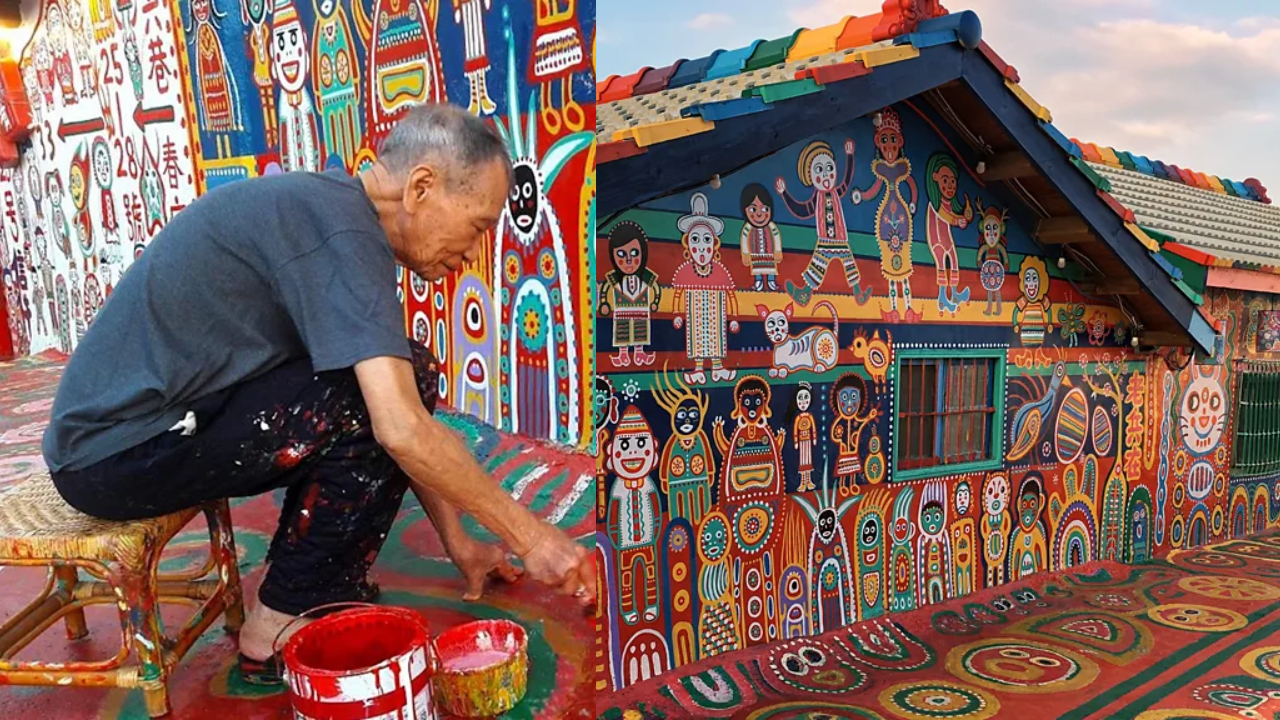
At an age when most people have long retired, Huang Yung-fu picked up a paintbrush and changed the fate of an entire community. Living alone in an aging military settlement in Taichung, Taiwan, the former soldier began covering the drab concrete walls around his home with bright birds, animals and cheerful human figures. What started as a way to pass the time soon transformed the abandoned neighbourhood into the world-famous Rainbow Village, attracting more than a million visitors each year and halting plans to demolish it. His colourful murals eventually spread across walls, pathways and doorways, creating an immersive open-air art destination celebrated by visitors from around the world. Affectionately known as "Rainbow Grandpa," Huang's extraordinary story remains one of the most inspiring examples of how creativity can preserve history, revive communities and turn an overlooked place into a global cultural landmark. According to BBC, he was 96 years old when his remarkable story captured worldwide attention.
Get breaking news anytime, anywhere. Download the TOI app now!
How an abandoned military village became one of Taiwan's most colourful landmarks
Rainbow Village is located in Nantun District, Taichung, and was originally built in the late 1940s as temporary housing for soldiers from the Kuomintang (Nationalist Army) who retreated to Taiwan after the Chinese Civil War.
At its peak, the settlement contained around 1,200 homes and housed thousands of military families. Over the decades, however, younger generations moved away, buildings deteriorated, and developers began purchasing the land for redevelopment. By the late 2000s, almost every resident had left, leaving only a handful of houses standing.
Huang Yung-fu, who had lived there for decades, refused to leave the only home he had known in Taiwan. As the BBC reported, with little to do and surrounded by empty buildings, he picked up a paintbrush and painted a small bird on the wall inside his house. That single drawing soon grew into thousands of colourful murals covering walls, pavements, doors and windows throughout the village.
Why Huang Yung-fu began painting at the age of 86
Huang had never considered himself an artist. According to BBC, he simply wanted to brighten the lonely surroundings after nearly everyone else had gone.
Each morning before sunrise, he would quietly carry tins of paint into the streets and spend hours decorating every available surface with smiling people, birds, tigers, cats, dragons and abstract patterns. His distinctive style combined vivid colours with childlike imagination, transforming grey concrete into a joyful outdoor gallery.
Speaking to the BBC, Huang explained that painting made him happy and gave purpose to his days. What began as a personal hobby gradually became an act of preservation, even though he never intended it to become famous.
How university students helped save Rainbow Village from demolition
The turning point came when students and professors from nearby universities discovered Huang's paintings while passing through the neighbourhood.
Recognising both their artistic value and the cultural significance of the ageing military settlement, they launched a public campaign urging the Taichung city government to preserve the village instead of demolishing it.
The campaign attracted widespread public support, and the authorities eventually abandoned redevelopment plans. Rainbow Village was preserved as a cultural attraction, allowing Huang to remain in his home while visitors from around the world came to admire his work.
According to Taiwan's Ministry of Culture , Huang's paintings transformed what had become a ghost town into an internationally recognised tourist destination, breathing new life into a community that was once destined to disappear.
How Rainbow Village became one of Taiwan's most visited attractions
Rainbow Village has become one of the most famous sites in Taichung, which is visited by over a million tourists every year.
People tour around narrow alleyways with colourful walls filled with paintings of different kinds, including paintings of various funny characters covering almost all the walls of Rainbow Village. Tourists also come here just to see the artist, who for many years greeted tourists and continued painting despite his increasing age.
Such an incredible transformation has brought him the name “Rainbow Grandpa,” and his paintings have received international recognition.
Although parts of Rainbow Village have faced preservation challenges in recent years, Huang's murals remain one of Taiwan's most recognisable cultural landmarks.
A paintbrush that preserved far more than buildings
Sadly, Huang Yung-fu died in January 2024 at the ripe old age of 100 years, leaving behind him a legacy which is much wider than the brightly coloured walls of Rainbow Village.
Through the life of Mr Huang, we learn that art not only serves to beautify but it also serves to preserve, connect people and influence the future of a whole community. What started out as painting a single bird on an old wall ended up preserving what was left of one ofTaiwan's military villages from being torn down.
Today, Rainbow Village stands not simply as an outdoor art gallery but as a testament to the determination of one man who refused to watch his home disappear. Armed with nothing more than paint, imagination and persistence, Huang Yung-fu proved that creativity can sometimes achieve what protests and politics cannot.