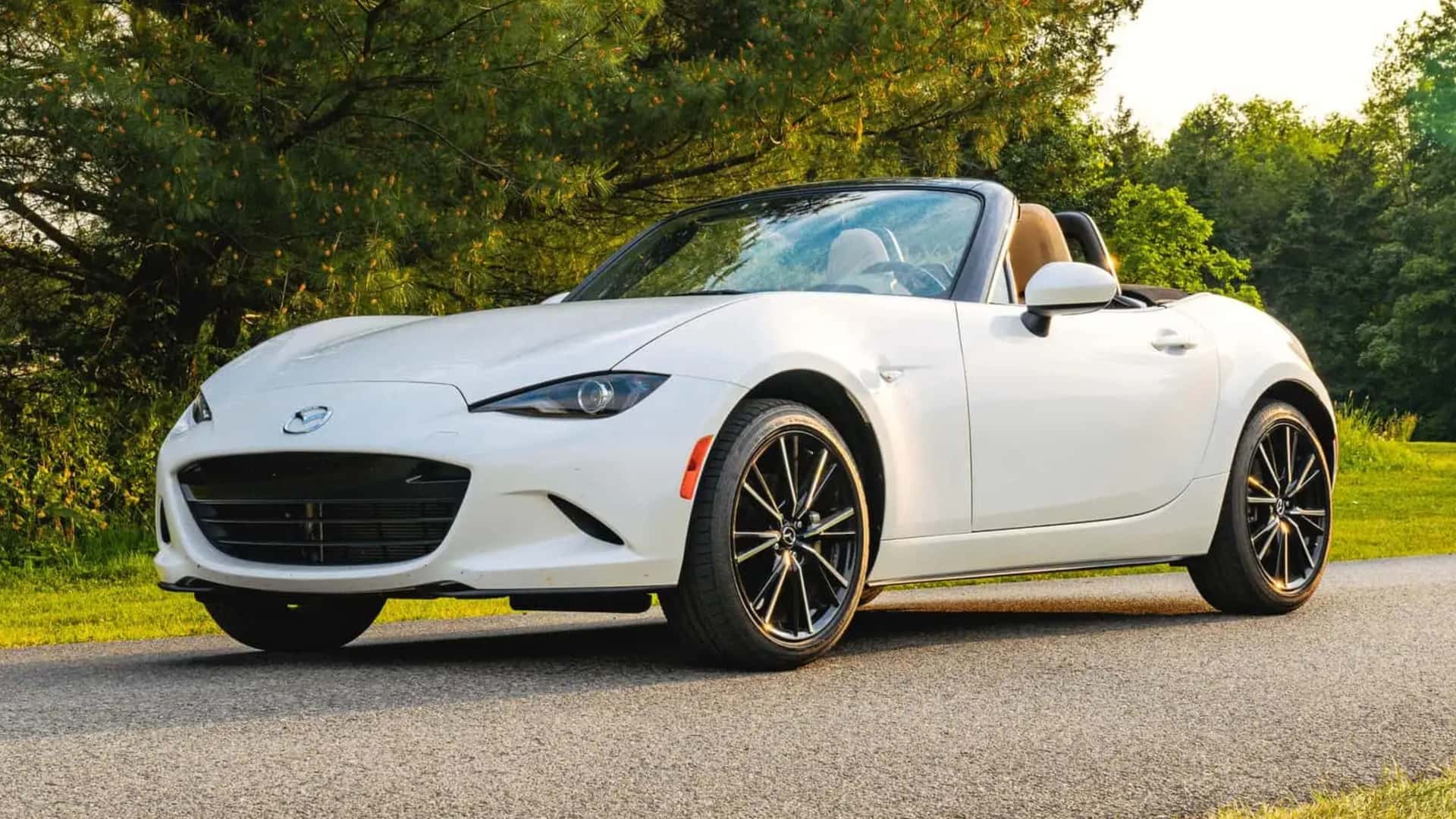
There are dozens of questions surrounding the future of the beloved Mazda MX-5 Miata. Will it have a gas engine? Will it keep its manual transmission? Maybe most importantly: Will it eventually go electric?
Today, we have an answer. Sort of. Mazda CEO Masahiro Moro said that the Miata could go electric—eventually.
Speaking with Germany's Auto Motor und Sport, Moro said the next-generation Miata "must also be ready for a scenario without a combustion engine." While he stopped short of confirming a battery-powered MX-5, the comment at least suggests that Mazda is designing the next roadster with electrification in mind.
That said, don’t expect the next Miata to ditch its internal combustion engine right away.
Mazda has repeatedly said that light weight remains the heart of the MX-5 formula. Earlier this year, company executives reiterated that today's battery technology still isn't ideal for a lightweight sports car, making gasoline the best option—for now.
Moro reinforced that philosophy by saying engineers are targeting a curb weight between roughly 2,200 and 2,645 pounds (1,000 to 1,200 kilograms) for the next Miata, all without relying on expensive materials like carbon fiber. That's remarkably close to today's ND-generation Miata.
Mazda Has Already Been Thinking About An Electric Miata
This isn't the first clue that an electric MX-5 is in development. Last year, Mazda patented an unusual EV layout that places most of the battery cells inside the transmission tunnel instead of beneath the floor like a conventional skateboard platform.
Additional battery modules sit behind the seats and ahead of the passenger compartment to preserve the balanced weight distribution that's central to the Miata's character. The design also retains rear-wheel drive with a single electric motor layout.
Of course, turning the Miata into an EV is easier on paper. We’ll simply have to wait and see what’s in store for our beloved sports car.
Motor1’s Take: It seems inevitable that the Mazda Miata would go electric, but the hope is that it happens later rather than sooner. CEO Masahiro Moro recognizes that reality and likely plans to stave off electrification for as long as possible.