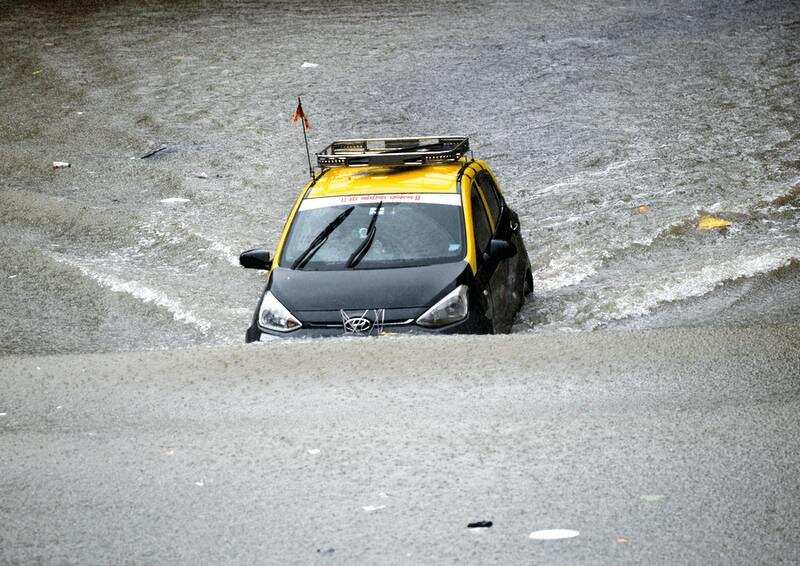
MUMBAI: Heavy rains battered the city overnight with a massive 200 mm recorded in a six-hour window between 11.30pm on Saturday and 5.30am on Sunday. The India Meteorological Department (IMD) issued a red alert for Mumbai at 7.45 pm on Sunday. The forecast will be valid till 8.30 am on Monday. It has sounded an orange alert from July 19-22, indicating heavy to very heavy rains at isolated places.
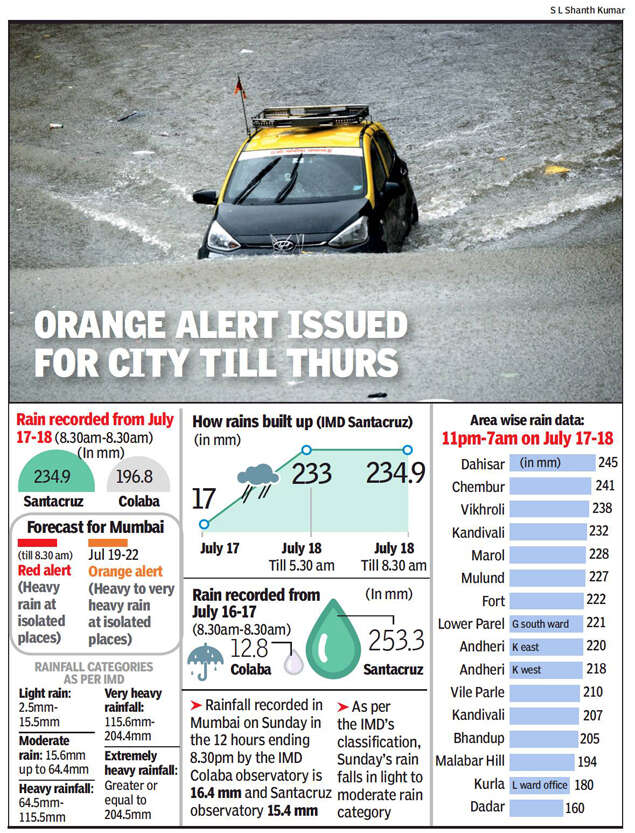
The two areas that were among those that received the highest rainfall—Chembur (241 mm) and Vikhroli (238 mm)—also bore the maximum brunt of the incessant downpour. Of the 33 lives lost in the city on Sunday, 29 were residents of these suburbs.
Till 11.30pm on Saturday, the India Meteorological Department (IMD)’s Santacruz observatory had recorded only 16 mm of rains, but by 5.30 am on Sunday, the city had logged 233 mm rainfall.
State environment minister Aaditya Thackeray termed it a ‘mini cloud burst’, with the automatic weather stations (AWS) in areas like Bhandup, Kandivali and Vile Parle recording over 100 mm between 1 am-2 am, but the IMD did not term it one.
Unlike the previous intense rain event of Friday where only the Santacruz observatory recorded 253 mm rains, while Colaba observatory recorded a meager 12.8 mm, on Sunday, both the Colaba (197mm) and Santacruz observatories (235mm) recorded triple digit figures.
The rains recorded by the Santacruz observatory were the second highest for the season with the highest (253mm) recorded so far on July 16. However, due to lack of extreme weather event warning from the weather bureau, no disaster management protocols were activated by the civic body.
“While IMD models could not capture the development of the in situ convective clouds, we did issue nowcast warnings and also an impact-based forecast was issued at 1am on Sunday,” Dr Jayanta Sarkar, scientist and head India Meteorological Department, Mumbai said. The IMD’s impact-based forecast said those staying at vulnerable places should be moved, but BMC officials said that by the time the warning was issued, it was too late.
Sunday’s intense spell made up for the entire month’s average rain of 827 mm with the total July rainfall now at 849.6mm. In June too, a triple digit rain figure (231.3mm) in a 24-hour span was recorded between June 9-10.
With the city experiencing the second thunderstorm in two days, experts said that the frequency of thunderstorms in July appear to have increased. Thunderstorms are generally a June phenomenon, prior to the onset of monsoons as these require land heating as a trigger to form.
“There was development of a thunderstorm near Raigad which moved south east to north west of Mumbai giving widespread rains to the city. In case of Friday’s (July 16) event, the thunderstorm had developed near Thane district and, hence, only the suburbs saw massive rains,” said Akshay Deoras, an independent meteorologist.