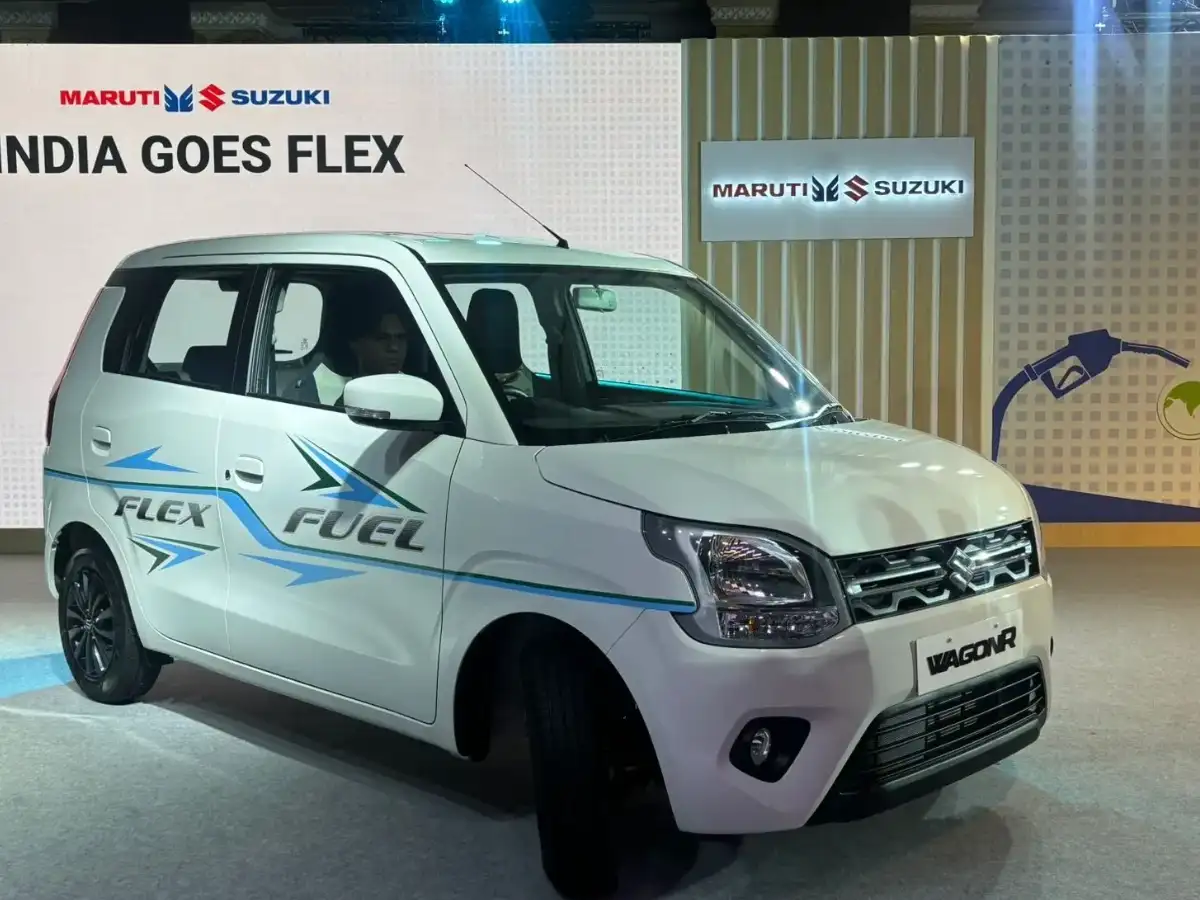
Maruti Suzuki on Thursday launched what it described as India's first flex-fuel passenger car, positioning the technology as a key pillar in the country's efforts to reduce crude oil imports, lower carbon emissions and strengthen energy security.
Speaking at the launch event, Managing Director and CEO Hisashi Takeuchi said the introduction of the flex-fuel Wagon R marked more than the debut of a new vehicle and represented "a new chapter in India's energy journey."
Also Read: India ranks among lowest globally in fuel price hikes: Hardeep Singh Puri
The company unveiled the vehicle in the presence of Union Road Transport and Highways Minister Nitin Gadkari and Petroleum and Natural Gas Minister Hardeep Singh Puri, both of whom have championed the use of alternative fuels and domestic energy sources.
Highlighting India's dependence on imported crude oil, Takeuchi said the country needed energy solutions that were "cleaner, affordable, scalable, and based on India's own strengths."
"India has two national objectives: First, reduce dependence on imported crude oil. Second, reduce carbon emissions. Flex-fuel meets both. It is truly Atmanirbhar and clean," he said.

Takeuchi credited Gadkari for consistently pushing the automobile industry towards biofuels and alternative energy solutions.
"When nobody believed in biofuels, you guided the industry that the produce of Indian farmers can replace foreign oil," he said, addressing the minister.
The Maruti Suzuki chief said flex-fuel technology could generate benefits well beyond the automobile sector by supporting farmers, ethanol producers and rural communities while linking agriculture with clean mobility.
"It connects mobility with agriculture, technology with farmers, and clean energy with Atmanirbhar Bharat," he said.
At the same time, he acknowledged that widespread adoption of flex-fuel vehicles would require coordinated efforts across the ecosystem, including fuel availability, vehicle launches, customer awareness and competitive pricing.
"An entire ecosystem needs to be developed – from fuel availability to more model launches, from customer awareness to fuel and vehicle pricing," Takeuchi said.
"In the absence of an ecosystem, it is the responsibility of the market leader to take the first step and encourage others."
"Today, Maruti Suzuki is taking the first big step with the launch of India's first flex-fuel car."
The company said the launch forms part of its broader multi-pathway strategy aimed at reducing emissions through a mix of technologies, including electric vehicles, strong hybrids, compressed natural gas (CNG), compressed biogas (CBG) and hydrogen.
Takeuchi described compressed biogas as a particularly promising route towards achieving net-zero emissions, noting that Maruti Suzuki has already announced nine CBG plants, of which two are operational.
"And today, with Wagon R Flex-fuel, we add another flower in our bouquet," he said.
"For Maruti Suzuki, this is a commitment to cleaner mobility, lower oil import dependence, and Atmanirbhar Bharat."
The launch comes as India continues to expand ethanol blending in petrol and promote alternative fuels as part of its strategy to improve energy security and reduce dependence on imported fossil fuels.
What is the buzz around flex fuel?
For average car buyers, a Flexible Fuel Vehicle represents a highly practical alternative to standard petrol models rather than a radical departure from daily driving habits.
These specialised engines are engineered to dynamically adapt to varying ratios of petrol and alcohol.
While the current crop of cars navigating Indian roads maxes out at an E20 blend, Maruti’s groundbreaking new WagonR is calibrated to run seamlessly on everything from standard petrol up to E100, which represents pure, undiluted ethanol.
Achieving this required an extensive mechanical redesign from Maruti’s engineering teams.
Because ethanol possesses highly corrosive properties and an inherent tendency to absorb ambient moisture, standard automotive fuel systems would rapidly degrade under its influence.
Further efforts being made towards energy transformation
India will pilot hydrogen-powered buses and trucks on 10 roads across the country, Union Minister for Road Transport and Highways Nitin Gadkari said on Thursday, adding that major conglomerates including Reliance Industries, Tata Group, NTPC and Ashok Leyland have joined the initiative.
"We have undertaken a pilot project that on 10 roads of India hydrogen buses and trucks will start. Reliance, Tata, NTPC, Ashok Leyland and many others have joined hands with us for this. We have started making hydrogen," Gadkari said.
Gadkari said India now has the potential to shift from an energy-importing nation to an energy-exporting one, citing the country's progress on ethanol, hydrogen and sustainable aviation fuel.
"We now have the potential to go from an energy importing nation to an energy exporting nation," he said.
On sustainable aviation fuel, Gadkari said India is currently producing 78,000 tonnes per year and could become a net SAF exporter within two years. He added that the government intends to eventually run fighter jets and helicopters on SAF as well.
"After ethanol, we will start working on sustainable aviation fuel. We want our fighter jets and helicopters to work on SAF. We can become a nation exporting SAF within two years," he said, describing hydrogen as "a fuel for the future."
Hardeep Singh Puri, meanwhile, said petrol and diesel price increases in India have remained "very, very minor" compared with most countries despite global geopolitical disruptions. He said India ranks among the countries with the lowest increase in fuel prices globally.
"In my calculation, India comes after Japan as the country which has the lowest increase in fuel prices amongst all the 193 countries in the world," Puri said.
The petroleum minister said flex-fuel vehicles are poised for rapid expansion after E85, a blend containing up to 85% ethanol, was identified as the mono-fuel standard under Bureau of Indian Standards specifications. The government plans to begin with around 50-100 ethanol dispensing stations across the Delhi-NCR and Mumbai-Pune-Nagpur corridors, expanding to 500 by December this year.