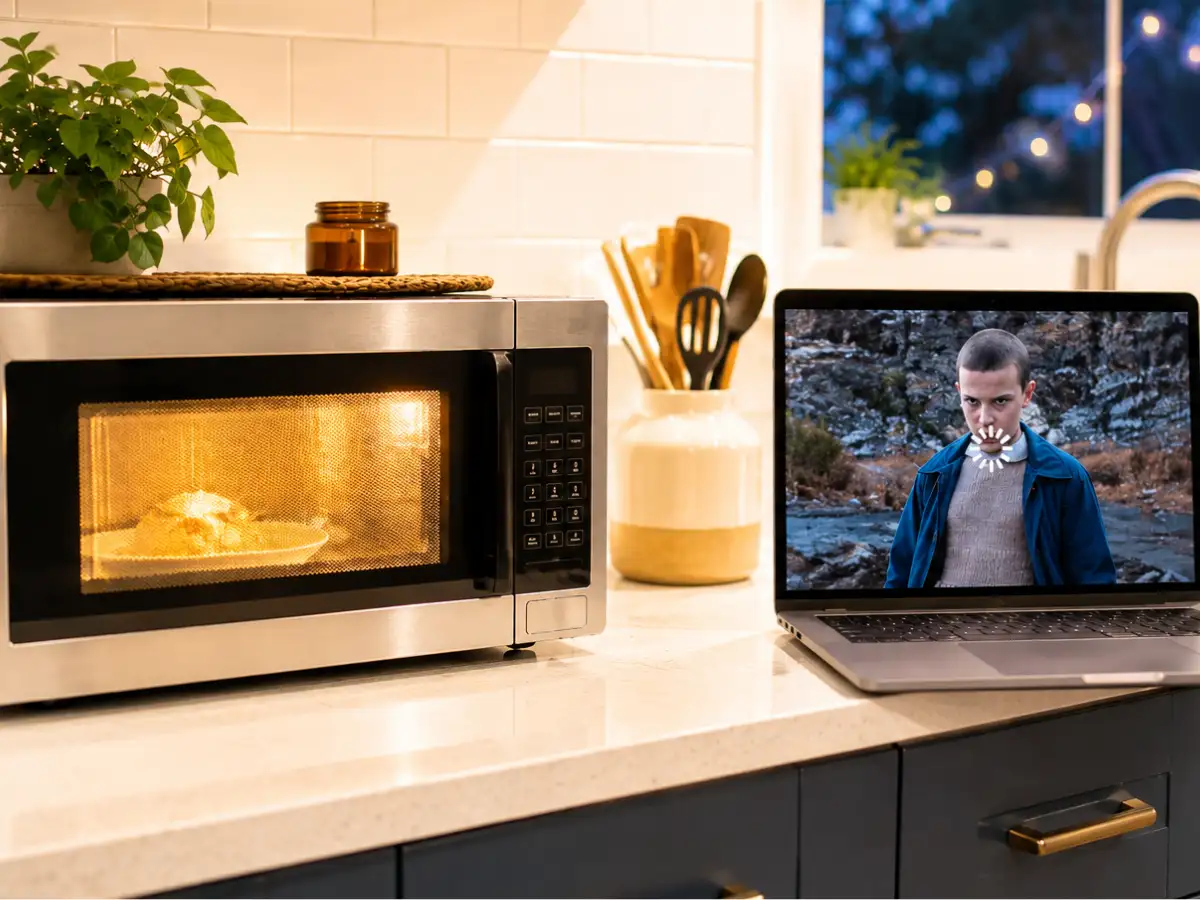
It's a scene that probably plays out in kitchens across America almost every night. Someone’s reheating leftovers, someone’s three episodes into a show, and the video freezes mid-sentence. The first reaction is to blame the internet provider. But a 2008 study from researchers at the Illinois Institute of Technology’s Wireless Networking and Communications Research Center says the real troublemaker could be sitting right there on the kitchen counter.
Your microwave and your router are, in a way, speaking the same language. Both are designed for the 2.4 GHz band, a slice of radio spectrum the government set aside decades ago for industrial and home appliances. According to the same Illinois Tech study, the microwave was never meant to share airspace with a router; it just so happens to be on the same frequency, and now millions of households are living with the consequences.
Why a food warmer can outdo a router
A microwave oven doesn't send emails or stream anything. It doesn't care about the internet at all. However, the magnetron tube that heats your food works in the vicinity of 2.45 GHz, and ovens are not perfectly sealed. Every time the device cycles, a little bit of that energy leaks out, lab measurements by the Illinois Tech researchers show. The leaking signal isn’t just stuck in one spot; it hops across a range of frequencies and adds brief spurts of broadband noise, repeating about sixty times a second, in sync with household power. In plain terms, a running microwave doesn't just nudge your Wi-Fi; for a few milliseconds at a stretch, it can drown it out completely.