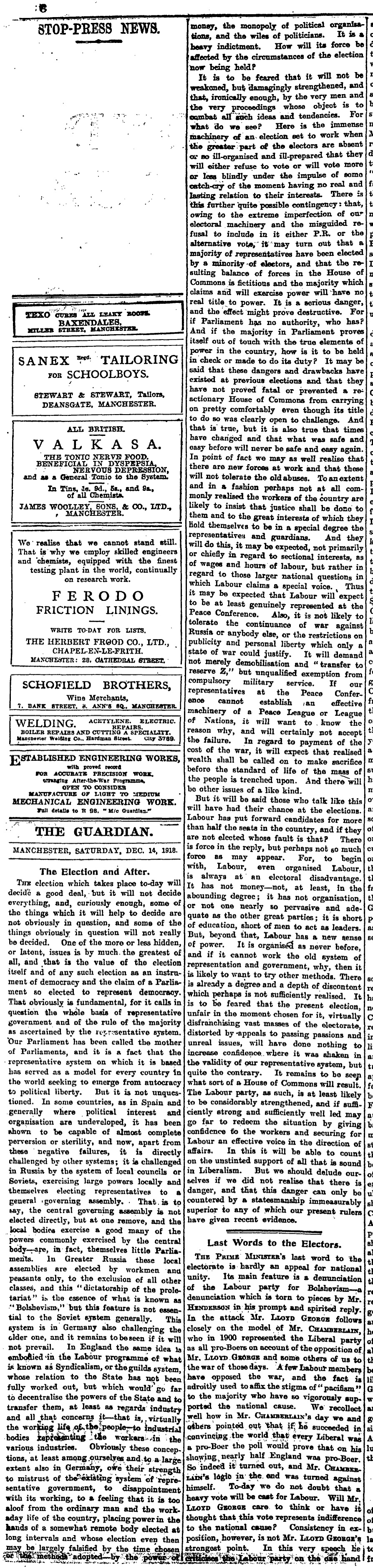
The Representation of the People Act became law on 6 February 1918. As well as granting the vote to all men over 21, women over 30 and who were occupiers of property or married to occupiers, also gained the vote. On 14 December 1918, (some) women finally had the chance to exercise their franchise in a general election.
Women’s emancipation, 11 February 1918
The extension of the Parliamentary vote to six millions of women by the passing of the Representation of the People Bill on Wednesday was celebrated at the Manchester Reform Club on Saturday by a reception given by Mr. William Royle and Mr. GG Armstrong to a large gathering of workers in the women’s suffrage movement in the Manchester district.
Mr. W. Royle, who presided, said that although not a bell had been rung or a flag hoisted, except by one spirited lady, a mighty revolution had just taken place – one of the greatest events in the political history of the country. The bounds of freedom and liberty had been enlarged. Manchester was largely responsible for the launching of the great cause of women’s suffrage on the stormy sea of political strife, and therefore had special reason for rejoicing that the ship had come sanely into port. (Hear, hear.) That afternoon they had two unseen guests among them – Lydia Becker and Jacob Bright, – whose names would be associated with this great movement to the last day of history. (Cheers.)
Councillor Margaret Ashton said that a great victory had been won, but it was only the beginning, not the end. Women had at last the weapon in their hands which would bring real victory – that equal suffrage which was the watchword of the old National Union of Women’s Suffrage Societies. When that was obtained we should be able to speak of democracy in this country for the first time. Women were awakening all the world over and trying to came out into the open and take their share in politics. The present crisis had shown how necessary it was for men and women to go forward together. Women had not the ideals of force to the same extent as men had. It was striking in this time of fearful trial how men had turned to women for help and had recognised how readily and well it had been given. This gave hope for the future. A stable civilisation necessitated a reorganisation of existing social conditions, and it was these conditions that women were most interested. Women, too, could have a tremendous effect internationally, because they were not divided in national feeling to the same extent as men.
A chapter of history
Mr. CP Scott said it was one of the glories of Manchester that it had stood amongst the first in this country in the prosecution of the cause the success of which they were celebrating. One name which had not been mentioned, and which should not be forgotten, was that of John Stuart Mill. (Hear, hear.) No more epoch-making book on social reform was ever written than The Subjection of Women. (Hear, hear.) Since its publication much had been done to remedy the injustices which excited Mill’s deep and justifiable indignation. Women, for example, could hold property now, and could be the guardians of their children. Formerly, all they had was their husbands’, and even after their husbands’ death the children were not theirs.
It was not until about 35 years later that the real political movement began, but one of the great handicaps and injustices to which women were subjected was immediately taken in hand. The first women’s college was established at Hitchin in the autumn of the year in which the book was published – 1869,– and about the same time the High School for Girls in Manchester was established. (Hear, hear.) Up to that time there had been no public secondary or grammar schools for girls. From such schools, the universities, and the professions women were barred. The doors of these had been opened since. And it was only then that the political movement for the suffrage became active and effective. It was this which had made the reform of to-day possible. (Hear, hear.)
The winning of the suffrage was not merely the beginning of legislative justice but of a great social change. The vote was not an instrument for extorting concessions from the male sex, but a symbol of that association of the sexes, the recognition of that equality and comradeship, which should be the basis of all social relations. There were some who feared that women would be unsexed by being given larger scope. Nothing could be more absurd.

Editorial: The suffrage celebration
Manchester has done well to be the first city to celebrate by a meeting of rejoicing the passing of women’s suffrage into law. It is in truth a great and transforming event, and is destined to have deeper effects on the life of the country than the war out of which it partly sprang. Manchester, moreover, is the home of the suffrage movement. Jacob Bright headed that movement, just as John Bright headed the earlier movement for democratising the electorate of men. But John Bright, mighty and successful as was his advocacy, never added so many male electors to the roll as have now been added women.
Strangely enough, Manchester was the first home of both branches of the suffrage movement, profoundly as these were opposed in spirit and in policy, and though no militants took part in yesterday’s celebration, Manchester none the less gave birth to their movement. It is a great victory, and the stepping-stone, it may be, to greater. For the vote in itself is nothing; it is valuable only for what it symbolises and may bring. It is first and foremost a signal recognition of human equality – let no one object that women have not even yet got the vote on quite the same terms as men; that battle is even now virtually won, – and, like every such recognition, will bring strength and sweetness in its train. Many good reforms, we doubt not, will follow from it; many inequalities and injustices will be redressed. But above and beyond all such partial gains will stand the fact that the woman enters for the first time as full partner with the man into the life and economy of the State. From that everything follows – her dignity, her usefulness, the means for full self-development.
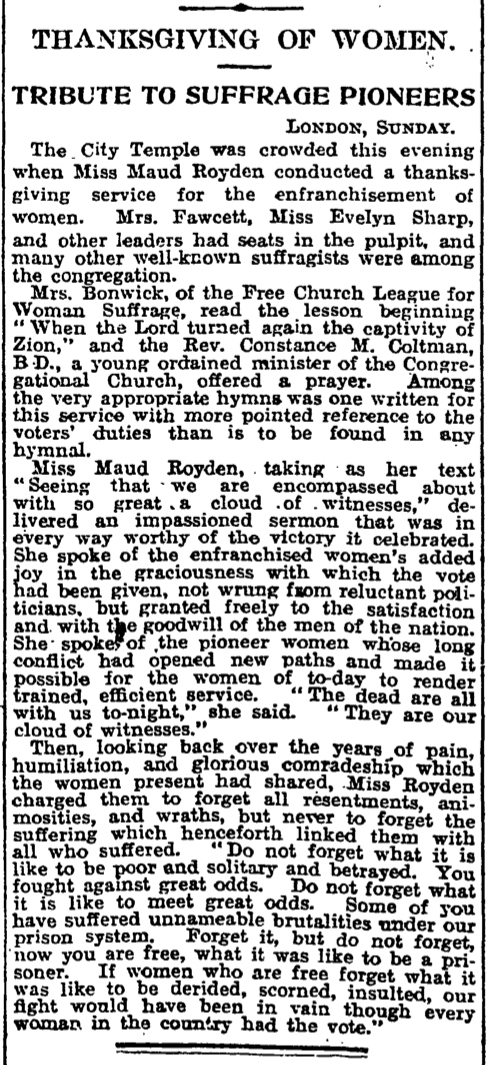
A thanksgiving service was also held on the same day at the City Temple in London.

Manchester University Guardian archive: women’s suffrage catalogue.