Vishy Anand’s brave fight in his €1m world title rematch with Magnus Carlsen at Sochi ended tamely when the Indian veteran, one down but with an edge in game 11 of 12, lost his equanimity and sacrificed rook for bishop in what he later conceded was a “bad gamble”.
Carlsen cashed in his extra material, and so won the match by 3-1 with seven draws. It was a narrower margin than in their first series at Chennai 2013, where Carlsen successfully dodged Anand’s opening preparation and made the Indian fight on the uncomfortable territory of passive positions. In Sochi Carlsen was readier to take on theoretical opening battles, even though this led to a disaster in game three and a very easy draw for Anand in game nine.
It emerged at the end of the match that Carlsen had been suffering from a heavy cold for several games, and was on medication when he fell asleep at the board during the eighth game. Another revelation was that in addition to his long-standing aides from Norway and Denmark, Carlsen also enlisted Michael Adams as one of his seconds. The England No1 is an expert on both sides of the Berlin Wall 1 e4 e5 2 Nf3 Nc6 3 Bb5 Nf6 which Anand used in four of his six games with the black pieces.
Carlsen now keeps his crown until at least 2016, when Italy’s world No2, Fabiano Caruana, is the favourite to be the next challenger. Anand will not retire yet. He was world champion for eight years including three successful title defences so his reputation is secure, even though his defeats by Carlsen and earlier by Garry Kasparov place him below the pinnacle of chess greats.
Besides Caruana, who can challenge? Vladimir Putin came in person to the Sochi closing ceremony, along with his sports minister and the head of Russia’s Olympic committee. It was announced that Sochi will host the women’s world championship next spring. That all adds up to a strong statement of intent.
Russia’s hopes of reviving its golden Soviet era lie with its top 10 ranked players Alex Grischuk and Sergey Karjakin rather than the veteran Vlad Kramnik, but their achievements do not match Carlsen’s and Caruana’s. So, despite Putin’s support, a serious challenge in the next five years is just as likely to come from China and the United States, which both have players with global potential and the resources to back them.
Beijing’s investment in its top players has bought impressive results. China won the 172-nation 2014 Olympiad, and boasts both the all-time No2 woman, Hou Yifan, still only 20, and the prodigy Wei Yi, 15, a grandmaster since 13. The secret has been spotting and developing talent at a young age despite Xiangqi, Chinese chess, remaining more popular than the international game.
US players were top dogs in the 1930s and major rivals to the USSR in the 1950s, even before Bobby Fischer. Now there is a new push from the shrewd St Louis billionaire Rex Sinquefield, who has made his city a global chess mecca. The US has Hikaru Nakamura and Wesley So in the world top 12, while Caruana, who has dual US and Italian nationality, has not ruled out a return to America in future.
Sam Shankland was an individual gold medallist at the 2014 Olympiad, and the latest US star is Samuel Sevian, 13, who this week became the youngest ever American GM and the sixth youngest in chess history. Here he beats the Sicilian Defence in bold sacrificial style.
Samuel Sevian v Ben Finegold
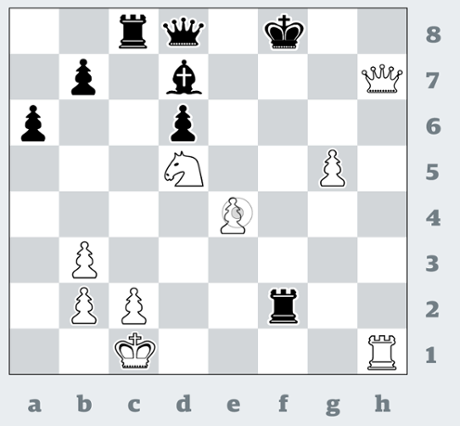
1 e4 c5 2 Nf3 Nc6 3 d4 cxd4 4 Nxd4 Nf6 5 Nc3 d6 6 Bc4 e6 7 Be3 Be7 8 Qe2 a6 9 Bb3 0-0 10 0-0-0 Qe8 11 Rhg1 Nd7 12 g4 Nc5 13 Nf5?! exf5 14 gxf5 Nxb3+ 15 axb3 f6?! 16 Nd5 Bd8 17 Rg3 Rf7 18 Qg4 g5?! 19 h4 Rg7 20 hxg5 fxg5 21 Rh1 Ne5 22 Qe2 Nf7? 23 Bb6! Bd7 24 Bxd8 Qxd8 25 f6 Rg6 26 Qh5 Kf8 27 Qxh7 Rxf6 28 f4 Rc8 29 Rxg5! Nxg5 30 fxg5 Rf2 (see puzzle diagram)
3386 31 Qh8+ Kf7 32 Rh7+ Ke6 33 Rh6+ Kf7 34 g6+ Ke6 35 g7+ Kf7 36 g8Q+ Qxg8 37 Rf6+ and mates
.