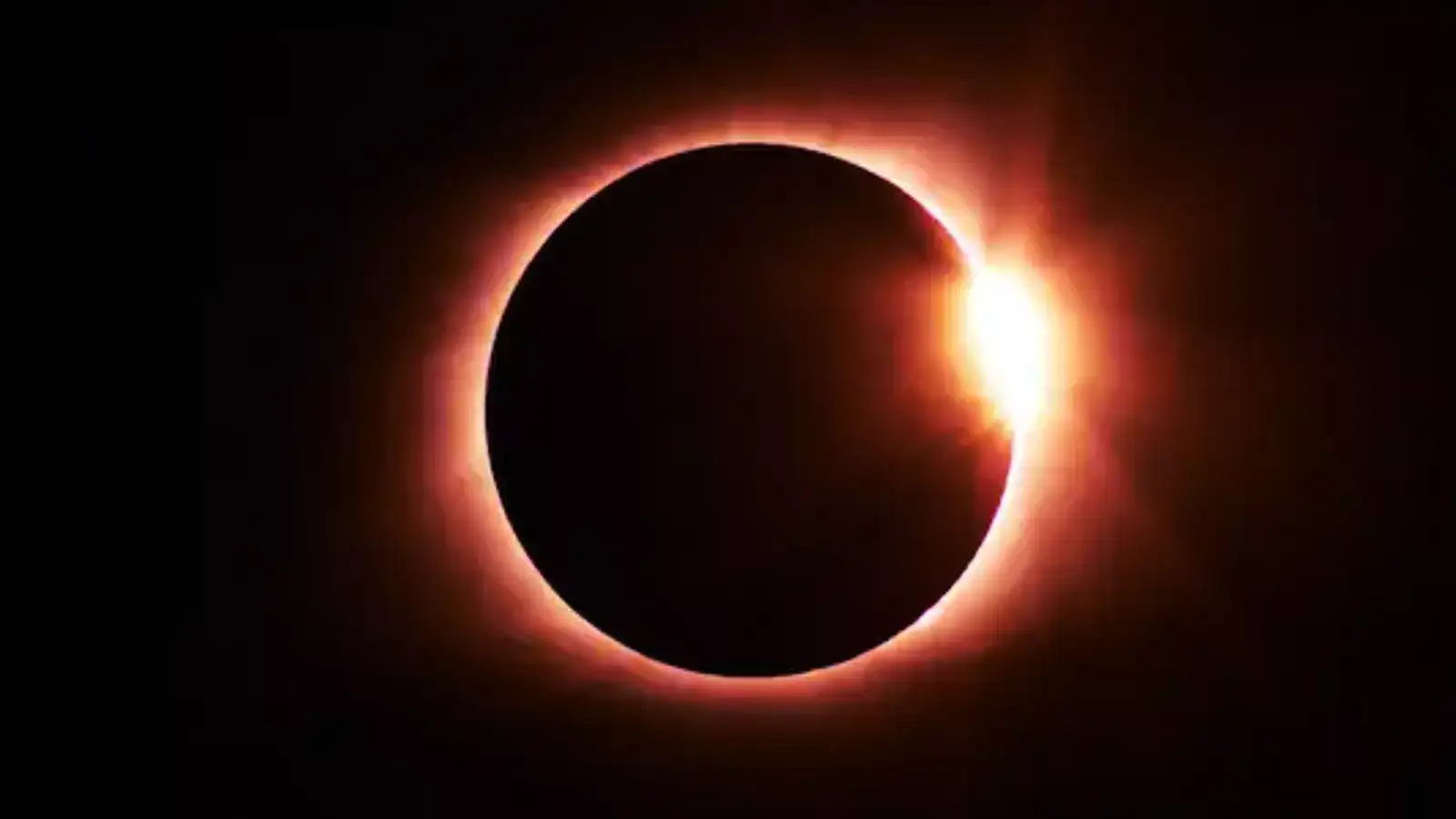
A rare and spectacular total solar eclipse will take place on August 2, 2027, and astronomers are already naming it one of the most remarkable sky events of the century. As per calculations released by NASA’s Goddard Space Flight Center, the eclipse will generate a maximum totality lasting 6 minutes and 23 seconds, making it the longest total solar eclipse visible from land in the 21st century.
The event is anticipated to transform daytime skies into deep twilight in regions of southern Europe, North Africa, and the Middle East as the Moon fully blocks the Sun for an unusually long duration. Scientists say no other total solar eclipse this century will match its duration.
Why the 2027 Eclipse Will Last So Long
Astronomers describe that the extraordinary duration is connected to the Moon’s orbital position during the eclipse. On August 2, 2027, the Moon will be near perigee, the point where it arrives closest to Earth. Because of this shorter distance, the Moon will seem to be slightly larger in the sky and will be able to cover the Sun for a longer duration.
At the same time, the eclipse path crosses areas where the Sun will appear almost directly overhead, mainly across North Africa. This positioning adds extra seconds to the period of total darkness.
Path of the Eclipse Across Multiple Countries
The eclipse path will start near southern Spain before moving across northern Morocco, Algeria, Tunisia, Libya, Egypt, Saudi Arabia, and Yemen. Durations of totality will increase gradually from west to east.
Observers in Tarifa, Spain, are anticipated to experience almost 4 minutes and 39 seconds of darkness, while Tangier, Morocco, could see around 4 minutes and 50 seconds. In Benghazi, Libya, totality is expected to last over six minutes.
Luxor, Egypt, is forecasted to become one of the best viewing areas in the world, with totality reaching almost 6 minutes and 19 seconds. Along parts of the Red Sea coast, eclipse duration could extend to around 6 minutes and 20 seconds.
The eclipse is expected to create dramatic viewing chances near famous Egyptian landmarks including the Karnak Temple and the Valley of the Kings.
Weather Conditions Could Improve Visibility
Meteorologists state that weather conditions may strongly favor eclipse viewing across parts of North Africa because the places experience extremely dry summer conditions and very low cloud cover.
Canadian meteorologist Jay Anderson, who prepares eclipse climate studies for Eclipsophile, told Space.com that eastern Libya and western Egypt face “no chance of cloud.” He also cited that Luxor experiences an average August cloud span of only 0.7 percent.
As per Anderson, dust may become a greater visibility concern than clouds in desert regions. However, he also noted that temperatures could drop suddenly during totality.
“The temperature will probably drop like a stone when the eclipse happens,” he said.
Conditions may be less predictable near the Strait of Gibraltar, where average cloud cover in August is much more because of moisture moving through the area.
Millions of People Will Witness the Eclipse
According to estimates from Timeanddate.com, around 88.9 million people live within the eclipse path of totality. This is considerably higher than the number of people who experienced the total solar eclipse visible across North America in April 2024.
For several observers, the eclipse will happen around midday. In Luxor, totality is expected at approximately 1:02 p.m. local time, while Jeddah is anticipated to experience the eclipse at around 1:22 p.m.
Even outside the narrow path of totality, a deep partial eclipse will still be visible in much of Europe, Africa, and the Middle East. Cities such as Lisbon, Madrid, Paris, London, Berlin, Cairo, Algiers, and Tripoli are all expected to witness varying levels of solar coverage.
What is Total Solar Eclipses
A total solar eclipse happens when the Moon passes directly between Earth and the Sun, temporarily blocking sunlight from reaching parts of Earth’s surface. During totality, the Sun’s outer atmosphere, known as the corona, becomes visible around the darkened Moon.
Most total solar eclipses last only a few minutes. Scientists say the 2027 event is particularly unusual because of the rare alignment between the Moon’s distance from Earth, Earth’s position around the Sun, and the eclipse path itself.
Astronomers believe events like this help scientists analyze solar activity, atmospheric effects, and celestial motion while also inspiring public interest in astronomy and space science.
FAQs:
Q1. What is happening on August 2, 2027?
A rare total solar eclipse will occur on that date. Scientists say it will be the longest total solar eclipse of the 21st century.
Q2. How long will the eclipse last?
NASA calculations show maximum totality could last 6 minutes and 23 seconds. This is unusually long for a total solar eclipse.