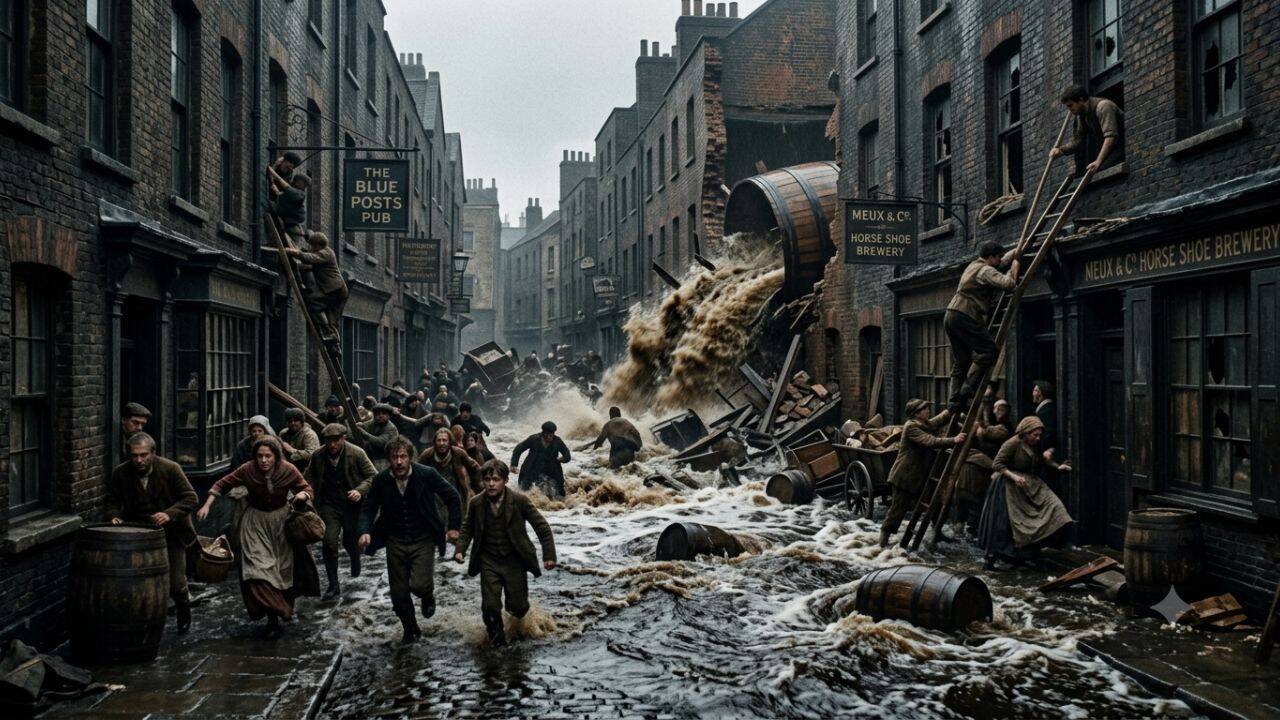
On an autumn afternoon in 1814, a quiet part of central London became the scene of an extraordinary industrial disaster. Residents around St Giles were suddenly confronted with a rushing wall of dark beer after a giant storage vat inside a local brewery failed. The accident destroyed buildings, swept through nearby homes and killed several people. At a time when London’s poorer districts were crowded with tightly packed housing, the consequences were severe. Panic spread rapidly as the powerful wave surged through narrow streets, leaving destruction and chaos in its wake. The event became one of the strangest disasters in the city’s history, remembered not for fire or machinery, but for thousands of barrels of fermenting porter spilling into the streets.
Get breaking news anytime, anywhere. Download the TOI app now!
The 22-foot beer vat that caused the deadly London beer flood of 1814
The Horse Shoe Brewery stood near the junction of Great Russell Street and Tottenham Court Road, an area that was rapidly changing but still contained some of London’s most crowded neighbourhoods. The brewery, operated by Meux and Company, was one of the many large brewing businesses supplying porter, a dark beer that had become especially popular among London drinkers.
By the early 19th century, breweries relied on enormous wooden vats to store and ferment their beer. These structures were built to hold vast quantities, allowing producers to manage the growing demand for porters. At the Horse Shoe Brewery, one of these tanks towered about 22 feet high and contained thousands of barrels of ale.
The vat was reinforced with large iron hoops designed to hold the wooden structure together under pressure. But inside, fermentation was constantly producing gases, placing strain on the container. On 17 October 1814, one of those iron rings suddenly gave way.
The collapse that unleashed hundreds of thousands of gallons
The initial failure did not immediately destroy the tank. Around an hour later, however, the weakened structure could no longer withstand the pressure. The enormous container burst apart, releasing a powerful rush of beer through the brewery.
The force was strong enough to damage part of the building itself. Other storage tanks were struck during the collapse, causing even more beer to escape. Within moments, a huge volume of porter was moving beyond the brewery walls and into the surrounding streets.
More than 320,000 gallons of beer poured into the St Giles area, where many families lived in small homes and basement rooms. The neighbourhood, known as the St Giles Rookery, contained some of London’s poorest residents, with overcrowded housing built close together.
The sudden flood moved quickly through nearby streets, carrying broken timber, bricks and debris along with the beer.
Homes destroyed and lives lost
The wave reached George Street and New Street, where the force of the liquid caused serious damage. Two houses with basement rooms collapsed after being struck by the flood.
In one basement, Mary Banfield and her daughter Hannah were having tea when the beer entered the building. Neither survived. Another basement was being used for an Irish wake for a two-year-old child who had died the previous day. The gathering ended in tragedy when four mourners were killed.
The flood also struck the nearby Tavistock Arms pub. A teenage worker, Eleanor Cooper, became trapped after part of the building collapsed around her.
Eight people died as a direct result of the disaster. Several brewery workers were caught in the chaos but survived, including some who were rescued from the rising liquid and rubble.
A city drawn to the aftermath
The disaster quickly attracted crowds. For many Londoners, the sight of so much beer flowing freely through the streets was impossible to ignore. Some people collected the liquid in containers, while others drank what they could.
Reports later claimed that another person died days afterwards after consuming too much alcohol, though details surrounding that case remain uncertain.
The aftermath created difficult conditions for residents. The smell of spilled beer lingered around the area for months, and damaged homes had to be cleared and repaired.
The tragedy also produced some grim scenes. Some families displayed the bodies of victims to visitors in exchange for money, turning public mourning into a disturbing spectacle. In one case, the weight of visitors gathering inside a building caused a floor to collapse, sending people into a cellar filled with the remains of the beer flood.
The legal battle and financial aftermath of the disaster
Following the disaster, Meux and Company faced legal action. However, the court decided that the collapse could not be blamed on negligence and classified the event as an unavoidable accident, effectively leaving no one legally responsible.
The financial impact on the brewery was significant. The company lost a large quantity of beer and faced costs of around £23,000, a major sum at the time. However, it recovered some money through government compensation and a refund of excise duties that had already been paid on the lost beer.
Those payments helped the brewery survive what could have been a devastating financial blow.
A disaster that changed brewing practices
The London beer flood also influenced how breweries approached storage. Large wooden fermentation vessels gradually became less common, with many companies moving towards stronger alternatives such as lined concrete tanks.
The Horse Shoe Brewery continued operating for more than a century after the accident. The site eventually closed and was demolished in 1922. Part of the area later became home to the Dominion Theatre.