What the ground remembers
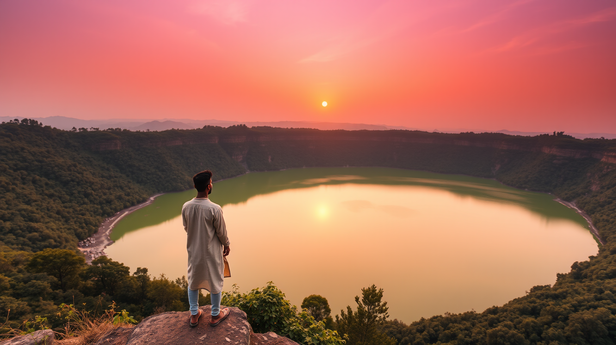
The water at Lonar is the colour of a bruise healing, greenish, then pink at certain hours, then a flat grey that makes you question whether you imagined the colour at all. You are standing inside a bowl roughly 1.8 kilometres wide and nearly 150 metres deep, and the bowl was not carved by a river or a glacier. A meteor travelling at roughly 90,000 kilometres per hour hit this exact stretch of the Deccan Plateau about 50,000 years ago. The ground did not forget.
Most impact craters on Earth have been worn smooth by erosion or buried under cities. Lonar is neither. The Maharashtra countryside around it is ordinary, farmland, small roads, a town that sells chai and goes about its business. Then the earth drops away and there it is: a lake sitting in a wound that the planet never quite closed. The rim is forested. The crater floor is green and wet and startlingly alive. The first thing you feel is not awe exactly. It is the particular disorientation of scale, the sense that the category you brought with you does not fit what you are looking at.
The water that shouldn't exist
Lonar is one of only four known saltwater lakes in the world that are also alkaline. The pH of the water sits between 10 and 11, closer to bleach than to the groundwater that feeds most Indian lakes. Cyanobacteria and halophilic microorganisms thrive in it. Flamingos arrive in season. The lake has no outlet. Whatever falls into it stays, concentrating over millennia into something chemically strange and biologically specific.
Scientists from across the world have studied Lonar because its mineral composition resembles the surface of Mars. The Geological Survey of India has documented its basaltic rock as the same type found at lunar impact sites, which is partly how the lake got its name, though the town of Lonar predates that scientific connection by centuries. The meteor impact itself is estimated to have released energy equivalent to roughly 100 times the atomic bomb dropped on Hiroshima. That number is not meant to dramatise. It is simply what it takes to make a hole this size in the Deccan basalt.
What the temples are doing there
Fourteen temples ring the crater floor. Some date to the Chalukya and Yadava periods, between the 6th and 13th centuries CE. The Daitya Sudan temple, dedicated to Vishnu, sits close to the lake's edge. Its stone carvings are detailed enough that you can read individual figures in the friezes, dancers, warriors, animals arranged in registers that run around the outer walls. The temple was built over a site where, according to local tradition, Vishnu slew the demon Lonasura, whose name the town carries.
Nobody built temples here by accident. The crater has drawn people for a very long time, and the impulse to consecrate it is not hard to understand. There is something about the shape of the place, the way the rim closes around you, the way the lake sits at the centre, that feels already arranged. The temples do not compete with the geology. They read as a response to it, the way a margin note responds to a text.
Why you feel something shift
You can walk the crater rim. The trail takes two to three hours depending on where you start and how often you stop. Most people stop often. The lake changes colour as the light changes, and the light changes constantly because the crater creates its own microclimate, cooler and more humid than the plateau above. At certain points on the rim, you can see the full circle of the water below and the ring of trees and the temples at the edge, and the geometry of it is so complete that it looks constructed.
Lonar is about 500 kilometres from Mumbai and roughly 140 kilometres from Aurangabad, which has an airport and connects to the Ajanta and Ellora circuit most visitors follow. Lonar is almost never on that circuit. The town has a handful of guesthouses and a Maharashtra Tourism property that is functional and quiet. There are no crowds. There are birds you will not see anywhere else in the region. There is the sound of the lake, which is not silence but is close to it, water moving very slightly, insects, the occasional call from the forest on the crater wall.
The alkaline water cannot be drunk. You cannot swim in it without skin irritation. You cannot take anything from the crater floor. The lake offers nothing extractable. What it offers is the experience of standing inside something that happened before human memory and that will outlast every structure built at its edge, and finding, against expectation, that this is enough.
Getting there without making it a footnote
The mistake most people make with Lonar is appending it to another trip. It becomes half a day tacked onto an Aurangabad itinerary, a crater glimpsed from the rim before the car turns back toward the highway. The lake does not work as a footnote. The geology requires time to settle. The temples require a slow walk. The crater rim requires the kind of attention that cannot be divided between this and the next thing on a list.
Fly into Aurangabad or take the overnight train from Mumbai to Jalna, then hire a car for the final stretch. Plan two nights in Lonar. Walk the rim on the first morning when the light is low and the water is doing its colour-shifting thing. Visit the Daitya Sudan temple in the afternoon when the tour buses from Aurangabad have not arrived, because they usually have not. On the second day, go back to the lake at a different hour and notice what changed. Something always has.
The crater was here before the temples, before the town, before anyone thought to name the meteor or measure its speed. The impulse to consecrate it and the impulse to study it are both attempts at the same thing: to place yourself in relation to something that does not need you to exist. Lonar does not ask to be understood. It only asks that you stay long enough to stop trying.