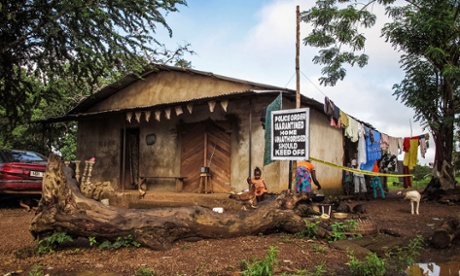
“We were just beginning to develop a good environment after the war shattered us — coming to integrate society, develop business and infrastructure — and now Ebola has taken us back again,” Samura Kamara, foreign minister of Sierra Leone, told the Financial Times in February.
Four months later, the Ebola crisis is slowly abating in Sierra Leone, but with new people still being diagnosed in recent weeks preventing an all-clear diagnosis, the country is struggling to attract businesses once keen to invest in a country rich in diamonds, minerals and fertile land. Those that invest are forced to charter cargo planes to fly in equipment in the absence of usual carriers. Then there’s the report by Sierra Leone’s auditor general that raises concerns about corruption. It emerged that the country failed to account fully for nearly a third of the $20m (£130m) it received to fight Ebola in 2014.
The World Bank also estimates that nearly 180,000 people in Sierra Leone have lost their jobs due to the Ebola crisis. Their most recent April survey revealed women are among the hardest hit.
So, with it being forecast that the country’s tiny $4bn economy will shrink 2% this year, versus earlier forecasts of 8.9% growth before the crisis hit, what change is needed for the country to get back on its feet?
With businesses forced to close in the aftermath of the crisis, how can jobs be created and entrepreneurship encouraged? How can international NGOs work with the government to strengthen the economy and cut off illicit financial flows? And with more than $1bn earmarked for the Ebola-affected countries like Sierra Leone and neighbours Guinea and Liberia, how do we avoid recreating an aid culture that slows real growth?
Join an expert panel on Thursday 18 June, 1–3pm BST, to discuss these questions and more.
The live chat is not video or audio-enabled but will take place in the comments section (below). Get in touch via globaldevpros@theguardian.com or @GuardianGDP on Twitter to recommend someone for our expert panel. Follow the discussion using the hashtag #globaldevlive.
Panel
Pablo Fajnzylber, manager, poverty and equity global practice, Africa region, World Bank, Washington, DC, USA @WBG_Poverty
Pablo oversees the bank’s poverty measurement work, statistical capacity building and poverty-related policy analysis in sub-Saharan Africa.
Dr Peter Davis, principal, Consilience Global, Oxford, UK
Peter is a political economist focusing on the role of the private sector in fragile states. His recent clients include IFC, OECD, DfiD and the EU.
Ade Daramy, chair, Sierra Leone UK Diaspora Ebola Response Taskforce, London, UK
Ade is an experience radio and tv broadcaster; consultant and cultural commentator on African diaspora affairs, African Arts, music and history.
Georgina Duffin, private sector development manager, Adam Smith International, Freetown, Sierra Leone @AdamSmithInt
Georgina founded DfID’s market development programme in 2013, which aims to increase Sierra Leone’s pro-poor economic growth.
Dylan Sogie-Thomas, private sector adviser, Office of the President, Freetown, Sierra Leone
Dylan has experience in governance, risk management, and promoting business in Sierra Leone.
Dr Moses Siche, economic adviser, UN Development Programme Sierra Leone, Freetown, Sierra Leone @UNDPSierraLeone
Moses is UNDP’s lead researcher on the socio-economic impact of Ebola on Sierra Leone.
Jamie Hitchen, policy researcher, Africa Research Institite, London, UK @jchitchen @AfricaResearch
Jamie is interested in informality in Africa. He worked in Sierra Leone until August 2014.
Rachel Glennerster, academic lead, Sierra Leone, International Growth Center, Boston, USA @RunningREs
Rachel has conducted research in Sierra Leone on public services, CDD, agriculture, and elections since 2004.
Thomas Dannatt, CEO, Street Child, London, UK @scosl
Thomas developed Street Child’s urban and rural livelihood schemes. He has travelled to Sierra Leone 40 times since 2008.
Mykay Kamara, managing director, A&A Investments and Services, London, UK
Mykay provides consultancy services and implementation support to clients developing energy and infrastructure projects in west Africa.