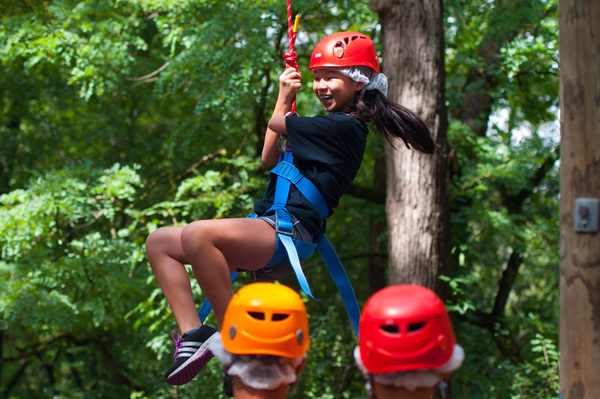
OLYMPIA FIELDS, Ill. _ Even before she was fitted into a harness, Lizbeth Serrano was soaring among the treetops.
Figuratively speaking, that is.
"It's great to be out here with people who are like you, people who understand," said the 12-year-old Justice girl, as she awaited her turn while younger kids worked their "different" limbs up the 38-foot high climbing wall at the Irons Oaks Environmental Center in Olympia Fields Aug. 19.
"When you're different, it's important to see other people who are different, too," she said.
As is customary when families get together for events sponsored by Lucky Fin Project, a national nonprofit group that celebrates limb differences, the participants were taking comfort in their sameness.
Lizbeth's mother, also named Lizbeth Serrano, said, "Every time we get together with the Lucky Fins it's like meeting family all over again. The kids feel a connection here because it's like seeing themselves as normal."
All of the families who attended the outing had a child with a "lucky fin," a shortened arm or a hand or foot with fewer than five digits or, in some cases, an amputated leg.
Tom Flynn, who himself has a lucky fin, is a gym teacher at Morton Gingerwood School in Oak Forest, Ill. He organized the event with the help of his boss, Deb Stanfield, a Homewood Flossmoor Park District employee and adventure center coordinator. Irons Oaks is a joint venture of the Homewood Flossmoor and Olympia Fields park districts.
Flynn, who was born with a fused right elbow and shortened arm, grew up hearing teachers tell him what he could and could not do.
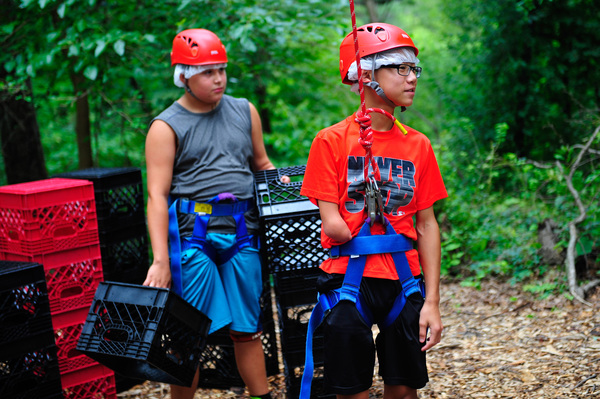
"Basically, whenever they told me I couldn't do something, I went out of my way to prove them wrong," he said. The father of four is a juggler, has gone sky diving and has participated in bike races. He spends his summers working at Irons Oaks.
"People see people who are different and think those differences make them disabled," Flynn said. "Different doesn't mean disabled, it just means different. These kids are amazing and they can do all sorts of things."
The Lucky Fin Project (www.luckyfinproject.org) was started by Michigan mom Molly Stapleman after her daughter, Ryan, was born with a stunted right hand, a condition known medically as symbrachydactyly.
Launched in 2010 as a spinoff from the Disney Pixar movie "Finding Nemo," in which the lead character clown fish doesn't allow his smaller "lucky fin" stop him from accomplishing anything he sets out to do, the Lucky Fin Project is now represented in all 50 states and more than 48 countries, Stapleman said.
"Our mission is to celebrate, educate, support and unite children, individuals and families affected by limb difference," she said.
Along those lines, Flynn pointed out one member of the organization is a runway model, another is a guitar player and another is a Mixed Martial Arts fighter.
Gavin Halagiere, an 11-year-old from Naperville, Ill., who once shied away from other kids, has found both friendship and courage through the Lucky Fin Project.
"Until we went to our first Lucky Fin picnic, Gavin didn't want to get involved with other kids," his mom, Rene Halagiere, said. "Now look at him. We can't stop him. The minute he saw there were all kinds of people like him, everything changed. Now, he wants to mentor younger kids."
Gavin's dad, Josh Halagiere, said, "He doesn't let anything hold him back."
Gavin, who was recently accepted into the Wounded Warriors Amputee Softball program as well as the Never Say Never Pirate camp in Florida, said, "I want to be a baseball player when I grow up."
If he has his druthers, he'll play for the Chicago Cubs.
Like many of the other parents at the event, Joel and Kerri Gorecki of Mokena, Ill., found the Lucky Fin Project through social media.
As the parents of 11 adopted children, Kerri Gorecki said parenting can be challenging, but not because several of their children have limb differences.
"Our lives our busy, but that's just because of the sheer number of kids we have," she said. Next year, they will have five teens at Lincoln-Way Central High School.
"These kids with differences really can do anything. There's no stopping them. There are no limits," she said. She cites 11-year-old Zach as an example. He loves wheelchair basketball and is so good that he plays with a high school team.
She said her children will have the added advantage of having siblings with similar differences.
"Kids don't meet many other kids like them in school," she said. "It will absolutely be helpful for them to have siblings with differences. Two of our kids have an upper difference. Two have leg amputations. So they see it all the time in our house. But I think sometimes they think it's not outside the house.
"But now," she said, gazing at her daughter atop a stack of climbing crates, "They know there are lots of kids with differences."
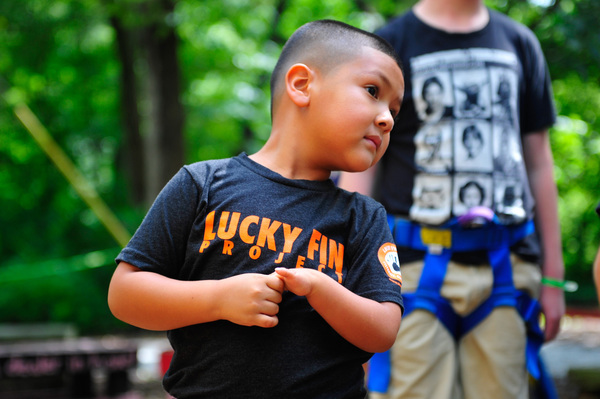
Carina Flores and Eduardo Cervantes of Chicago's Ashburn neighborhood, attended the outing with their son, Isaiah Cervantes, who just turned 5, and his little sister, Gia Cervantes.
"I have been looking an opportunity like this," Flores said. "This is the first time we actually found somebody who lives in the Chicago area that has the same hand as his."
The first year after her son was born was "really hard," she said. "There was nobody to relate to or reach out to. His therapists said they didn't know anybody, they couldn't refer us anywhere. So I started digging on my own."
She found the Lucky Fin Project.
"It's important for him to feel he's OK, to feel that he belongs," Flores said. "Now I'm worried about him starting kindergarten this year. I want to hear stories from other mothers about how they dealt with it."
Denise Hohe was also thrown for a loop early on after her daughter Madelyne was born.
"We did not know prior to her being born; ultrasound didn't pick it up that she was going to have a hand difference," said the Plainfield mom.
"We felt very isolated and alone because we didn't really know anyone else who had a child with this. I feel like that's a common denominator among all the parents in this group."
Madelyne is now 9 and a member of a traveling competitive dance team.
"This is not a disability; it's just a difference," Hohe said.
As for outings like the Irons Oaks one, Hohe said, "It's good for kids to have friends like them. Usually these kids go to school and they're the only one who has a limb difference in the whole school. But then they come to things like this and they see they're not alone."