A government backbencher has attacked Australia’s paid parental leave policy, saying the Coalition should go “back to the drawing board” to find a way to offer more generous payments to low-income women as part of a bipartisan deal with Labor.
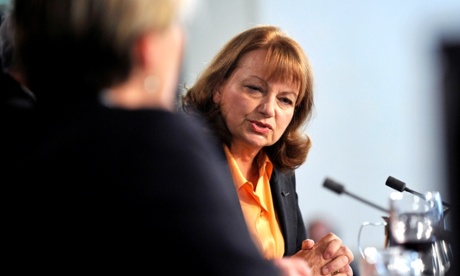
Dr Sharman Stone said the bitter political debate over paid parental leave in recent years had left Australian mothers with “the worst of all worlds” and urged her colleagues to fight for more generous provisions for low-income women.
The government booked almost $1bn in savings in the 2015 budget from abandoning the $11,500 – now offered under the national paid parental leave scheme to women earning up to $150,000 a year – for those mothers who already receive that amount, or more, from their employers. The measure proved one of the most controversial in the generally well-received budget after ministers characterised women accessing both the $11,500 and an employer-provided scheme as “double-dippers” and suggested it amounted to a “rort” or a “fraud”.
Stone – formerly the Coalition’s shadow minister on the status of women – backed the criticism of higher-paid women, especially public servants, accessing two schemes.
But she said low-income women often needed to access both taxpayer and employer schemes to achieve a reasonable amount of time with their newborns.
“Clearly we are in a terrible dilemma because we have the worst of all worlds – it was extraordinary that some higher-paid women, particularly public servants, were able to access a generous employer-provided scheme and also collect $11,500, but for low-income earners it was not at all unreasonable for them to add to the minimalist national scheme to get a few more weeks at home with their newborn if that was all their struggling small business employer could afford,” Stone told Guardian Australia.
“We can’t leave the policy where it is now. Australian women deserve much better than this system which allows some women to be very well cared for by their employers while low-income women, working for themselves or for small businesses, struggle to be able to afford more than a few weeks off to nurture their newborns ... we as the Coalition need to go back in and fight for those low-income women.
“Labor has left us with this cheap and mean scheme with a minimum number of weeks’ paid leave and no superannuation, it refused to support the Coalition’s attempt to level the playing field.”
“The Coalition probably needs to accept that any scheme we eventually come up with might not be as generous as what we were offering before [the prime minister’s former “signature” policy offered 26 weeks at full replacement wage – up to $75,000 – but was abandoned in favour of more generous childcare payments] … but we need to have a bipartisan conversation to come up with something that offers a bigger benefit to low-income women.
“Women offer society the incredible public good of having babies, but it comes with a big cost to their careers and to their continuity of superannuation. Eighteen weeks’ leave on the minimum wage is not enough when you consider the huge benefits of time with a newborn baby and the benefits of breastfeeding.”
Employer groups and unions have also raised concerns that the government’s plan may not achieve its desired savings from the private sector, because employers would offer their current benefits in different ways, in order to make sure that they continued to be in addition to the $11,500 offered under the national taxpayer-funded scheme.
The ACTU president, Ged Kearney, told Guardian Australia employers and unions were likely to discuss possible changes to the scheme outlined in the budget.
The paid parental leave changes may also not pass the Senate, with Labor, the Greens and several crossbench senators opposed and furious lobbying under way. They are due to take effect from July next year.
Two members of the expenditure review committee of cabinet, Mathias Cormann and Josh Frydenberg, confirmed during budget week that their wives had accessed two paid parental leave schemes.
Joe Hockey has suggested that employers shifting paid parental leave to other benefits would amount to a “scam”.
“And if [employers] change the scheme to try and scam the government and scam taxpayers, well, I mean that reflects on them as much as anything else,” the treasurer said.
The shadow treasurer, Chris Bowen, has said Labor would try to undo the budget changes to paid parental leave in government, if they do pass the Senate.
Bowen said it was “an ill-thought out, illusory saving, as employers naturally and inevitably consider removing their own schemes as their employees will, under the Abbott-Hockey model, be no better off as a result of their employer schemes”.