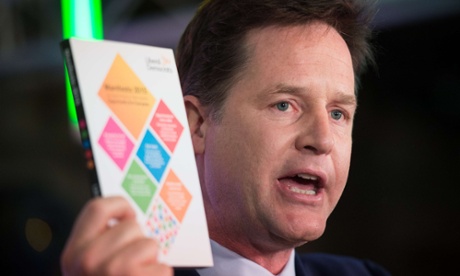
The Liberal Democrats are promising a slew of measures to protect journalists in the most detailed set of proposals on the media of any of the party manifestos released so far.
Measures include a public interest defence for journalists who break the law to expose crime or corruption and a “British ‘First Amendment’ law” to require the authorities and the courts to take into account the importance of a free media.
Referencing the Charlie Hedbo attacks in January, the manifesto attempts to highlight the party’s commitment to freedom of expression: “As the Charlie Hebdo attacks in Paris showed, freedom of expression cannot be taken for granted. In an open society there can be no right ‘not to be offended’, which is why Liberal Democrats in government have strengthened the law to make it harder for prosecutions to be brought for using ‘insulting words’, and have led the way in protecting journalists’ sources under the 2000 Regulation of Investigatory Powers Act (Ripa),” says the manifesto.
“Yet censorship and self-censorship are still rife, and the threat of prosecution can have a chilling effect on the willingness of people to speak out against injustice and corruption.”
The manifesto says journalists should have the chance to challenge in court the use of Ripa powers to access journalist communications before they are authorised, as long as it does not jeopardise an investigation.
No other party has explicitly said it backs journalists being able to challenge access requests under Ripa before they are carried out, something many in the media and the NUJ insist is vital to protecting whistleblowers. However, the Green party has promised to scrap the act for a variety of reasons, including its use to uncover journalists’ sources.
The manifesto also promises to remove ministers from deciding appointments to the BBC Trust or the board of Ofcom, ensure the licence fee does not rise faster than inflation and carry out a post-legislative review of the Defamation Act 2013 to ensure the effects of libel law have been reduced.
While providing a detailed list of measures that will appeal to most media organisations, the manifesto takes a strong line on press regulation.
The document says that after 12 months of the industry’s current attempts to self-regulate – which is undertaken by Ipso – “there is significant non-cooperation by newspaper publishers”, then parliament should legislate to enforce an independent system of regulation.