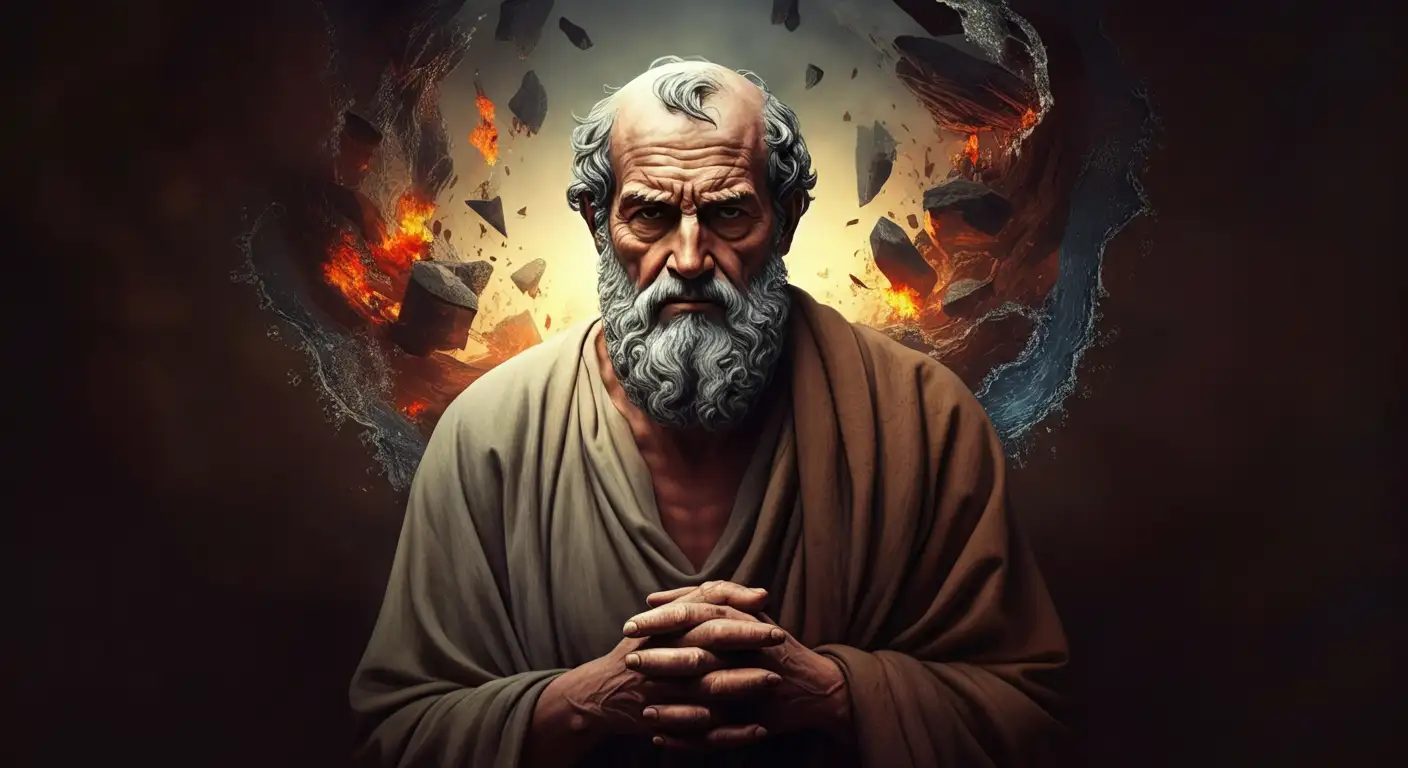
Lesson of the day by Heraclitus: Human life is often filled with contradictions. People experience joy and sadness, agreement and conflict, success and failure, sometimes all within the same moment. Ancient Greek philosopher Heraclitus observed this constant tension in existence and tried to explain it through one of his most thought-provoking ideas. He believed that opposites are not separate forces, but deeply connected parts of a single reality.
Heraclitus on Understanding Life’s Contradictions
Heraclitus said that, "
Couples are wholes and not wholes, what agrees disagrees, the concordant is discordant. From all things one and from one all things," as per BrainyQuote.
While the quote seems confusing because it mixes opposing ideas, Heraclitus is pointing out that contradiction is a natural part of life. Things that appear to be in conflict—like agreement and disagreement often exist together and shape each other. What looks divided on the surface may actually be connected underneath.
Lessons by Heraclitus on Unity Behind Conflict and Harmony
The idea of “wholes and not wholes” suggests that nothing is completely separate or complete on its own. Instead, everything gains meaning in relation to its opposite. Harmony and conflict are not enemies; they are part of the same system that keeps life in balance.
Heraclitus also emphasizes unity behind diversity. When he says, “From all things one and from one all things,” he is describing how everything in the world is connected at a deeper level. Even though life appears scattered and varied, it ultimately forms one continuous whole. At the same time, that unity expresses itself in many different forms.
Lesson of the Day May 19: Finding Balance in a Changing and Connected World
People often try to separate experiences into strict categories, good or bad, right or wrong, success or failure. Heraclitus challenges this way of thinking. He suggests that opposites are not problems to be solved but relationships to be understood.
The lesson encourages a broader perspective: instead of resisting contradictions, we can see them as part of a larger balance. Life is not made of isolated moments but of interconnected forces that define and shape one another.
Who Was Heraclitus
Heraclitus (c. 540 BCE–c. 480 BCE) was a Greek philosopher from Ephesus (now Selçuk, Turkey). His original writings are lost, and his ideas survive in fragments quoted by later authors.
He believed fire was the basic principle of the universe, describing it as an “ever-living fire” that constantly changes through cycles of transformation between fire, water, and earth, as per a Britannica report.
A key idea in his philosophy is logos, or universal reason, which he said most people fail to understand. Through logos, he argued that everything is connected, especially through opposites.
He taught that opposites define each other, such as hot and cold or health and disease and that even the same thing can be experienced differently, as per the Britannica report. He saw these contrasts as part of a unified system in constant change and balance.
Inspiring Quotes by Heraclitus
Here are a few quotes by Heraclitus.
- "No man ever steps in the same river twice, for it's not the same river and he's not the same man," as per BrainyQuote.
- "Good character is not formed in a week or a month. It is created little by little, day by day. Protracted and patient effort is needed to develop good character," as per BrainyQuote.
- "Man is most nearly himself when he achieves the seriousness of a child at play," as per BrainyQuote.
- "Our envy always lasts longer than the happiness of those we envy," as per BrainyQuote.
- "To God everything is beautiful, good, and just; humans, however, think some things are unjust and others just," as per BrainyQuote.