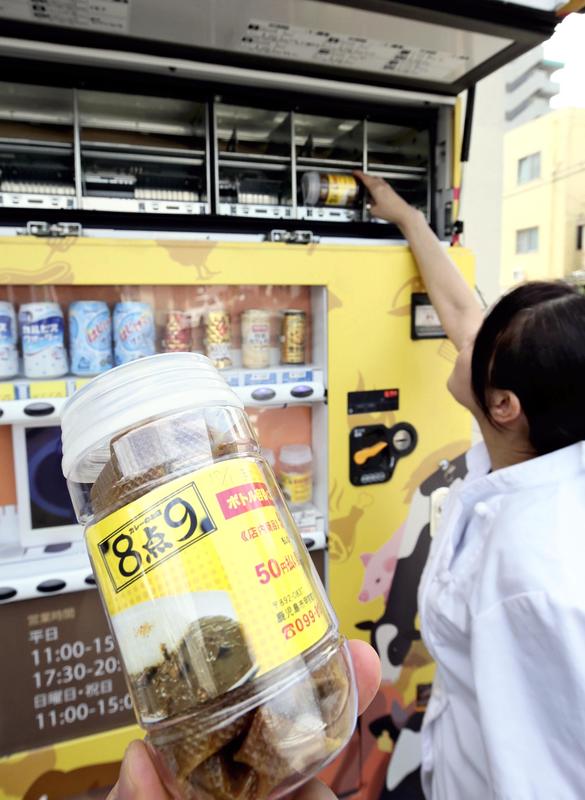
KAGOSHIMA -- Do you ever have a craving for curry late at night when no shops are open? A residential district in Kagoshima city about a 15-minute drive from JR Kagoshima-Chuo Station has just the solution: a vending machine that, in addition to the typical juice, coffee and tea, sells curry.
For some enthusiasts, curry is considered something to drink rather than eat. So I wonder if curry is really starting to be sold as a beverage?
At the bottom right of the display of the yellow vending machine are two sample packages of curry that look like sealed cups of sake. One 230-gram package costs 400 yen.
The vending machine was set up in December last year in front of Hachi-ten-Kyu, a curry restaurant that opened in November 2016. Owner Yoichi Suenaga, 46, decided to sell his curry to cater to regulars.
Suenaga said he often saw some company employees, after finishing lunch at his restaurant, getting hot curry dishes to take out for their colleagues. Such orders made him wonder what would happen if the colleagues they were bringing food to had already finished their lunch.
So Suenaga came up with the idea of selling his curry in packages so that customers can eat it anytime they want. Moreover, he decided to sell the packaged products in a vending machine to allow customers to buy them anytime regardless of the opening hours of his restaurant.
Thanks to the unusual combination of curry and a regular vending machine, Suenaga's idea immediately became the talk of the town, prompting customers at one point to line up for the packaged curry. Even now, an average of 30 to 40 packages are sold daily, with the vending machine curry accounting for about 30 percent of his restaurant's total sales.
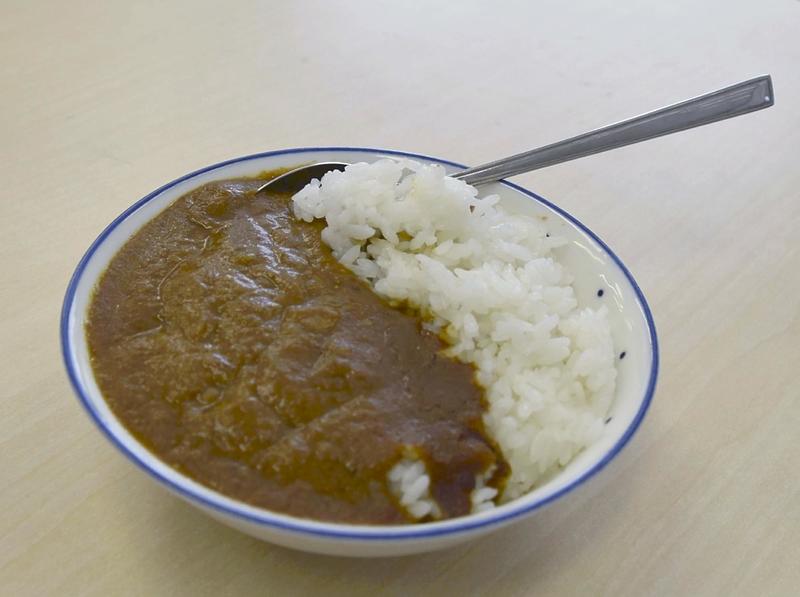
The curry sold in the vending machine is the same as that served in the restaurant. To heat it up, the package can be boiled as is, or the contents can be emptied into a microwave-safe container and microwaved. In principle, the expiration date is the day of purchase.
The thick curry has a deep, rich flavor, as it is made from stock prepared with beef tendon and Suenaga's own miso-based mixture. He lets the curry sit for about two days. It is not too sweet nor too spicy so that most anyone can appreciate it.
Customers can also order servings of rice to take out if the restaurant is open. Those returning the empty curry packages to the restaurant receive a 50 yen rebate or a 50 yen discount on items on the menu.
"I'm glad if I can serve my curry when customers crave the dish," Suenaga said.
According to the Tokyo-based Japan Vending System Manufacturers Association, Japan is the world's leading nation for vending machines, with more than 4.23 million machines installed as of the end of December 2018.
Of them, there were 72,000 units that sold food items in an array of options.
For example, at the Tenmonkan shopping district in central Kagoshima, a vending machine sells crepes in seven flavors, such as chocolate-and-banana and mascarpone cheese. At Saga Airport, a machine sells sheets of dried nori, a specialty of Saga Prefecture, while Kumamoto has one that offers snacks of edible insects, in the spotlight as an alternative source of food.
Other examples include a vending machine in Awaji, Hyogo Prefecture, that sells chikuwa long fish cakes rolled on green bamboo skewers, while another in Hiroshima sells pizzas that are freshly baked in the machine's oven.
Read more from The Japan News at https://japannews.yomiuri.co.jp/