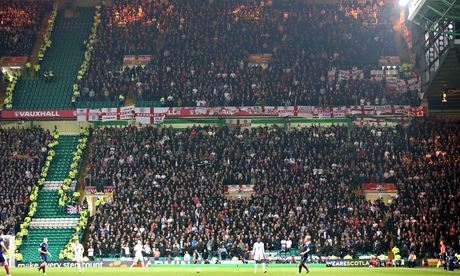
In the end England and Scotland’s first meeting north of the border in 15 years was a case of the good, the bad and the ugly. England were good, most notably in the fast, fearless start orchestrated by Jack Wilshere from his deep playmaker’s position. Scotland were surprisingly bad, a shadow of the tight, well-drilled counterattacking team that had troubled the world champions in Dortmund in September. And England’s fans brought the ugly, spending a large part of the first half chanting “Fuck The IRA/Fuck the IRA/Fuck the IRA” over and over and over ... and over ... and over again.
It has come as a surprise to many that the IRA chants have even been reported, let alone spun more broadly into a topic of the day in the non-sport media. The fact is, songs aside, a potentially combustible occasion has now passed off remarkably peacefully, with just 29 football-related arrests in Glasgow compared to 250 the last time the two teams played there, and no reports of serious trouble away from the ground.
Plus, of course, it is important to remember that this is no more than a song and a fairly meaningless one at that. Just as God Save The Queen is a plea to an entity that doesn’t exist to preserve one that shouldn’t, so the idea of not surrendering to the IRA – which is no longer demanding surrender in any meaningful fashion – is a fairly decrepit rallying cry.
But then, football songs have always tended to operate under their own broad-brush code of logic. No doubt the England fans singing were in their own minds “taking” Celtic Park, offering a semi-banterous slapdown-in-song to the usual inhabitants of a ground at which the quietly decomposing cadaver of the IRA is often winched up out of its casket and marched around the place in song.
How offensive is any of this? Certainly the Football Association wants no truck with songs that reference 35 years of sectarian fighting, and phonecalls were made during the match to ask the England band to stop playing the tune in its repertoire that is habitually co-opted as an anti-IRA anthem. Against this, it must be said there was very little response from the home crowd, who seemed if anything a little baffled by the whole affair.
This was not a Celtic crowd but a Scotland one, drawn from the country at large and more likely to exist at one remove from this opposition, or even to be more naturally inclined to join in on the England side of this particular retro-tribal argument. Perhaps in time Celtic Park might have even found itself joined in song, a post-referendum moment of unity, hands joined across the trenches by the magic of Fuck The IRA.
In defence of the singers there are those who will point out, correctly, that it is possible to hear much worse at pretty much any ground. This is the natural tone of football crowds, a space in which the freedom to shout whatever you like within the law still exists, fanned by the liberating, anonymity of the mob. Similarly taking offence has undoubtedly become a kind of shared national pass time. By 9am the next morning the actions of a few hundred drunk people had already been teased out on BBC radio into a debate about the offence-etiquette of, among other things, not wearing a remembrance poppy. I’m offended. You’re offended. I’m offended that you’re offended. We’re on a hair trigger here.Yet there are some more serious points to be made. For a start under the Offensive Behaviour At Football legislation it is potentially a criminal offence to sing inflammatory political songs. Last year a Celtic fan was acquitted in court, on balance, of being likely to incite public disorder by singing the Roll of Honour during an away game at Inverness Caledonian Thistle (a version that includes the words “England you’re a bastard”). This sounds like good sense being brought to bear. But it is still a point of tension and a reminder of the kind of territory some elements of England’s support are in danger of straying into, perhaps without realising.
Which leads on to the more obvious point here. Fuck The IRA may be fine, just about, in Glasgow. But in Dublin, where England play in June next year, the response is likely to be more energetic. That will also be a fraught and abrasive atmosphere. Just as the Scots booed right through God Save The Queen in Glasgow, many England fans see it as their right to respond to the barbs and poison that are the common currency of many football crowds. The prospect of a repeat in Dublin, however, raises some genuine security questions, and promises a night of lingering tension for police and the wider populace.
Beyond this there is a broader point about the enduring obsession with the IRA of a small sector of England’s support. It is, quite simply, all a bit dull and retrogressive. Personally I’m not offended by people mentioning the IRA as much as I am by the sheer, lumpen lack of imagination, the butting away at the same old thoroughly scabbed wounds. What is the IRA even doing in this discussion? What does sectarian murder and intimidation have to do with loyalty to your national football team? The answer, of course, is nothing.
And yet on we plod, a nation in the slow lane even here. The best football songs have a little wit, or express a certain superiority: Anderlecht fans singing “your support is fucking shit” in perfect English at the Emirates earlier this season, or German football’s effortless annexing of Football’s Coming Home.
There is a grace in affirming the value of your own sporting culture rather than simply deriding an opponent: You’ll Never Walk Alone, or even Jerusalem if you must (as someone once pointed out: a song that is basically a series of rhetorical questions, the answer to all of which is no).
There will probably be consequences from here. The band will be called to account, although it is perhaps unfair to lay this at their door. They have in the past tried to drown out the edgier songs, while here they stopped playing the troublesome song when it was pointed out to them. Certainly there is a very good case that the band should be banned. But less for this, more for the broader offence of simply being the band in the first place.
What happens to England versus Scotland remains to be seen. In terms of spectacle – and indeed revenue – there is a very good case for reinstating it to the calendar as a kind of annual heritage friendly. In real terms this was a trouble-free occasion and a fascination sporting spectacle.
England’s fans will have enjoyed the trip to Glasgow, even as a vocal minority were making the chances of it happening again any time soon a little more remote.