Labour is to hold a vote on the European arrest warrant after the Conservative leadership provoked fury among MPs by breaking its promise to let parliament have a say on the controversial power.
Yvette Cooper, the shadow home secretary, will force a debate on 19 November in a move that will highlight the government’s U-turn.
Labour supports the European arrest warrant, along with the Conservatives and Liberal Democrats, arguing it is a crucial crime-fighting power. But dozens of Tory backbenchers argue it is used to send British people abroad to be tried on minor offences.
However, MPs from across the House of Commons objected to the way the government promised a debate on the power, but then submitted a motion relating to 11 other EU justice and home affairs measures, provoking chaotic and angry scenes.
The Speaker, John Bercow, suggested the government’s attempt to avoid a vote on the issue – and therefore avoid a backbench rebellion – would be regarded by the public as contemptuous, while Tory MPs called the decision underhand and tyrannical.
Speaking on BBC Radio 4’s Today programme, Cooper said the government had attempted a “sleight of hand” and was “running scared of Eurosceptics”.
But there are now likely to be recriminations within the Conservatives about how the home secretary, Theresa May, and the chief whip, Michael Gove, allowed such confusion and panic over what was only ever likely to be a minor rebellion. The official explanation was that there was only a need to vote on the 11 EU measures that required legislation, and the others, including the arrest warrant, could be decided by proxy.
Liam Fox, a Tory backbencher and former defence secretary, claimed the government had simply been caught out by “arcane” parliamentary processes.
“The government were technically correct, but I think the house was angry because the house wanted a specific debate on a specific issue and it would have been easier to give them that.”
He said Labour showed hypocrisy and Bercow seemed to go over the top in emphasising that it was not a debate on the arrest warrant. MPs began to accused the government of a stitch-up after Bercow intervened to say he had taken advice that it could in no way be presented as a vote on the arrest warrant.
In an extraordinary attack on the government, he said: “I think I have given a fairly clear indication that this has been a sorry saga. And the house should not be put in this position. Most of us think that a commitment made is a commitment that should be honoured, and we should try to operate according to sensible standards, rather than try to slip things through via some sort of artifice.
“It may be the sort of thing that some people think is very clever, but people outside of the house expect straightforward dealing. And they are frankly contemptuous, and I use the word advisedly, contemptuous of what is not straight dealing. Let’s try to learn from this experience and do better.”
Labour then called a vote on whether the entire debate should be abandoned, which provoked panic among Tory whips.
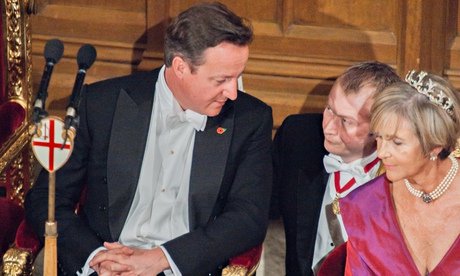
Senior Tories, including David Cameron, were forced to rush back from the Lord Mayor’s dinner wearing white tie, while supportive backbenchers engaged in a US-style filibuster in the Commons to ensure the government was not defeated.
After narrowly winning the vote called by Labour, the government won the overall motion in favour of the EU justice and home affairs measures, with only 36 MPs rebelling.
While some Tories are angry with their leadership, others are likely to blame Bercow for making the ruling. A senior Tory source said it was obvious that May considered the vote to be on the arrest warrant, as she had been publicly making the case for why it was needed.
The source said it was “bemusing” that anyone could consider it to be anything else and Labour had simply been playing politics. May had informed Bercow on Sunday of how the motion would be put and had not met any objection, the source added.
Cooper pointed out that the prime minister promised only a few weeks ago in the Commons: “I am not delaying a vote on it [the arrest warrant]. There will be a vote on it.”
May had also written to Cooper at the weekend, saying: “Dear Yvette, let me be absolutely clear: Monday’s debate and vote in the House of Commons will be a debate and vote on the whole package of 35 measures – including the arrest warrant – which the government wants the UK to remain part of in the national interest.”
Bill Cash, the Tory chairman of the European scrutiny committee, said it was a “travesty of our parliamentary proceedings” and completely unbelievable that May could argue the motion was about the warrant.
Damian Green, a Tory former Home Office minister, suggested the lack of a vote on the warrant could leave it open to legal challenge, while Sir Menzies Campbell, the former Liberal Democrat leader, suggested the motion should be withdrawn and reworked.
Jacob Rees-Mogg, a Tory rightwinger, said the government was taking the “way of tyranny” by stopping the Commons from holding the executive to account.
Ukip argued that the incident showed the government could not be trusted to hold a referendum on whether the UK should remain a member of the EU.