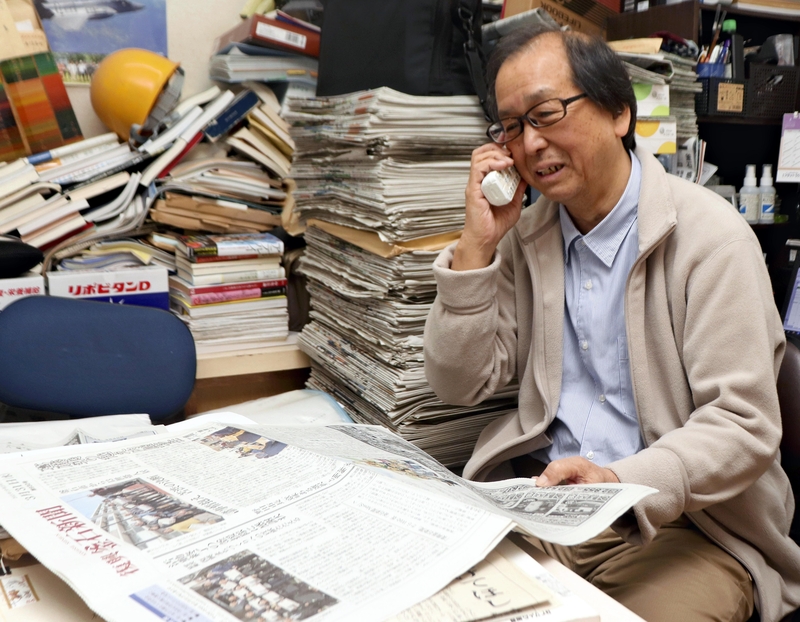
MORIOKA -- A local newspaper started in Kamaishi, Iwate Prefecture, in the direct aftermath of the Great East Japan Earthquake to keep survivors of the disaster informed brought its decade-long history to a close at the end of March.
The Fukko Kamaishi Shimbun, which continued carrying stories of the recovery efforts written by reporters who themselves had been victims of the tragedy, ceased publication due to declining circulation and other factors.
"In these 10 years, we regarded it to be our role to keep a record of the mood in Kamaishi along the way like a diary," said Shuichi Kawamukai, 68, who served as editor-in-chief.
On the morning of March 31, when the 930th and last issue had been distributed, the phones in the office did not stop ringing.
"It's sad that I won't be able to read it anymore" and "Thank you for all you have done," were common sentiments offered by callers.
In response to the voices from the readers, Kawamukai said, "Even in the age of the internet, I deeply felt that people wanted printed newspapers."
Kawamukai was a reporter for the Iwate Tokai Shimbun, an evening newspaper covering Kamaishi and nearby areas, when the massive earthquake hit on March 11, 2011.
He was interviewing children who had evacuated to high ground when he saw the tsunami approaching. The main office of the newspaper, located in the city center, was washed away, and its printing presses were lost. The paper had to shut down.
As he searched for a way to restart the newspaper, Kamaishi Mayor Takenori Noda, who had been a classmate of his, approached him with a request. "I want you to transmit information about the city through a newspaper," the mayor said. Amid the confusion in the wake of the disaster, it had been difficult to keep residents informed.
With two former Iwate Tokai Shimbun reporters and eight salespersons, Kawamukai founded the new company. In exchange for playing the role as the city's information outlet, the new venture was eligible for subsidies from the central government for three years
The Fukko Kamaishi Shimbun, comprised of four or six broadsheet-sized pages, was published twice a week with a circulation of 20,000, and was distributed free of charge to all households in the city.
The inaugural edition came out on June 11, 2011, three months to the day after the disaster, and carried the names of every resident who died in the calamity.
At the time, there was no other information source that listed the deceased, and Kawamukai made it his mission, saying, "First and foremost, we have to do that."
As time went on, the newspaper carried fewer articles about disaster victims. While reporters from many mass media outlets stuck microphones and voice recorders into the faces of bereaved family members, Kawamukai decided, "We're not going down that route."
Though Kawamukai's family had survived the disaster unscathed, his house suffered significant damage. Two former colleagues from the Iwate Tokai Shimbun were killed. There were current staff members who were still searching for missing family members.
He believed that it would be painful for readers to continue reading the newspaper if it only carried such hard-new stories as anecdotes from bereaved family members. As much as possible, he wanted stories and photos about people and communities that had a forward-looking spin.
This was epitomized when the 2019 Rugby World Cup came to town, with Kamaishi serving as one of the cities hosting matches. The newspaper reported on the city residents interactions with foreigners and the fervent atmosphere in the newly built rugby stadium.
There were pros and cons regarding to bidding to become a venue. But to Kawamukai, "This has given children a chance to have pride in their hometown."
However, once the World Cup ended, the paper saw advertising revenues plunge. The newspaper started charging for copies in 2014, and the circulation went into a steady decline, dropping to about 4,000 in the end.
Seven of the 10 employees are now 60 or older, and Kawamukai thought that 10 years would be a good demarcation point. Kawamukai has left the front line of the business, and other reporters will keep putting information on the website.
Even if Kamaishi is restored, "Survivors may feel that time has remained stopped at that day," Kawamukai said.
In a column that appeared in the final issue, he wrote, "I pray that the 'everyday things' recorded in our pages will have significant meaning 10, 20 years from now."
Read more from The Japan News at https://japannews.yomiuri.co.jp/