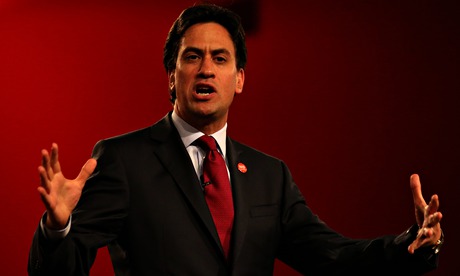
John Prescott is known both for plain speaking and for misspeaking, so his calling Ed Miliband “Red Ed” on the radio this morning is just as likely a slip of the tongue as it is a political judgment. But just how red is Ed?
His father was a Marxist scholar
Ralph Miliband was a Marxist sociologist who was considerably to the left of the Labour party that his younger son would go on to lead. His influence is obvious in Ed’s passion for politics; when the Daily Mail decided to attack Ralph as a man whose leftist views meant he “hated” Britain, it was enough to bring Ed out swinging.
Miliband’s closeness to his father is often used as a stick to beat him with politically, but the truth is, despite sharing a critique of the way modern capitalism works, Ed wants to save it from itself, not bring down the system.
He has a long history of activism
Miliband has said his favourite time at university was the four weeks when he was engaged in a rent dispute with his college. This history of activism may be more influenced by his mother, Marion, than his father. Despite being considerably to the left of the party’s current mainstream, she has stayed in Labour whereas Ralph left. That’s not to say this was always harmonious. Marion Kozak Miliband is a lifelong campaigner against Trident (an area where she differs with her sons). During the leadership contest Ed joked that she would probably be voting for Diane Abbott.
He was the choice of the unions
During the leadership contest, as it became clear that a Miliband was going to lead the party, the support of the unions swung behind Ed. Most of the major Labour affiliates backed him and it was this that won the day for him.
However, since then the relationship between the Labour leader and the unions has been more complicated. Len McCluskey, the leader of Unite – Labour’s largest affiliate – has criticised Ed for his approach to austerity and his opposition to a general strike. In the meantime, Ed has forced changes through the party that have altered the relationship between Labour and the unions in ways that some union leaders were less than thrilled about.
He wants to give away power and control
Miliband’s analysis of capitalism is not about the state v big business, as it is frequently caricatured. It is about where power lies and how to devolve it. Ed wants to win power in order to give it away. But then so says every politician vying for election. Anyone remember the big society? David Cameron’s wheeze has long since crumbled to dust in the face of ministerial power and trappings. So why should we believe it this time?
Well we probably shouldn’t. Or at least we should hold on to a reasonable amount of scepticism. All politicians need their feet held to the fire. And with great promises of devolution of power comes great accountability.
But so far, the Labour policy platform is showing real signs of this strand of leftist thinking. Bringing in new measures to control shocking rent rises (measures described by Grant Shapps as “Venezuelan-style rent controls”) is a key example of where Miliband has tried to shift the balance between the haves and the have-a-lot-lesses.
He likes lefty songs
On Desert Island Discs, Miliband’s best choices were Nkosi Sikelel’ iAfrika, which these days may be the uncontroversial South African national anthem, but in the 80s, when Ed was cutting his political teeth, was the anthem of the banned anti-apartheid ANC. Being anti-apartheid may have set you apart as a lefty in the 80s – proudly so for most of us – but now even Cameron is getting in on the act.
Another selection was the song of a union martyr, The Ballad of Joe Hill. Maybe one day we’ll be grown up in our attitude towards those who organise for workers’ rights and try not to read too much into a nice ditty about a man who was almost certainly wrongfully put to death.
Miliband also chose Take on Me by A-ha, which goes to show – well, nothing really. Except he was wrong to overlook the superior The Sun Always Shines on TV.
So just how red is Ed?
Miliband is neither as lefty as his critics from the right would have you believe nor as rightwing as his critics on the left argue. His is a gentle but systemic social democracy. His critique of capitalism is as much about the distribution of power as it is of money. He may – in fact – be the least statist leader the Labour party has had since its early days. He is not New Labour, but neither is he a return to the Bennite left. The shibboleths of many lefties – anti-Trident, rail nationalisation etc – have been resisted and rejected in favour of a more complex analysis of how to change our economy and the power structures within it.
Ed may be red, but he’s definitely a new shade of it.