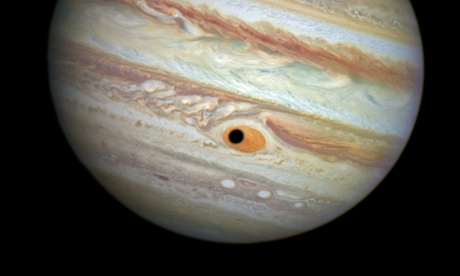
Eye of the storm: Nasa released this close-up of Jupiter and its Great Red Spot, taken by Hubble on 21 April as the shadow of the Jovian moon, Ganymede, swept over the 16,000-kilometre-wide storm.
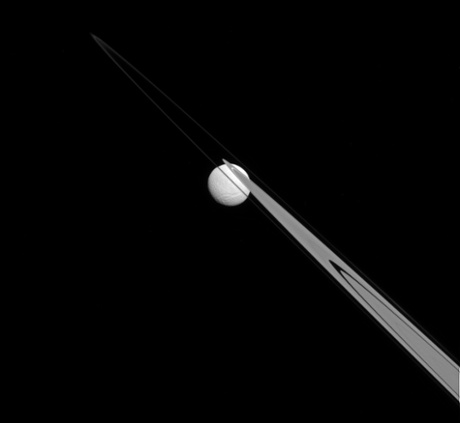
In another trick of perspective, Saturn’s moon Tethys appears to have been impaled on the planet’s A and F rings in this picture taken in visible light by the Cassini spacecraft. Both Tethys and the particles that make up the rings are primarily ice. The gap in the A ring through which Tethys is visible is the Keeler gap, which is swept clear by the moon Daphnis (not visible here). The picture was taken at a distance of approximately 1.8m kilometres from Tethys.
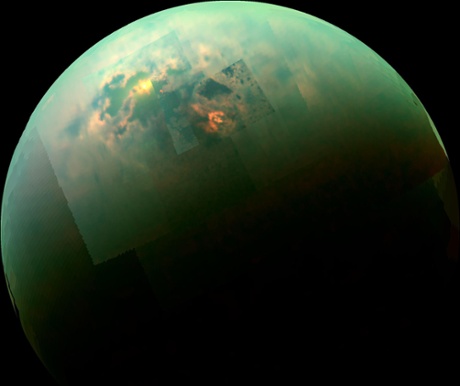
Bright sunlight reflecting off hydrocarbon seas near Titan’s north pole. The moon’s seas are mostly liquid methane and ethane. This new view, which shows Titan in infrared light, was captured by Cassini’s Visible and Infrared Mapping Spectrometer.
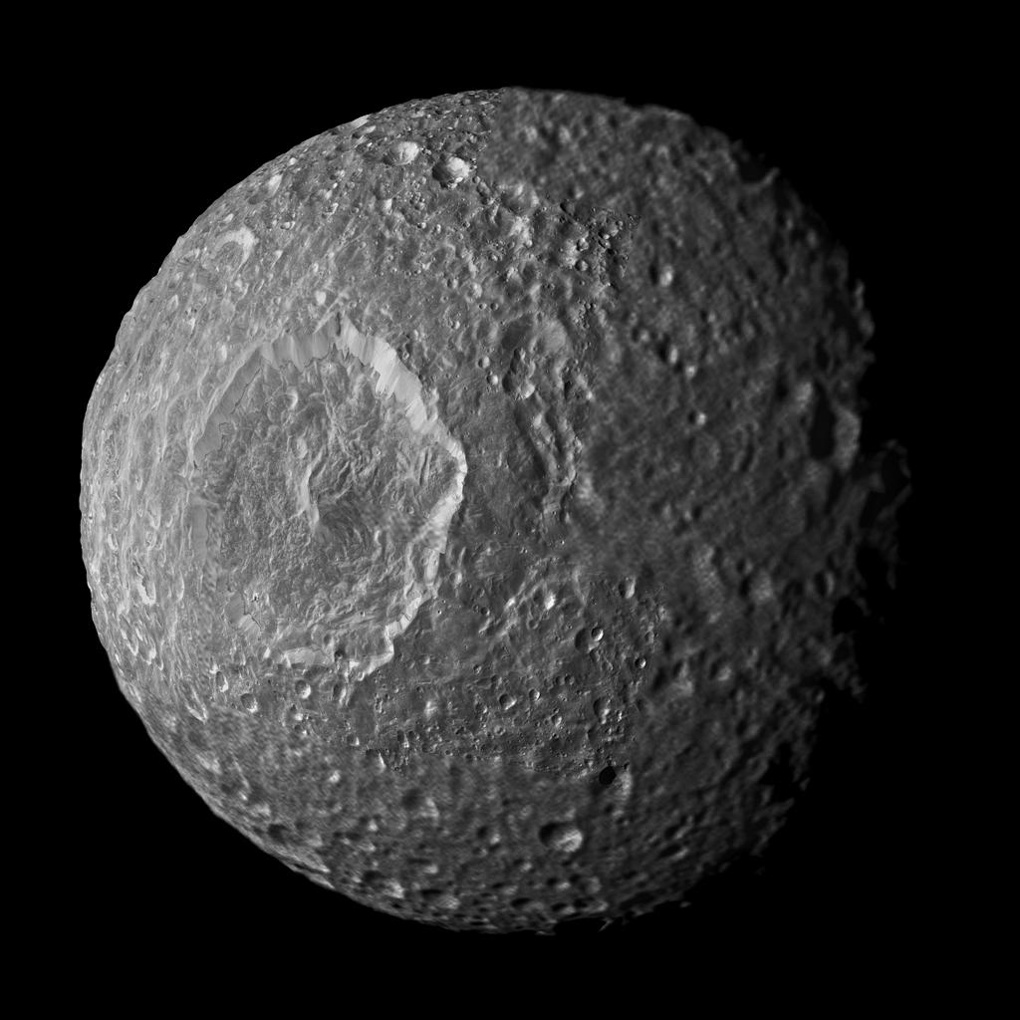
Astronomers used images of Saturn’s icy moon Mimas taken by Cassini to determine how much the moon wobbles as it orbits the planet. They concluded that either the moon has a frozen core shaped like a football, or it contains an ocean of liquid water.
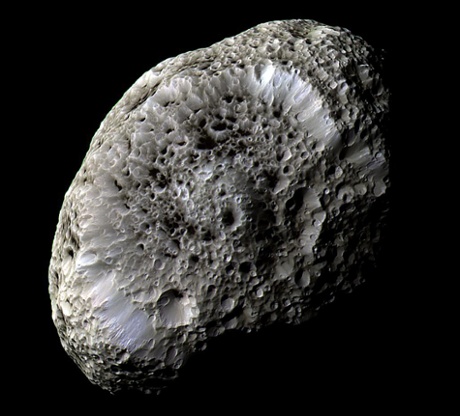
Saturn’s moon Hyperion, which looks a bit like a dirty ball of expanded polystyrene, is electrostatically charged. A new analysis of data from a Cassini flyby in 2005 found that the spacecraft was briefly bathed in a beam of electrons shooting from the moon’s charged surface. Our own moon is the only other astronomical body known to be electrostatically charged, but astronomers believe many objects, such as asteroids and comets, carry such a charge.
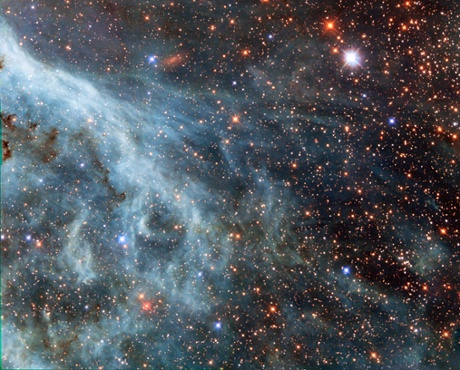
These glowing plumes of gas are part of the Large Magellanic Cloud, a relatively small galaxy that orbits our own galaxy, the Milky Way. This Hubble image shows part of the Tarantula Nebula’s outskirts.
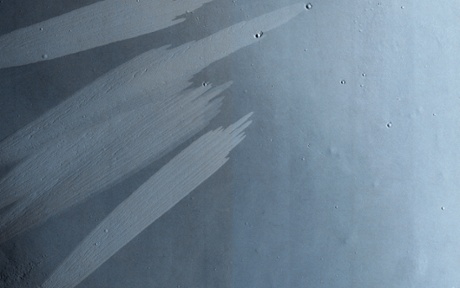
Bright and dark ‘slope streaks’ inside craters in the Arabia Terra region of Mars. The formation of slope streaks is among the few active processes know to be occurring on the red planet. The cause of the streaks is uncertain, with both dry and wet processes being proposed. The most popular theory is that the slopes form by gravity-driven, fluid-like movement of dry sand or fine-grained dust (analogous to an avalanche on Earth) exposing darker underlying material.
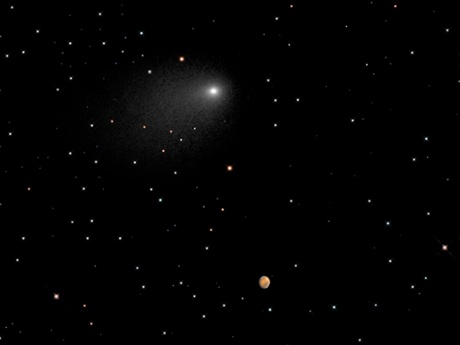
A photo composite of the encounter between Comet Siding Spring and Mars on 19 October. Separate Hubble images of Mars and the comet have been combined into a single picture. A single photographic exposure of the stars, the comet and Mars would be blurred because all the objects are moving relative to each other and Hubble can only track one target at a time. In addition, Mars is 10,000 times brighter than the comet, so its exposure here has been adjusted so that details on the red planet can be seen.
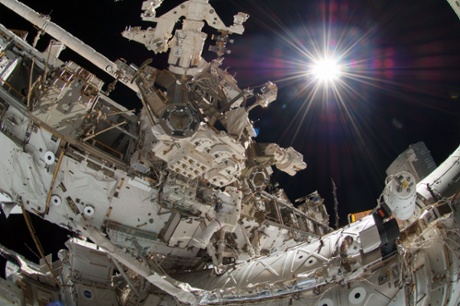
Nasa astronaut Reid Wiseman during a spacewalk on 7 October. For more than six hours, Wiseman and Esa astronaut Alexander Gerst worked outside the Quest airlock of the International Space Station to relocate a failed cooling pump and instal gear that provides backup power to robotics equipment.
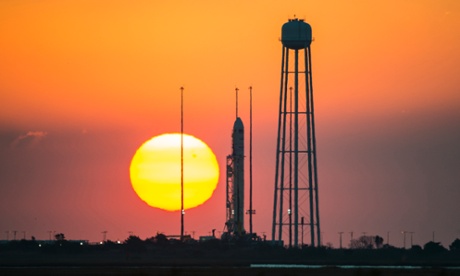
The Orbital Sciences Corporation Antares rocket, with the Cygnus cargo capsule onboard, on the launchpad at Nasa’s Wallops Flight Facility in Virginia as the sun rose on 26 October. The rocket was scheduled to launch the following day with the Cygnus spacecraft carrying more than two tonnes of supplies bound for the space station, including science experiments, experiment hardware, spare parts, and crew provisions. It exploded on take-off.
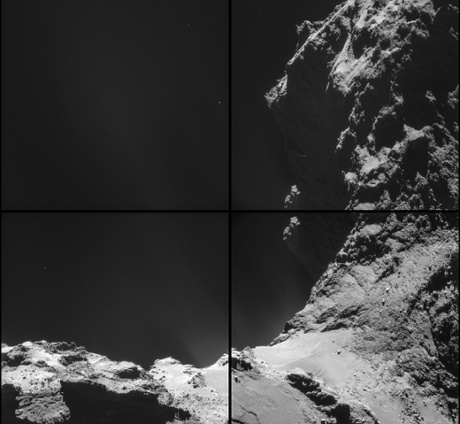
A montage of images taken by Rosetta’s navigation camera on 18 October from a distance about 7.8km from the surface of Comet 67P/Churyumov-Gerasimenko. The world watched agog on 12 November as the European Space Agency attempted to land its Philae probe on the comet. Despite the probe bouncing into a tight spot where its solar arrays were mostly in shadow, Philae sent back a wealth of data before its batteries died.
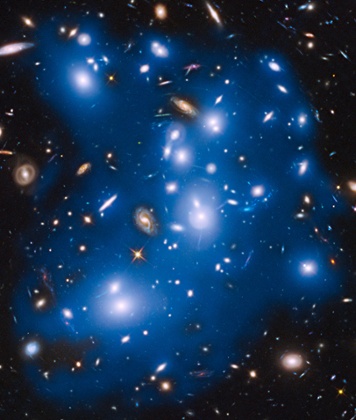
Hubble picked up the ghostly glow of stars ejected from ancient galaxies that were gravitationally ripped apart several billion years ago. The mayhem happened 4bn light-years away, inside an immense collection of nearly 500 galaxies nicknamed Pandora’s Cluster. No longer bound to any one galaxy, the scattered stars now drift freely. By observing the light from the orphaned stars, Hubble astronomers have assembled forensic evidence that suggests as many as six galaxies were torn to shreds inside the cluster over a period of six billion years.
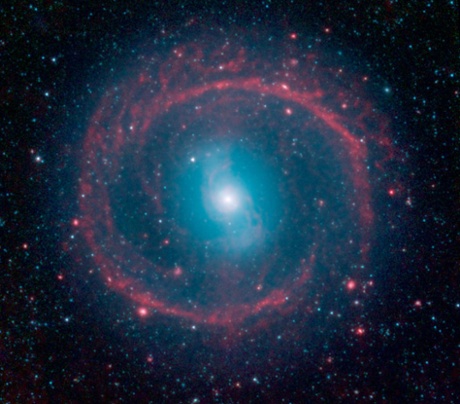
A new image from Nasa’s Spitzer Space Telescope, captured in infrared light, reveals where the star-forming action is taking place in galaxy NGC 1291. The outer ring, coloured red, is filled with new stars that are igniting and heating up dust, which glows with infrared light. The stars in the central area (blue) produce shorter-wavelength infrared light. This is where older stars live, having long ago gobbled up the available gas supply, or fuel, for making new stars. The galaxy is about 12bn years old and is 33m light years away in the Eridanus constellation.
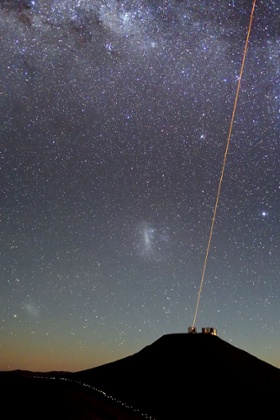
A laser beam cuts through the night sky from Unit Telescope 4 of the European Space Observatory’s Very Large Telescope in Chile. The two Magellanic Clouds are visible to the left of the beam as faint, fuzzy patches against the starry background. The particularly bright star to the right of the beam is Canopus, the second brightest star in our night sky after Sirius.
The beam is part of the telescope’s adaptive optics system, which compensates for the distorting effect of water vapour, pollution and turbulence in the atmosphere using deformable mirrors. The laser creates an artificial star about 90 kilometres from the ground. Astronomers can then measure how this fake star twinkles and correct for the distortion. At certain wavelengths, telescopes that use adaptive optics can produce images sharper even than those from space-based telescopes.
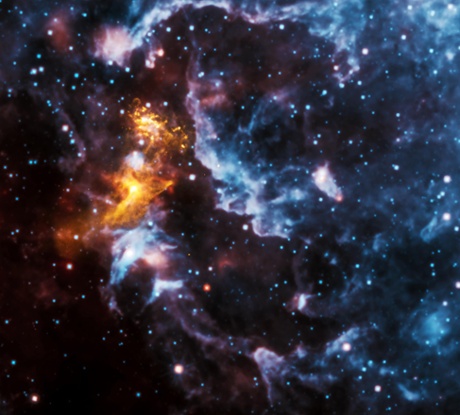
Pareidolia is the psychological phenomenon whereby people see recognisable patterns in clouds, rock formations, food – or space. When an image from Nasa’s Chandra X-ray Observatory of PSR B1509-58 – a spinning neutron star surrounded by a cloud of energetic particles – was released in 2009, it quickly gained attention because many saw a hand-like structure in the X-ray emission.
In this image of the same system, X-rays from Chandra (in gold) are seen along with infrared data from Nasa’s Wide-field Infrared Survey Explorer telescope (red, green and blue). Pareidolia has struck again because some report seeing an ethereal face in the infrared data. Spooky …
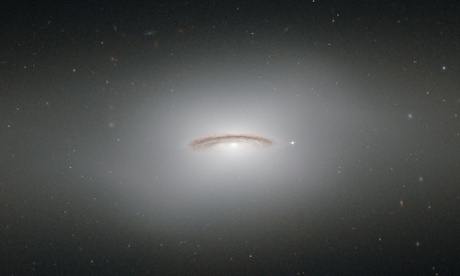
Galaxy NGC 4526 appears to hang like a halo in the emptiness of space in this image from Hubble. It is one of the brightest lenticular galaxies known and has a supermassive black hole at its centre with the mass of 450 million suns.
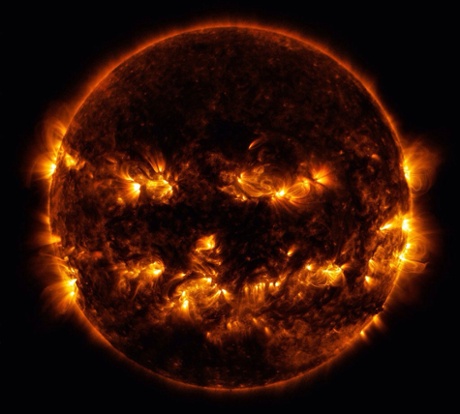
Pareidolia strikes again. On 8 October, active regions on the sun combined to look something like a jack-o-lantern made from a hollowed-out pumpkin. The active regions appear brighter because they emit more light and energy, reflecting the intense and complex magnetic fields hovering in the sun’s atmosphere or corona.




.jpg?w=600)