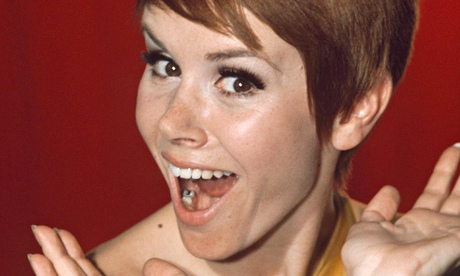
Comedians are often defined by one stock expression, from Jack Benny’s sighing “...well!” to Homer Simpson’s “Doh!” For Judy Carne, who has died aged 76, the phrase was “sock it to me” and every time she uttered it, or anything close to it, on America’s hit comedy sketch show Rowan and Martin’s Laugh-In, she would be doused in water, disappear down a trap door, or worse. The producer George Schlatter had appropriated the phrase from black musicians with whom he worked. It made Carne the show’s central figure, and put “sock it to me” into 1960s vernacular.
Carne was a vivacious singer and dancer whose rise to something close to stardom had been rapid in the US, and which Laugh-In wound up bringing to a screeching halt.
She was born Joyce Botterill in Northampton and grew up in Kingsthorpe, where her parents were greengrocers. Her talent was recognised early and she won a scholarship to the Bush Davies theatrical school in East Grinstead, West Sussex. At 17 she made her debut on stage under her new name, Judy Carne, in the revue For Amusement Only, and on television in The First Day of Spring (1956).
She appeared on the panel of Juke Box Jury, and in the sitcom The Rag Trade, and, according to her 1985 autobiography, Laughing on the Outside, Crying on the Inside, while still a teenager had already had affairs with Anthony Newley, Vidal Sassoon and Stirling Moss. “What a privilege,” she wrote in her autobiography, with more than a hint of irony.
Her film debut came in A Pair of Briefs (1961). A year later she was in Los Angeles starring as an English exchange student in the television series Fair Exchange. It was on a promotional tour for the show that Carne met Burt Reynolds. “We were immediately in love, so we immediately made love,” she recalled. They married in 1963, and divorced in 1966, amid mutual recriminations, including spousal abuse.
Carne moved directly to another show, The Baileys of Balboa, with Paul Ford and Sterling Holloway, and made her American film debut – billed as “Nameless Broad” – in Arthur Hiller’s classic The Americanization of Emily (1964).
In 1966 she began two seasons co-starring with Pete Duel in Love on a Rooftop, but broadened her talent thourhg acting in many television shows, including sitcoms such as I Dream of Jeannie, Gidget and The Farmer’s Daughter, but also in westerns such as The Big Valley, Bonanza and Gunsmoke. She appeared in The Man From U.N.C.L.E., and played English characters in three episodes of Twelve O’Clock High.
The pilot special of Laugh-In came in September 1967; the show was launched in January 1968 to immediate acclaim. Carne was part of an influential British contingent that helped shape Laugh-In. Along with her fellow actor Richard Dawson, they included the writers Barry Took, Jeremy Lloyd and Digby Wolfe. It was Wolfe who both gave the show its title, and, as a veteran of That Was the Week That Was in both Britain and the US, created its “look at the news segment”.
The show’s anarchic mix of one-liners and censor-testing satire was presided over by Dan Rowan and Dick Martin, a Las Vegas nightclub pair whose act derived from Dean Martin and Jerry Lewis. They stood in for their middle-American audience as chaos reigned around them and spent much of the time leering at the scantily dressed female cast, especially Carne. Laugh-In made her famous, but there were drawbacks. She became so locked into “sock it to me” she never had a chance to display her wider talents, and as Goldie Hawn’s role in the show expanded Carne chafed, leaving the show midway through the third season.
Hawn would quit after the third season, moving on to bigger things, and Carne found herself not only typecast but also labelled as irresponsible for the manner of her departure. She found other television series closed to her and returned to the stage, notably starring on Broadway as Polly in The Boyfriend, and touring with musicals, while doing daytime television game shows.
Her autobiography detailed other affairs, with Steve McQueen and Warren Beatty, and a long-term relationship with a woman. She had a brief marriage to Robert Bergmann, a would-be producer. Reynolds, who lent her steady support, brought her on as a guest the first time he hosted The Tonight Show, but work became sparse. By the late 1970s Carne was addicted to heroin, and was noticed only when she was arrested, on drug possession or theft charges, or hospitalised after an overdose.
In 1978 she was celebrating her acquittal on charges of heroin possession when she and Bergmann crashed a car he was driving, and she broke her neck. Charged with drug possession and forging prescriptions the following year, she jumped bail.
Eventually she returned to Northamptonshire, to the village of Pitsford, where in 1985 she completed her autobiography, co-written with a companion, Bob Merrill. Once again called Joyce, she lived quietly in the village and best known for walking her dogs.
• Judy Carne, actor, born 27 April 1939; died 3 September 2015
• This article was amended on 10 September. The director of The Americanization of Emily was Arthur Hiller, and not Billy Wilder.