
South Pacific
A very early memory of mine – I was maybe six or seven – was going to see a production of South Pacific that my dad was in. My dad was president of the Accrington Amateur and Operatic Dramatic Society for 35 years or more. Weirdly enough, my memory is not of the show itself, but of going backstage and experiencing that atmosphere for the first time. I remember seeing these impossibly glamorous women with feathers on and smelling beautifully of perfume, and going into the men’s dressing room where my dad was leading the chorus in a singalong. It was just this highly charged, very powerful, fully sensory experience that I will never forget. I did my earliest performance at the age of three – not professionally, I hasten to add – so I was already getting up in front of people and showing off, but there was something about that backstage experience that really cemented the feeling that I wanted to be part of this.
Macbeth
I used to go to the Royal Exchange in Manchester a lot. That was our theatre when I was growing up. My parents used to take me when I was a kid, and it’s still probably my favourite theatre in the world. It’s just absolutely gorgeous and an amazing space to play. Back in the 80s, it was without question the best theatre outside London. Its reputation at that time was second to none. I remember going to see a production of Macbeth with David Threlfall – this was pre-Shameless, he wasn’t a name by any stretch at that stage. Frances Barber played Lady Macbeth. They had such an incredible chemistry together. It was set in a Holocaust-era concentration camp; it was the camp inmates doing a production of Macbeth. It was unbelievably haunting and powerful.
Richard II / Richard III
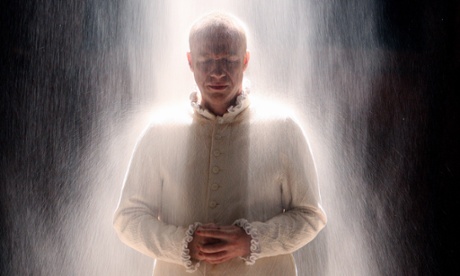
Two productions of mine that were game-changers in a way, and hugely influential on me, were the Histories that I did for the RSC. We did all eight History plays, from Richard II to Richard III, and I bookended the season with those two very different roles. That’s probably, to this day, the most fantastic theatrical experience I’ve had. Two and a half years, one company, one director, eight plays. It was really incredible. Michael Boyd had just taken over the RSC, and there was a feeling that it had become quite a sexy place to work again, which maybe it hadn’t been for a while. His vision for the Histories was incredible. We had a fantastic cast and I was playing two of the greatest roles ever written, which were also almost antithetical. You have Richard II, who’s this kind of glamorous aesthete; this beautiful, shallow, superficial, vain man who believes in the divine right of kings and believes that he’s God’s right-hand man on earth. And then you’ve got Richard III, who is a deformed, twisted man, with an incredible self-loathing because of the way he looks, which is a big part of who he is. To explore that kind of range was an incredible privilege.
August: Osage County
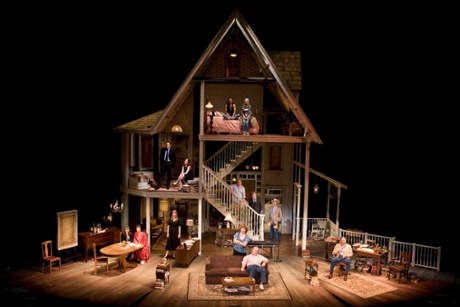
August: Osage County at the National Theatre was this incredible story about a very dysfunctional family. It had an incredible set that was basically a house dissected - it was like a house had been cut in half vertically, so you could see into all the floors of the house and all the rooms. It was a beautifully written, phenomenally well acted piece of theatre that I saw two or three times. What was so brilliant, in this world of celebrity culture where theatre shows all have faces that people recognise from TV, to sell tickets, was that I didn’t know anybody in it at all. They were all US actors from the Steppenwolf theatre company – and they weren’t TV or film stars either, they were theatre actors. I didn’t recognise any of them, but it didn’t matter. In fact in many ways, that added to it, because I wasn’t filtering the experience through having seen them in anything else. Every single performance in it was absolutely immaculate.
Urinetown
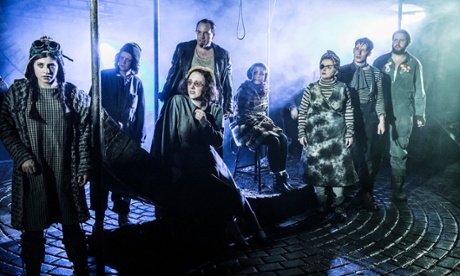
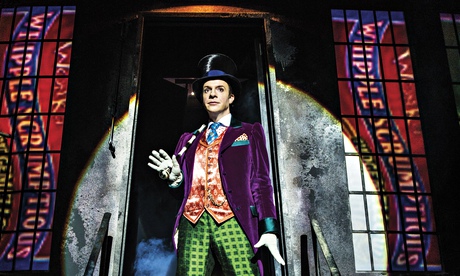
The other production that was a game-changer for me was Urinetown. I’d never done a musical professionally before, and I think the reason I’m playing Willy Wonka now is that I opened that door last year with Urinetown. Suddenly a whole new world opened, which I wasn’t necessarily anticipating, but I’m enjoying every minute. I’d just done 10 years of Shakespeare, and I wanted to do something completely different. Jamie Lloyd, who was directing Urinetown, got in touch and wanted to see me for it. To be honest, I didn’t take it very seriously at first, because I thought they’d find somebody who’s a much better singer than me. I can hold a tune, but I’m not a singer, and there are plenty of actors out there who have got really amazing voices. I thought, “Well, I’ll just go along for the ride and it will be a good experience to do some very different auditions.” Then I just kept on getting closer and closer to it and then I was offered it. Fortunately for me, it was a relatively gentle easing into the world of musicals, because I was playing the narrator, and he has only three or four lines to sing on his own; the rest is all ensemble singing. I think I needed that year of Urinetown, and exploring what my voice was. I don’t think I could have played Willy Wonka a year and a half ago; I don’t think my voice would have been up to it.
• Jonathan Slinger stars in Charlie and the Chocolate Factory at the Theatre Royal Drury Lane, London



