/An%20Intel%20sign%20out%20front%20of%20a%20corporate%20office%20by%20wolterke%20via%20Adobe%20Stock.jpeg)
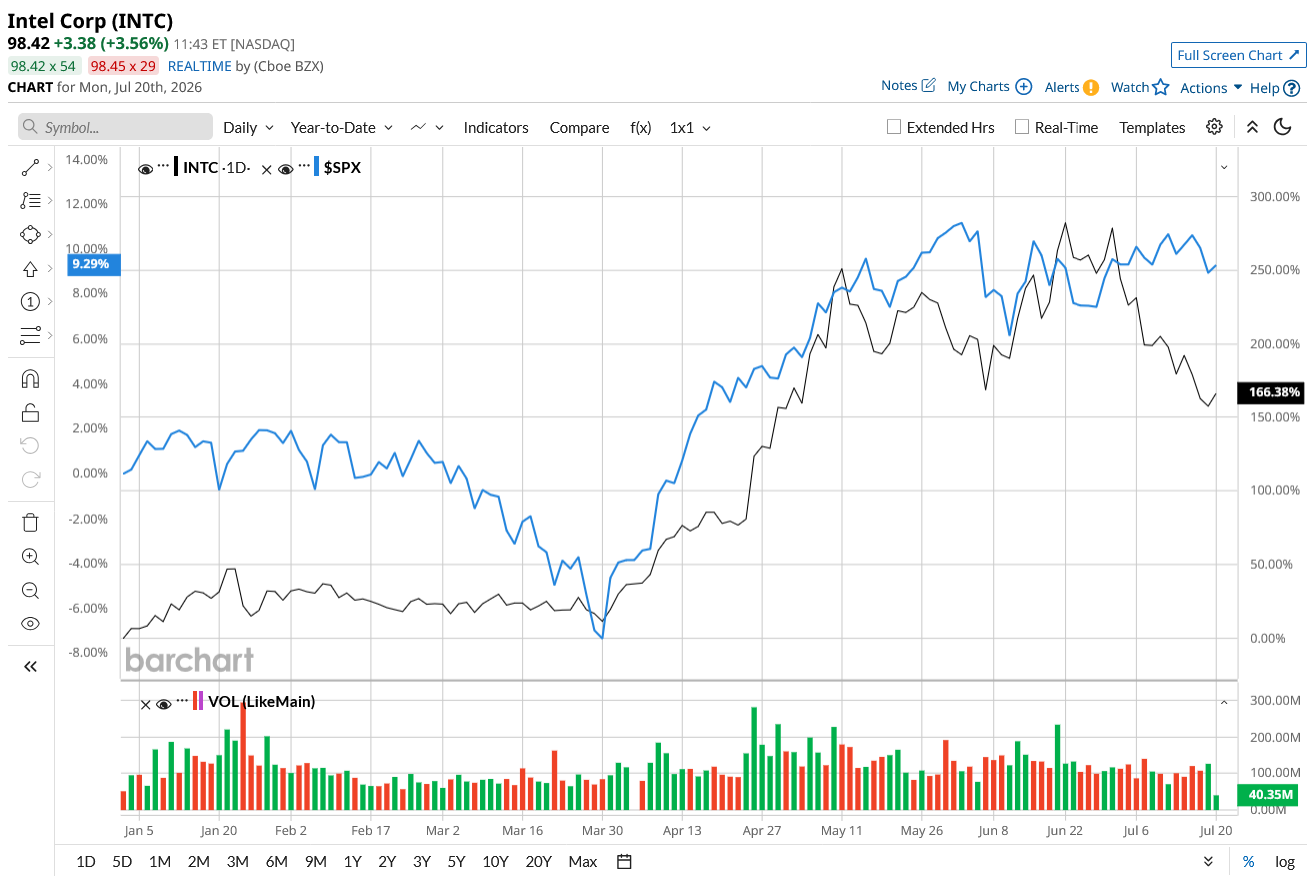
Jim Cramer recently put Intel (INTC) at the top of his list, calling it his "favorite stock" on CNBC's “Mad Money.” After staying on the sidelines for years during the AI boom, Intel has finally started to catch up with its peers. Amid the excitement of its most ambitious transformations, INTC stock has surged 165% year-to-date (YTD), surpassing the market’s 8.7% gain. However, Cramer’s optimism for Intel isn’t just based on its quarterly performance or its turnaround story. It is actually based on where the semiconductor industry is investing billions of dollars over the next several years and how Intel fits into it. Let’s dig into this deeper.
Why Intel's Relationship With ASML Matters So Much
Cramer is tying Intel's future directly to one of the most important companies in the semiconductor supply chain: ASML Holdings (ASML). Both companies sit at the very opposite end of the semiconductor chain but are closely linked. Specifically, ASML builds the lithography machines that semiconductor manufacturers use to print microscopic circuit patterns onto silicon wafers. Intel, as a chip designer and manufacturer, then installs them in its fabs to manufacture chips. Unlike companies such as Nvidia (NVDA) or AMD (AMD), which largely outsource chip manufacturing to Taiwan Semiconductor Manufacturing (TSM), Intel designs its processors and also manufactures many of its own chips in its fabrication plants. Over the past few years, Intel has been aggressively trying to regain leadership in semiconductor manufacturing after falling behind rivals like AMD, TSMC, and Nvidia.
In ASML’s second quarter, the company indicated that demand for advanced chipmaking is accelerating. According to the management, AI demand is pushing customers to invest in 3nm production for current AI accelerators, 5nm and 4nm chips supporting AI ecosystems, rapid ramp of 2nm technology, and early investments toward future 1.4nm nodes. This is resulting in increasing demand for advanced lithography systems more than expected. That’s the reason ASML increased its full-year 2026 guidance to between 43 billion euros and 45 billion euros. Intel, as one of ASML's earliest and third-largest clients, is well-positioned to benefit from this. These machines are expected to play a major role in future manufacturing technologies such as Intel's next-generation process nodes. According to ASML's management, Intel Foundry uses ASML's High-NA EUV technology on the Intel 18A process node to build a fraction of Intel Core Ultra Series 3 processors.
In fact, Intel’s CEO, Lip-Bu Tan, stated the same in the Q1 earnings call that Intel 3 Xeon 6 and Intel 18A Core Series 3 have become the fastest product ramps in five years. The company also stated that demand is so strong that even after increasing production, it still can't fully satisfy customers. AI is expanding beyond training into inference, physical AI, robotics, and edge AI, which Intel predicts will result in a $1 trillion total addressable market for semiconductors.
ASML also specified that its backlog continues to increase and customer visibility now extends multiple years. Furthermore, ASML reported that memory-related system sales are predicted to increase by more than 75% by 2026, EUV system sales by more than 45%, and advanced logic foundry-related system sales by more than 25%. As a result, if the entire industry is expanding leading-edge capacity, Intel's heavy investments no longer look excessive. These investments would ultimately boost Intel’s earnings. This is the reason Cramer believes Intel is investing at exactly the right point in the semiconductor cycle, as Intel’s future isn't just tied to AI accelerators. It also depends on foundry manufacturing, CPUs, networking, and broader semiconductor infrastructure.
Intel is set to report its second quarter earnings on July 23. Analysts predict an 11.6% increase in revenue to $14.4 billion, with an adjusted EPS of $0.22. For the full year, analysts now forecast a 164.4% increase in earnings, followed by an increase of 45% in 2027.
INTC Stock: The Bigger Picture
Jim Cramer’s support for Intel isn’t just about one quarter or its turnaround story. AI has created an investment cycle that extends well beyond GPU makers. Cramer believes Intel is well positioned to capitalize on the massive wave of AI-related semiconductor spending. Its close partnership with ASML, leadership under Lip-Bu Tan, aggressive foundry investments, and growing role in AI infrastructure have transformed it from a former semiconductor laggard into one of the industry's most closely watched turnaround stories. Whether Intel will prove him right remains to be seen.
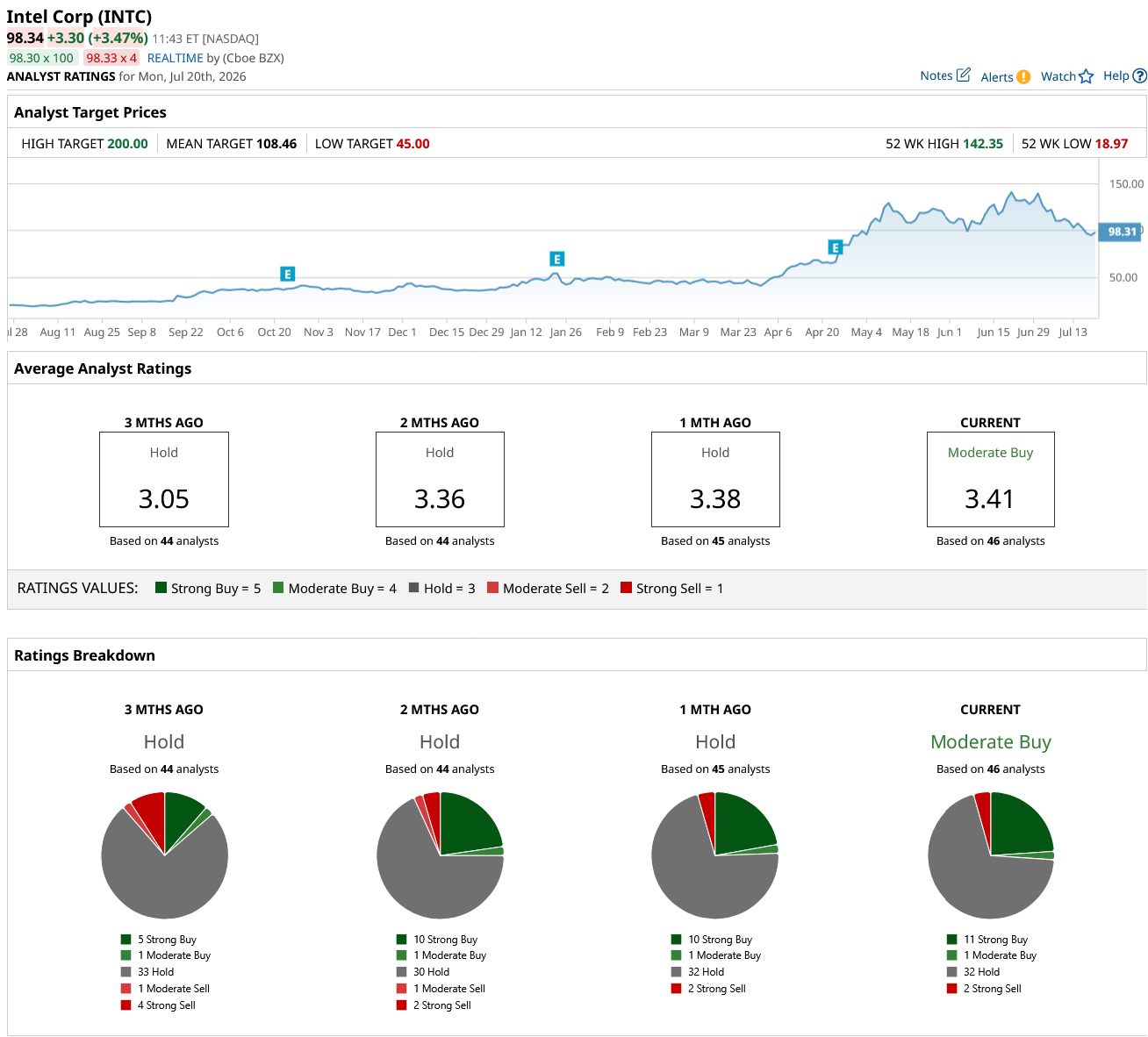
Overall, Wall Street maintains a consensus “Moderate Buy” rating for INTC stock. Of the 46 analysts covering the stock, 11 rate it a “Strong Buy,” one says it is a “Moderate Buy,” 32 rate it a “Hold,” and two suggest it is a “Strong Sell.” INTC is just 9% below its average target price of $108.46. However, its high price estimate of $200 implies an upside potential of 104% from current levels.