With the comprehensive spending review looming at the end of November, public leaders and their management teams are poring over their spreadsheets, crunching the numbers and weighing up potential cuts.
In the face of deciding which services and policies to proffer as sacrificial lambs, what happens down on the Brighton seafront at the Labour party conference runs the risk of feeling a bit irrelevant. But as the Guardian’s public services editor, David Brindle, has pointed out, Corbyn’s Labour party has got to have meaningful things to say to public services leaders across the UK if it is to be a credible opposition.
“I firmly believe that leadership is about listening,” Corbyn told the conference on Tuesday, in his leadership speech. That will need to include listening to those responsible for delivering local government services, health, social care, policing and social housing. Those leaders are anxiously trying to work out what November’s comprehensive spending review will mean for their services.
Corbyn also said that Labour will unapologetically challenge austerity, although shadow chancellor John McDonnell has said the party will manage the economy carefully. Corbyn and shadow housing minister John Healey have both set building more council houses as a cornerstone an important part of a Labour policy of public investment for growth. On Monday, Healey announced that the state could build 100,000 new council houses and housing association homes a year to drive down the UK’s spiralling housing benefit bill and tackle the affordability crisis.
How, many public leaders will be wondering, will Labour square this circle? The party’s view of business and its role in providing public services will be crucial, and there have been some interesting straws in the wind during the Brighton conference.
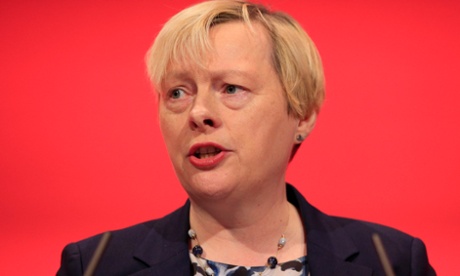
Labour may have decided to support renationalisation of the railways and the biggest surge in social housebuilding since the 1970s, but it is not jettisoning the use of private firms in public services. For instance, even though Corbyn will be at a rally in Manchester on Monday on the future of postal services, Labour does not propose to reverse the sell-off of Royal Mail. Shadow business secretary Angela Eagle told the party conference on Monday that Labour would be “pro-business and pro-worker” and Corbyn, in his leader’s speech, talked about the party’s support for small businesses.
There is a fine line for Labour here, if it wants to encourage partnership between public and private providers. On Friday, John Cridland, director general of the employers’ organisation the CBI, said devolution of power to local regions presented more opportunities for tackling tough issues through better coordination of services.
Calling for private businesses to play a larger part in changing public services, Cridland said councils were too concerned about who delivered services, rather than what they delivered – a claim rebutted by local government experts.
The former head of the civil service and new president of the Local Government Association, Lord Kerslake, pointed out that that in recent years, local government has made as much progress as any part of the public sector in making services more efficient. That has included widespread use of private firms, but Kerslake said the public still does not see the benefit of outsourcing public services, despite many years of privatisation.
“I favour a mixed-market approach but the truth is that it isn’t always right and it doesn’t always work, and when it goes wrong it can be very hard to put right,” Kerslake told the Guardian Public Leaders Network.
Kerslake, a former chief executive of Sheffield city council and former permanent secretary in the Department for Communities and Local Government, who has just been appointed by Labour to lead a review of the work of the Treasury, said that politically, people seemed unable to move beyond two polar views.
“Either they think the private sector is always better or they think it is wrong in principle to use the private sector for public services,” he said. “The truth is more complex. Good commissioning and a strong market can deliver real value. Poorly managed and under-resourced tendering is invariably a costly disaster. Interestingly, despite many years of public private partnering the public are still to be persuaded of its benefits.”
Last November the FT published research showing that private contracts for public services had almost doubled during the first four years of the coalition government. From 2010 to 2014, the government spent £88bn on privatised services, compared to the £45bn spent on outsourcing in the previous four years under Labour.
Rob Whiteman, chief executive of the Chartered Institute of Public Finance and Accountancy and former chief executive of the London borough of Barking & Dagenham, said councils are split over privatisation. “Interestingly half of councils are telling us that using the market more to provide services forms part of their efficiency plans for the next five years, but an equal number tell us that they are bringing some services back in-house to form new council-owned commercial ventures, often in collaboration with other councils, because they do not feel they have got full value from the market,” he told the Guardian.
Sign up here for your free weekly Guardian Public Leaders newsletter with news and analysis sent direct to you every Thursday. Follow us on Twitter via@Guardianpublic







.jpg?w=600)