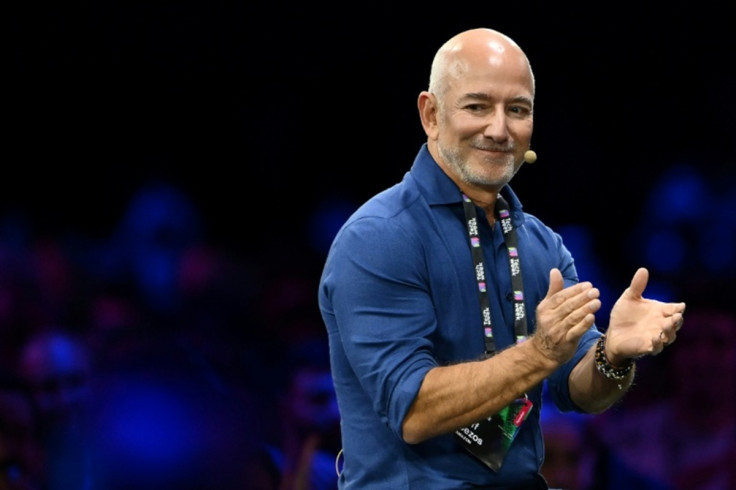
Jeff Bezos has stepped directly into the fierce debate over American economic inequality with a startling new policy proposal. Speaking during a major television broadcast this week, the Amazon founder argued that the current system places an unfair burden on everyday workers who are simply trying to get by.
His intervention has reignited discussion about whether the nation's fiscal framework disproportionately penalises those at the bottom of the income scale. Bezos' remarks, delivered on CNBC's 'Squawk Box', have already sparked political backlash and renewed calls for reform.
Proposed Income Tax Exemption
Amazon founder Jeff Bezos made an unexpected appeal on Wednesday, suggesting that the lowest-earning half of American workers should be completely exempt from income tax. During an appearance on CNBC's 'Squawk Box', the company's executive chairman pointed out that these individuals provide only a tiny fraction of the government's overall funding, making any demand for payment from them fundamentally illogical.
During a discussion with CNBC presenter Andrew Ross Sorkin, Bezos cited several statistics to explain his view of the nation's fiscal structure. He noted that the wealthiest one percent of citizens are responsible for nearly 40 percent of total government tax collection, whereas the entire lower half of the population accounts for a mere three percent.
Relief for Struggling Workers
His stance was unmistakable, suggesting that the three percent contribution ought to be wiped out entirely. Bezos argued that 'when people are starting out and they're struggling, stop taxing them. We don't need it. We live in the wealthiest country in the world.'
He also connected the debate to everyday life by highlighting a fictional healthcare worker making $75,000 (£56,000) annually. 'We shouldn't be asking this nurse in Queens to send money to Washington,' he said. 'They should be sending her an apology. It really makes no sense.'
To provide perspective, data from the Tax Foundation shows that the lower half of American taxpayers recorded an adjusted gross earnings figure of just under $54,000 (£40,200) during 2023. Meanwhile, households sitting within the wealthiest one percent took home a minimum of $676,000 (£503,400) over that same twelve-month period.
Billionaire vs. Working Class Relief
Expecting the inevitable criticism, Bezos confronted his individual circumstances head-on. He pointed out that his own federal payments amount to billions of dollars, effectively separating his personal financial contribution from the wider debate surrounding taxation on the ultra-rich.
"People sometimes say that I don't pay taxes. It's not true. I paid billions of dollars in taxes," says @JeffBezos. "That's not going to solve the problem. You could double the taxes I pay and it's not going to help that teacher in Queens." pic.twitter.com/NIaHKQgoC5
— Squawk Box (@SquawkCNBC) May 20, 2026
He took a subtle swipe at politicians campaigning for higher levies on the wealthy, saying: 'You could double the taxes I pay, and it's not gonna help that teacher in Queens. I promise you.' That specific remark struck right at the heart of an active political dispute inside New York City.
Local Backlash and Policy Friction
Mayor Mamdani, who won his election after campaigning heavily on a promise to lower living costs for everyday residents, was quick to challenge that assertion. He hit back on X with a brief yet sharp reply: 'I know a few teachers in Queens who would beg to differ.'
I know a few teachers in Queens who would beg to differ. https://t.co/JEnRnM2xII
— Mayor Zohran Kwame Mamdani (@NYCMayor) May 20, 2026
The back-and-forth intensified a friction that has increasingly come to characterise the political landscape of New York. Mamdani has been campaigning vigorously for a fresh levy on luxury secondary residences, commonly referred to as a pied-à-terre tax, aimed at estates valued at five million dollars and upward.
Jeff Bezos on NYC Mayor Zohran Mamdani's proposed pied-à-terre tax: "I think that the pied-à-terre tax is a fine thing for New York to do." pic.twitter.com/dsWrk07V6R
— CNBC (@CNBC) May 20, 2026
He has maintained that the policy could generate roughly $500 million (£372 million) each year for public amenities, whereas the city's financial watchdog has estimated a lower return of between $340 million (£253 million) and $380 million (£283 million) a year once affluent homeowners alter their habits.
Bezos expressed that he has no issue with the secondary residence levy itself, describing it as a perfectly reasonable move for the city to make. His dispute with Mamdani focuses less on that particular policy and more on the wider notion that raising levies on billionaires will significantly upgrade the living standards of everyday working residents.
True Cost of Queens Educators
Grounding the shared references to Queens educators in actual data reveals a clearer picture of the local economic landscape. By September 2025, entry-level compensation for New York City instructors reached $68,902 (£51,310) for individuals holding a bachelor's degree without prior classroom experience, while those possessing a master's degree started at $77,455 (£57,680).
Official figures from NYC Public Schools indicate these rates are scheduled to climb to $71,314 (£53,106) and $80,166 (£59,698), respectively, in September 2026.