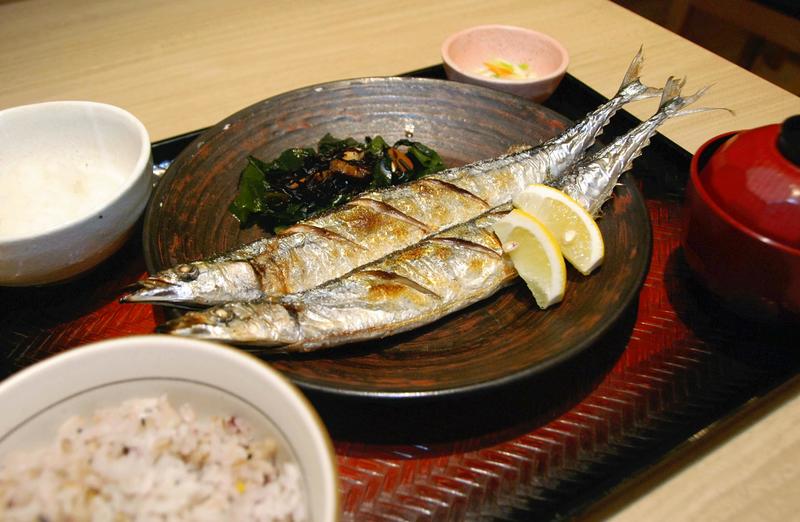
Sanma saury and sardines are gaining popularity among consumers across the nation this season, which has seen a bountiful catch of both fish.
Their affordable prices and reputation as a "substitute healthy food" for mackerel, which is in short supply, have been pushing up sales at restaurants and retail stores.
According to the Japan Fisheries Information Service Center (JAFIC), the volume of sanma saury caught from January to September stood at about 39,000 tons, up about 90 percent from the previous period last year. The volume of Japanese sardines was also the highest in five years.
Ootoya Holdings Co., an operator of chain restaurants, promotes "a set menu of charcoal-grilled sanma saury from off Nemuro" (one sanma saury per serving) as an autumn delicacy.
Since Oct. 3, the operator has marked down the price to 940, yen cut by 40, yen as the purchase price of sanma saury has been lowered by 20 to 30 percent thanks to the bountiful catch of the fish.
Canned sardines are also selling well at supermarkets -- canned sardines priced at 108 yen a can are stacked high at supermarket Akidai Sekimachi Honten in Nerima Ward, Tokyo, with their sales volume hitting a 20 to 30 percent increase from the previous year.
According to an organization of a related industry, the total volume of canned fish produced in 2017 was 99,000 tons. Of the volume, canned mackerel accounted for 40 percent and canned tuna for 34 percent, while sanma saury was 10 percent and sardines were 5 percent of the total.
The amount of canned sardines sold from April to August this year is expected to increase by 50 percent from the previous year, and it appears that canned sardines and sanma saury will have a greater presence at the dining table.
Blue-backed fish such as sanma saury and sardines are rich in docosahexaenoic acid (DHA) and eicosapentaenoic acid (EPA). DHA and EPA are said to prevent a hardening of the arteries, which is one example of lifestyle-related illnesses. They are also said to be effective in lowering neutral fat levels.
On the other hand, mackerel are in short supply, even though the fish has been popular due its low price and simple taste for several years.
JAFIC statistics indicate that the volume of raw mackerel catches from January to September was about 340,000 tons, up about 20 percent from the previous period last year.
However, the domestic supply of mackerel is becoming tight as African countries have ramped up imports from Japan, seemingly due to tightened control over mackerel catches due to conservation in Europe, which African countries have relied on for imports of the fish so far.
Read more from The Japan News at https://japannews.yomiuri.co.jp/