The Trans-Pacific Partnership trade deal came into effect Sunday, slashing tariffs on a wide range of imported agricultural products that will likely bring cheer to the wallets of consumers in Japan through cheaper beef and other goods.
However, the domestic agriculture industry will face stiffened competition from cheaper imports, and it remains unclear if the TPP will lead to increased exports of automobiles and other Japan-made products.
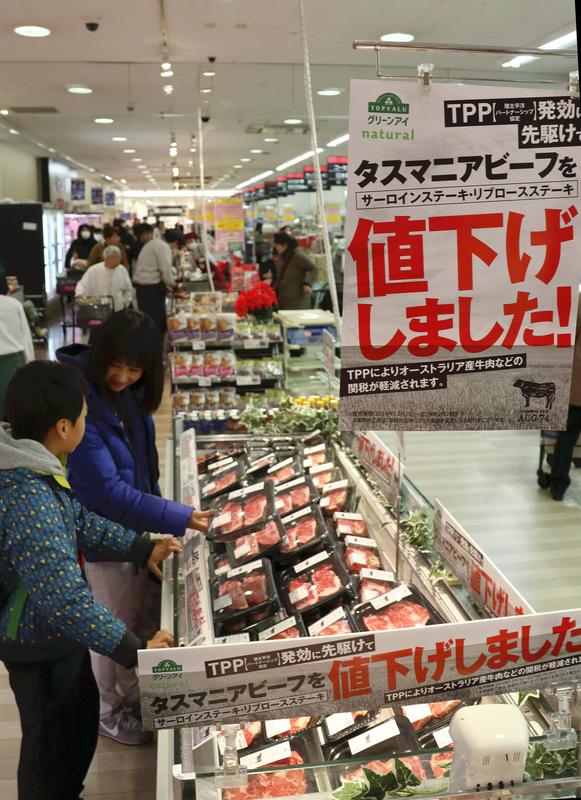
Aeon Co., a major supermarket operator, held a special sale at about 400 of its stores earlier this month to publicize the benefits TPP would bring to shoppers.
"We've cut the price of Tasmanian beef before the TPP comes into effect," read one sign displayed at the Aeon stores. From Dec. 7, Aeon trimmed the price of two Australian beef products by up to 20 percent during the sale. For example, sirloin steak, which previously cost 598 yen (about 5.4, dollars excluding tax) per 100 grams, was reduced to 480 yen (about 4.4 dollars).
Japan's tariff on imported beef was slashed from 38.5 percent to 27.5 percent when the TPP came into force, and this will be lowered to 9 percent in the 16th year. The tariff on imported Australian beef had already been lowered to 29.3 percent for chilled beef under the Japan-Australia economic partnership agreement, but an Aeon official said the campaign aimed to boost sales of the meat.
"We want the TPP effectuation to become an opportunity for many people to readily try Australian beef," the official said.
Sales of Australian beef at Aeon stores reportedly increased by about 20 percent compared with before the special campaign.
"It's easy to afford at that price," a 43-year-old company employee said as she shopped at an Aeon store in Urayasu, Chiba Prefecture. "I can more put beef on the table, not only for special days."
The TPP also cuts tariffs on several kinds of fruit. The 6.4 percent tariff on kiwifruit has been immediately axed, which is estimated to bring a savings of several dozen yen on types of kiwifruit that retail for about 1,000 yen (about 9 dollars) for 10 of the fruits.
Nearly 80 percent of kiwifruits available around Japan are grown in New Zealand. A spokesman for Zespri International (Japan) K.K., the Japanese arm of Zespri International Ltd., which produces and sells kiwifruits from New Zealand, has high hopes for the TPP.
"We'll figure out a price that is beneficial to both Japanese consumers and New Zealand kiwifruit growers," the spokesman said.
According to calculations by Atsushi Nakajima, chairman of the Research Institute of Economy, Trade and Industry, the reduction and elimination of tariffs under the TPP will cut household expenditures on food by about 1.5 percent to 2 percent in the first year and ultimately by about 5 percent. "The TPP could become a powerful ally of consumers," Nakajima said.
Meanwhile, it likely will take some time until the effects of the TPP start to appear in the food service industry.
About 40 percent of beef tongue imports come from TPP member nations such as Australia and New Zealand. The 12.8 percent tariff on tongue will be halved in the first year of the TPP coming into effect and abolished in the 11th year. However, an official at a beef tongue restaurant chain suggested that consumers should not expect prices to fall quickly.
"There are many unclear variables, such as the impact of exchange rates. Labor costs and other expenses aside from tariffs are increasing, so it's rather hard to tell whether prices would drop," the official said.
Domestic farmers face a blow
The increasing imports of cheap agricultural, forestry and fishery products will deal a heavy blow to Japanese farmers.
According to figures released in December 2017 by the Agriculture, Forestry and Fisheries Ministry, the TPP coming into force could slash the annual production value of Japan's major farm, forestry and fishery products by up to about 150 billion yen (about 1.36 billion dollars).
This is because accepting cheap agricultural, fisheries, and marine products from abroad will push down prices of their domestically produced counterparts. The impact is expected to be biggest in the beef sector, which is projected to lose up to 39.9 billion yen (about 360 million dollars) due to fierce competition especially with Australian meat. On milk and dairy products, a field in which New Zealand is a major producer, a drop of 31.4 billion yen is forecast. The agriculture ministry will take "defensive" support measures, such as offering subsidies to farmers whose incomes drop due to the TPP.
On the other side of the coin, the axing and reductions of tariffs applied overseas on Japanese food products also offer an opportunity for Japanese growers to go on the offensive and carve out new markets.
GRA Inc., an agricultural producer based in the town of Yamamoto, Miyagi Prefecture, exports high-end strawberries that can sell for up to 1,000 yen each, mainly to Southeast Asia. The TPP will eliminate strawberry tariffs that ranged from 4 percent to 20 percent in the member nations. "That will be a plus for us in terms of price competitiveness," a GRA official said.
The agriculture ministry has set a target of increasing exports of food, agricultural, fisheries and marine products to 1 trillion yen (about 90 billion dollars) in 2019, a 25 percent increase compared with 2017. The ministry plans to use the TPP as a springboard to boost exports.
Read more from The Japan News at https://japannews.yomiuri.co.jp/