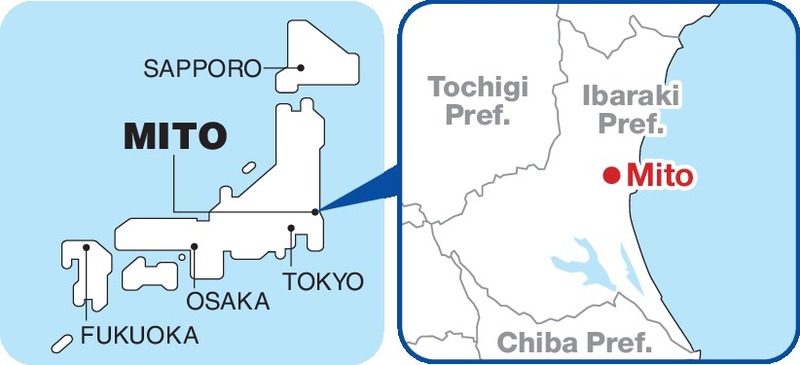
MITO -- Kairakuen, one of Japan's Three Great Gardens, is a well-known viewing site for ume blossoms. The garden boasts about 3,000 ume trees which can be classified into about 100 varieties, and the "Mito Ume Festival" -- an ume blossom viewing festival held every spring -- has a history spanning more than 120 years.
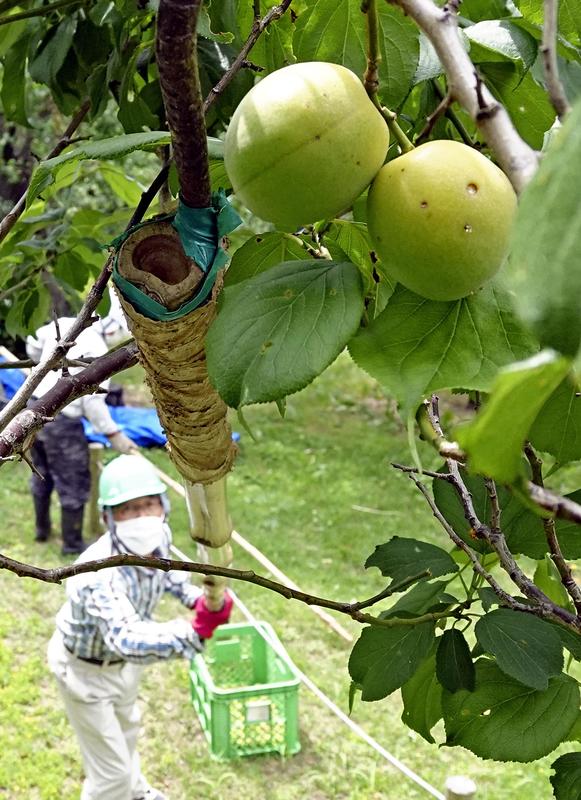
At an event held every June in Kairakuen, gardeners knock the green fruit from the trees by shaking the branches with bamboo poles. It is said that the purpose of this event is to provide nutrition to the trees and make it easier for them to bloom the following year.
But the fruit of the ume trees from Mito has only been produced only in small quantities and are rarely distributed despite the reputation of its beautiful blossoms.
"Many of the ume trees in Kairakuen are for viewing purposes," said Yoshikazu Ueki, an official of the Mito municipal government's farming promotion section. He added, "We have grown few ume trees for the purpose of harvesting fruit in our prefecture."
According to data compiled by the Agriculture, Forest and Fisheries Ministry, Mito ranked 169th in ume production nationwide with about 10 million yen shipped in 2018, after placing 193rd in 2017 with roughly the same 10 million yen value. While these rankings do not befit its reputation as an ume blossom viewing spot, the municipal government has made efforts to increase fruit production and promote it as their local brand, which are now beginning to bear fruit.
The initiative for branding such product was triggered in 2012 when the Mito municipal government, the Ibaraki prefectural government, farmers and companies that process ad distribute ume teamed up to establish a council on promoting Mito as an ume production center.
At the time, there were opinions among tourists visiting Mito that they "want to buy Mito-produced ume as a souvenir" while local food makers expressed a desire to "produce items from locally-produced ume."
With the slogan of "revitalizing the regional economy by dint of ume," the council aimed for stable production and distribution of the Shirakaga variety of ume, which selected for cultivation because it is well suited for processing. Wishing to bring in fortune, the council decided to adopt Fukuyui (written with the kanji characters for fortune and linkage) as the brand name for the product in Mito and promote it as a local specialty.
A total of 12 farming households began producing the brand-name fruit in 2012 and managed to achieve their first shipments in 2017. The planting area, which stood at about 1.62 hectares at the end of fiscal 2014, increased to about 2.7 hectares at the end of fiscal 2019. Accordingly, the range of consumption expanded as the number of products that use Fukuyui increased from 19 kinds of confectionery in fiscal 2017 to 28 kinds of items in fiscal 2019, including liquor.
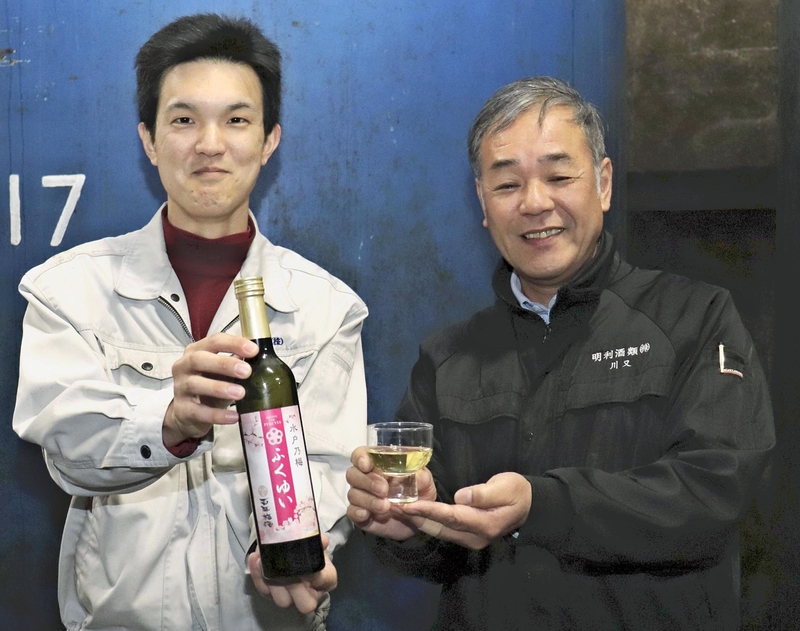
Meirishurui Co., a sake and shochu liquor brewing company in Mito, launched liquor made wholly from Fukuyui this year.
"We could finally realize our long-cherished dream," said the company's production department manager Masumi Kawamata.
The 55-year-old Kawamata and his subordinate Hiromu Kawasaki, 29, had tested Fukuyui liquor production since 2017. In the first two years, the company avoided using the brand name of Fukuyui because the fruit's shipment volume was small and other brands were blended, they said.
The company said that many of the buyers showed interest in the Fukuyui brand, despite having never heard of it before. Kawamata and Kawasaki expressed determination to expand the sales of the new brand liquor by highlighting features such as the acidity of the fruit itself to make it a classic souvenir of Mito.
The interest in edible ume has been spreading in the younger generation, too. Taisei Girls' High School in Mito has been developing new products since 2015 as part of its classroom and extracurricular activities. In fiscal 2019, the school blended the fruit harvested in Ibaraki Prefecture with green chilies to develop a seasoning that was sold at food stores throughout the prefecture.
Mito will continue its challenge of evolving into a new city of ume where visitors can enjoy both viewing blossoms and eating their fruit.
--Garden opens in mid-19th century
Kairakuen was built in 1842 by Tokugawa Nariaki (1800-1860), the 9th feudal lord of the Mito Domain, as a recreation spot for local commoners. Nariaki, who had long taken delight in viewing flowers, planted many ume trees at the site of the current garden for reasons including the fruit's health benefits.
The garden has been loved by the local people. The Mito Ume Festival began in 1897 after the railway link opened between Ueno Station in Tokyo and Mito Station. The garden came to gain fame as a viewing spot for ume blossoms.
Read more from The Japan News at https://japannews.yomiuri.co.jp/