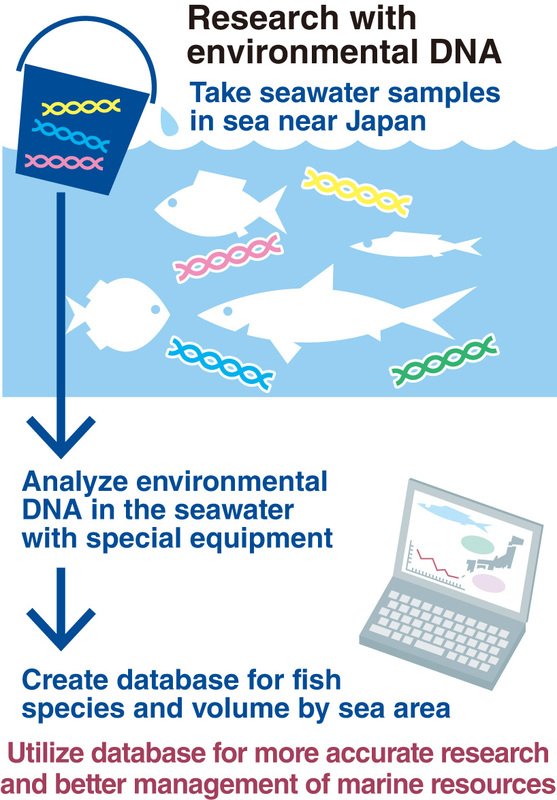
The Fisheries Agency plans to create a database for marine resources based on the environmental DNA of fish, which is genetic material that is left in seawater, according to sources.
The agency intends to collect seawater samples in the sea around Japan as early as this summer, and start to gather and analyze the data of environmental DNA necessary to specify the species and volume of fish.
Japan's fish catches are declining due to changes in the marine environment and overfishing. The agency's move is aimed at introducing restrictions on fishing based on more scientific data and leading to the protection of marine resources.
According to the plan, the agency will collect samples of seawater from the sea around Japan, including the Pacific Ocean, the East China Sea and the Sea of Japan, taking four years to gather the data. It will change the location, season and depth of the sea where seawater samples are taken to establish a more accurate research method.
The research results will be compiled based on different sea areas, such as naming them the "database on the Pacific Ocean" and the "database on coastal areas." They will be shared with researchers and those in the fishery industry.
In the future, the agency wants to use the analysis results based on environmental DNA as a criteria for fishing restrictions that the agency is imposing on such species as bluefin tuna, saury and Japanese flying squid, known as surumeika.
In general, research on marine resources is conducted by catching fish with a net or using fish sonar. This costs a lot of time and money, and there have been considerable variations in the survey results.
With the new research method focusing on environmental DNA, researchers analyze the DNA of fish that is left in the sea, which mainly comes from the mucus and droppings of fish.
If the characteristics of DNA included in the seawater samples match those of the DNA of a species of fish that has been detected by research in the past, it will be possible to specify the species living around the area in which the seawater samples have been taken.
"[The new method] is convenient and the accuracy is extremely high," said Satoshi Kameyama, a senior researcher at the National Institute for Environmental Studies.
The new method can also significantly reduce the time and cost for research and does not require catching fish, thus having the advantage of not having a negative influence on fish resources.
By creating the marine resources database based on the latest technologies, the agency intends to utilize the data analysis for a more precise future forecast of marine resources and more effective fishing restrictions, leading them to the recovery of marine resources, the sources said.
Read more from The Japan News at https://japannews.yomiuri.co.jp/