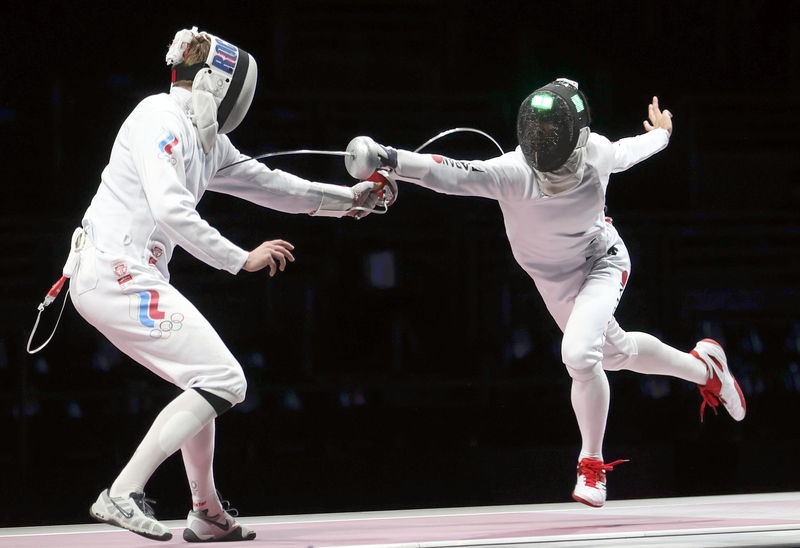
In the world of fencing, the epee is regarded as the "king" among the three swords because it has the most number of competitors in the sport's main stronghold of Europe.
Now Japan wears the crown.
The Japanese trio of Koki Kano, Masaru Yamada and Satoru Uyama won the gold medal in the men's team epee event on Friday night, defeating the Russian Olympic Committee 45-36 in the final at Makuhari Messe. Kazuyasu Minobu, who competed in an earlier match, also received a gold medal.
The medal was the first gold and third overall won by Japan in fencing, with the previous two coming in the foil. A 10-year program for the country to make its mark in epee paid off with the historic victory.
"I feel we have really taken a big step forward in the fencing world," Minobe, the 34-year-old team leader, said at a press conference on Saturday morning.
Japan came into the competition ranked No. 8 in the world, and it looked like it might not be around for long after struggling to defeat the United States in its opening match. But with reserve Uyama coming in from the next match and stepping up, the team steadily advanced against higher-ranked opponents to set up the showdown with the No. 7-ranked ROC.
"I gave everything I had on the piste so that I would have no regrets," Uyama said.
The key victory came against world No. 1 France in the quarterfinals. With the score tied 44-44, the next point scored between Kano and Yannick Borel would decide the match. Kano came through to complete the upset and keep Japan's unlikely run going.
Fencing as a sport was introduced in Japan in the early Showa era (1926-1989) by a returnee who had studied in Europe. From that time, the foil was the main sword of choice, as rules against stabbing the head and arms made it more a game of skill and suitable for smaller-built competitors.
The epee, which was introduced later, has no such limitations on what can be struck, meaning that arm length and other physical attributes can mean the difference between victory and defeat. As such, Japanese fencers tended to avoid it.
The sport gained its biggest boost in Japan when Yuki Ota won a silver medal in the men's individual foil at the 2008 Beijing Olympics, which was followed by silver in the team foil four years later in London. Riding that wave, Japan officials decided to embark on a program to increase player numbers and further make the sport known.
In 2010, the Japanese team invited a noted Ukrainian coach and, at the same time, began efforts to assess promising young fencers who might be more suited to the epee. Among those scouted was Yamada, when he was a junior high schooler with long arms and agile movements.
Finding this diamond in the rough paid off in gold. "I was so sure that we could definitely win," Yamada said after the final.
For Kano, at 23 the youngest team member, it took an overnight sleep for the magnitude of the squad's accomplishment to sink in.
"I woke up this morning and having this gold medal in my hand, I could finally feel this is real," he said on Saturday.
Read more from The Japan News at https://japannews.yomiuri.co.jp/