The restaurant industry has begun efforts to reorganize to ensure its survival as the COVID-19 pandemic continues.
The situation is especially urgent in Tokyo, Kanagawa, Chiba and Saitama, which are still under a state of emergency, the second one declared by the central government.
Many dining establishments are also rethinking their product strategies to meet changing consumer needs.
-- Capital tie-up
"This problem is sure to persist for some time to come," said Tadao Kikuchi, chairman of family restaurant chain operator Royal Holdings Co., at a press conference on Feb. 15.
"Taking the pandemic's impact and our company's chances of survival into account, we looked into forming business alliances," he said, announcing that the holding company's Royal Host chain and its tempura rice bowl chain Tendon Tenya had formed a capital and business tie-up with general trading company Sojitz Corp.
Kikuchi, a former official of the now-defunct Nippon Credit Bank, said that he had been searching for a business partner since last autumn, under the impression that the pandemic's impact would continue for quite some time.
After the first state of emergency was declared last spring, Royal Host's sales fell nearly 60% from the same period the previous year. Although home delivery and takeout services were enhanced, overall sales fell by about 30% this January.
Besides its restaurants, Royal Holdings deals in four related types of businesses, such as in-flight meals and hotel management. The company had believed that any of the other businesses should be able to cover any losses another one may suffer. However, as a result of the decrease in the number of flights and visitors to Japan, all of its businesses have taken a hit.
By receiving 10 billion yen in capital assistance from Sojitz, Royal Holdings aims to improve in a number of areas such as its food procurement efficiency.
"If we don't do something now, our options will be even more limited," Kikuchi said.
-- Takeout and delivery
Japanese-style pubs known as izakaya are in a more serious situation than regular restaurants. The Japan Foodservice Association said Thursday that food industry sales in January fell 21% from a year earlier. When sorted by business category, sales at izakaya declined 75% while at family restaurant chains sales fell 35%.
Rikiya, a yakitori bar in the Kinshicho area of Sumida Ward, Tokyo, had been closed from mid-January, opening back up last month on a limited basis when there are reservations. Sales have been hampered by the state of emergency-related request to close by 8 p.m. and not serve alcoholic beverages after 7 p.m.
"The situation won't change unless the state of emergency is lifted," said Rikiya's owner.
Large companies are also struggling.
Izakaya chain Tsukada Nojo operator AP Holdings Co. launched Kitchen Cloud, a company that specializes in home delivery and takeout services. Despite this, its liabilities exceeded its assets following a decrease in sales. Kitchen Cloud is now receiving subsidies from major fresh food delivery company Oisix ra daichi.
Suntory Holdings Ltd. is making Dynac Holdings Corp. a wholly owned subsidiary as it looks to accelerate efforts to close unprofitable outlets.
"Dynac has many employees," said Suntory Holdings President Takeshi Niinami. "We'd like to carry out reforms as soon as possible and rebuild the company responsibly."
-- Relying on subsidies
As of Feb. 25, 1,049 businesses, mainly in the restaurant industry, filed for bankruptcy with debt of at least 10 million yen each due to the pandemic, according to Tokyo Shoko Research Ltd., a private credit research company.
Although the number of such cases fell below 100 in December and January, the latest state of emergency has caused the numbers to rise again.
Many businesses are believed to have remained open thanks to either subsidies provided to establishments that comply with the government's request to shorten business hours or employment adjustment subsidies that were designed to help companies offer allowances to their workers who have been put on leave.
However, there's no end to the pandemic in sight and whether customers will return once the crisis subsides remains unclear.
"Many businesses rely on government support measures to stay afloat," said a person in charge at Tokyo Shoko Research. "More and more businesses may file for bankruptcy and close their shops out of resignation over the uncertainty of the future by the end of this fiscal year."
-- Catering to solo diners
Some companies have looked to draw customers who wish to eat alone to avoid the Three Cs of closed spaces, crowded places and close-contact settings.
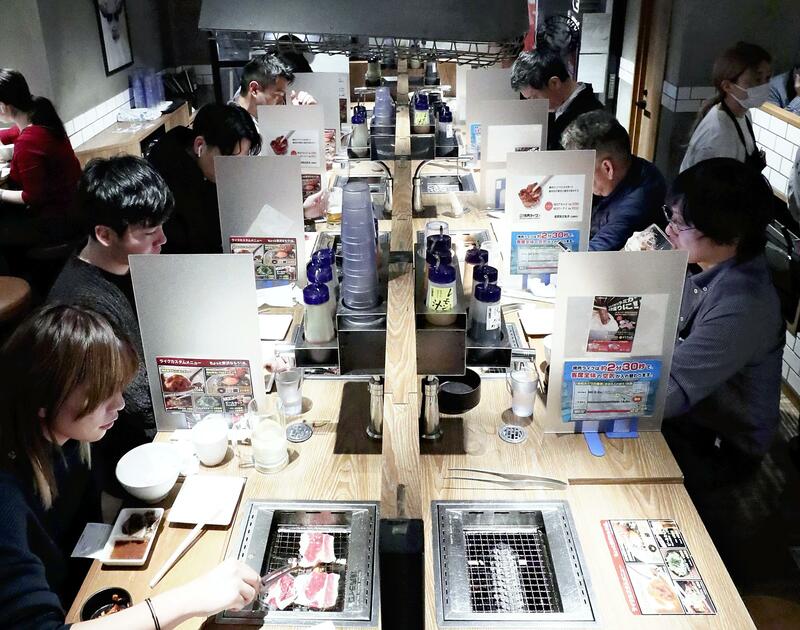
Yakiniku Like has long been a yakiniku grilled meat chain that caters to people who want to dine solo. Its branches in the Tokyo area are now seeing a boom in popularity. One location was busy with customers who were sitting one-by-one between partitions and grilling meat over a roaster in front of each person. Most customers were seen finishing their meals in about 20 minutes.
While many restaurant chains are closing unprofitable outlets, Yakiniku Like is opening new branches.
"By supporting changes in consumption style, we can offer new options," Yakiniku Like President Morihisa Arimura said. "The pandemic isn't all negative."
Read more from The Japan News at https://japannews.yomiuri.co.jp/