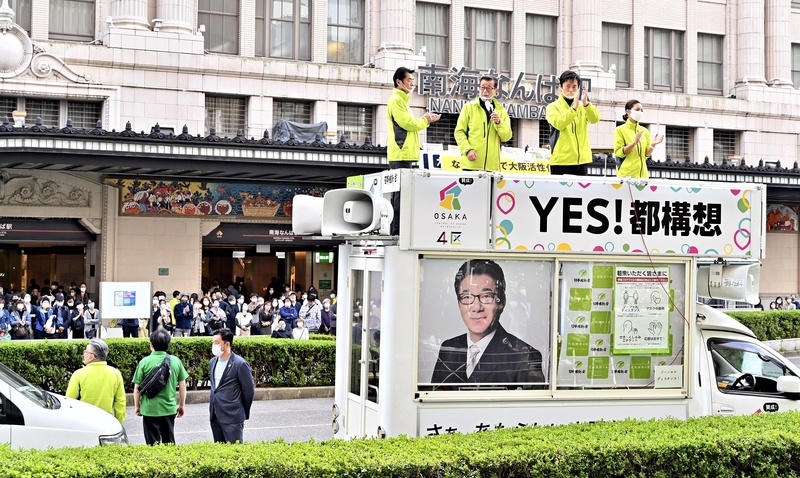
OSAKA -- Five years ago, the Nippon Ishin no Kai (Japan Innovation Party) put an Osaka metropolis plan referendum to voters in the city that was rejected by a slim margin. That loss drove the party's founder, then Osaka Mayor Toru Hashimoto, to retire from politics. Ichiro Matsui, the current head of the party and mayor of Osaka, picked up the mantle but the Osaka metropolis plan was dealt another defeat in Sunday's referendum.
-- Single fell swoop
"I accept the will of the citizens of Osaka," Matsui told reporters late Sunday as he began coming to grips with another narrow defeat for the referendum.
Osaka Gov. Hirofumi Yoshimura and senior officials from Komeito's Osaka headquarters were among those at the press conference held at a hotel in Osaka, where Matsui also announced that he would retire from politics after his term as mayor expires in April 2023.
In one fell swoop, Ishin no Kai has lost its leader and key policy.
There are calls for Yoshimura to succeed Matsui, but the governor's ability to unify the party is limited compared to Matsui, who co-founded Nippon Ishin no Kai with Hashimoto.
"I remained in the party even after Hashimoto left because I could stick with Matsui," a senior party member said.
-- Political gambit fails
Ishin no Kai's biggest miscalculation was overlooking the views of Komeito's supporters.
To move the deadlocked metroplis plan ahead, the party made a tricky move in the Osaka gubernatorial and mayoral elections held in April last year. Then Osaka Gov. Matsui and then Osaka Mayor Yoshimura resigned in the middle of their terms. In the subsequent elections, Matsui ran for mayor and Yoshimura ran for governor. Both men won. Ishin no Kai also made great strides in the prefectural and municipal assembly elections held the same day.
Komeito has four incumbents from single-seat House of Representatives constituencies in Osaka Prefecture. The party switched its stance and decided to support the Osaka metropolis plan to avoid a confrontation with Ishin no Kai, as Ishin no Kai had threatened to field a rival candidate in the next lower house election. Komeito's about-face shook up the political calculus in Osaka. Previously, all political parties aside from Ishin no Kai were against the plan.
After the referendum was declared on Oct. 18, Komeito leader Natsuo Yamaguchi visited Osaka and took to the streets with Matsui and others trying to garner support for the metropolis plan. It was an unusual situation: Komeito was supporting the metropolis plan while the Osaka chapter of the Liberal Democratic Party -- Komeito's ruling coalition partner in national politics -- opposed the plan.
"Matsui lobbied our leaders," said an official with Soka Gakkai, a Buddhist lay organization that is Komeito's main support base.
Many Komeito supporters remain opposed to Ishin no Kai, as the two are rivals. Discontent swirled as Komeito's leadership drastically changed its policy. Some Soka Gakkai members launched a campaign complaining that Komeito was sacrificing its principles for the sake of an election.
-- The coronavirus factor
The novel coronavirus pandemic also played an outsize role. Matsui and Yoshimura were unable to hold large-scale gatherings with supporters and could not give advance notice when delivering speeches on the street to prevent infections until the last phase of the campaign period.
In another blow, Yoshimura was never able to appear in a TV debate after the referendum was declared. Yoshimura has gained support through his measures to curb the pandemic and his popularity would have been a boon.
A source at a TV network said those opposing the metropolis plan were reluctant to appear on TV, saying that the issue is a matter for the city of Osaka and they wouldn't appear in a debate with Yoshimura.
The Ishin no Kai camp lamented this strategy to outflank Yoshimura.
Meanwhile, Hashimoto never gave a speech on the streets, instead opting to tweet, "The metropolis plan is a 'Great Osaka' plan to compete with the world."
The campaign for the referendum, which was based on the law on the establishment of special wards in major cities, had no limitation on the number of fliers or TV commercials. Ishin no Kai spent about 400 million yen on public relations and publicity -- far exceeding the 50 million yen spent by the LDP and the 60 million yen spent by the Japanese Communist Party -- but failed to gain enough support.
Read more from The Japan News at https://japannews.yomiuri.co.jp/