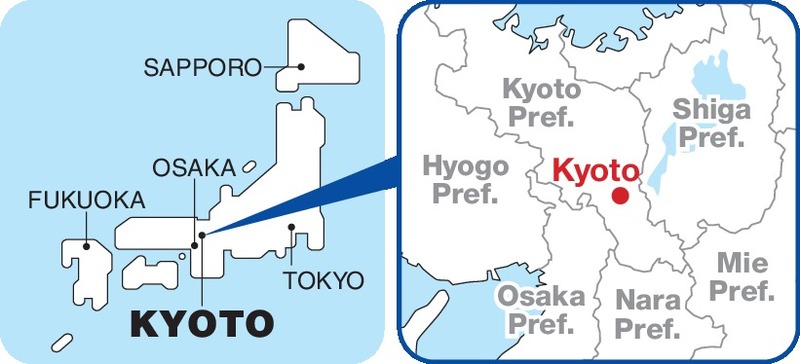
KYOTO -- An increasing number of companies based outside Kyoto Prefecture have been setting up offices in the central part of Kyoto, as part of their efforts to secure capable human resources by taking advantage of the city's name recognition.
Kyoto is not just famous at home and abroad, it is also home to many universities. Many companies headquartered in places other than Kyoto Prefecture -- mostly those in the information technology sector -- have been opening design offices or development bases in the heart of the ancient capital city with the aim of making their recruitment drives easier amid increasing concerns that a labor shortage could blunt their growth.
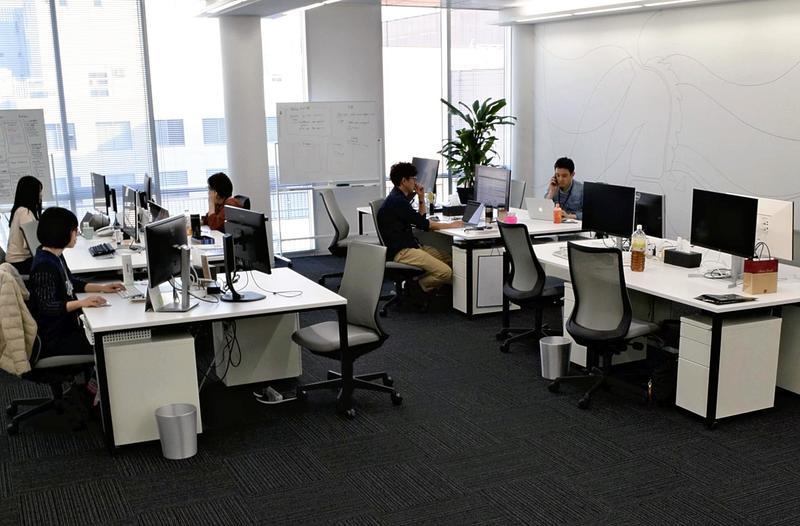
In October 2018, Fenrir Inc., an Osaka-based start-up developing smartphone apps, among other business, set up its Kyoto branch office in a building near Shijo-Karasuma, one of the main crossings in the center of the city. The 210-square-meter office is currently staffed by about 10 regular workers but can accommodate up to about 30 staff members.
The biggest feature of the office is set to be a section called the "Project Room," which is scheduled to open this spring and will account for half of the entire floor space. The room is designed to facilitate joint development with universities and interactions with students and other companies.
Keiichi Totsuka, head of the branch office, said his company aims to make the room "a place where students can gain up-to-date information," thus promoting its edge and ultimately making it easier to find capable human resources.
In the same neighborhood as Fenrir's new office, Line Corp., a major Tokyo-based communications app operator, also opened its development base in June last year. In the same month, CyberAgent Inc., a major internet ad agency in Tokyo, also launched its global creative center, which is tasked with creating products for the Southeast Asia market.
Another Tokyo firm, Money Forward, Inc., opened its development base near the city's Sanjo-Kawaramachi crossing in February.
"We don't have any preferential tax incentive or other benefits geared toward IT companies," said an official of the Kyoto municipal government in charge of encouraging companies to operate businesses in the city.
Even so, more and more companies have set up offices in central Kyoto because they are facing fierce competition in their recruitment drives.
The Tokyo metropolitan area is suffering shortages of engineers in artificial intelligence and other IT fields. The ratio of job openings to job applicants in the IT field hit 4.06 in Tokyo in October 2018, but the ratio stood at 1.9 in Kyoto, meaning it is easier for companies to find IT engineers here.
"Work styles among individuals have diversified," said Kaoru Fujii, editor-in-chief at Rikunabi Next, a service for mid-career job seekers. "If companies hire someone only at their own convenience, they will not stay long."
In this sense, it seems natural for companies to set up offices in Kyoto.
"There are many who are interested in living in Kyoto to work, not just among new graduates, but also among mid-career job seekers," a Money Forward spokesperson said.
The Kyoto municipal government holds seminars once a year to encourage companies to start businesses in the city. A seminar was held in February, which Mayor Daisaku Kadokawa also attended. The local government is also willing to work as a go-between to facilitate collaborations between companies operating in the city.
"It remains important [for us to offer assistance] even after companies start businesses in our city," said Masatoshi Morinaga, a senior official at the municipal government. "Quite a few companies continue operating here."
Hideyuki Araki, a senior researcher at Resona Research Institute Co., said advances in communications technologies have made it possible for people to work no matter where they are.
"Decisions on where to set up offices now focus more on how comfortable they can be for workers and how much they can help improve productivity," he added. "Kyoto's distinctive atmosphere, which has been created by its long traditions, is apparently welcomed by companies as this environment can provide workers with the inspiration they need for their professions."
Many companies are also setting up their offices in central Kyoto because they aim to secure capable non-Japanese workers.
"Many foreign engineers want to work in Kyoto, rather than somewhere else in Japan," said Line President Takeshi Idezawa.
An official of Panasonic Corp., which opened its design base in central Kyoto in April last year, said when the maker tried to hire a designer from Europe, the person initially showed reluctance. "However, the designer eventually accepted our offer when we said we'd be opening an office in Kyoto," the official said.
According to the Japan Student Services Organization, Kyoto Prefecture had 11,219 foreign students as of May 2017, ranked fourth on the list following Tokyo, Osaka and Fukuoka.
Kyoto is becoming a strategic place for companies aiming to expand their businesses overseas.
"Many non-Japanese who have been studying in Kyoto hope to remain in the city [after completing their programs]," said an executive at a major IT company.
Read more from The Japan News at https://japannews.yomiuri.co.jp/