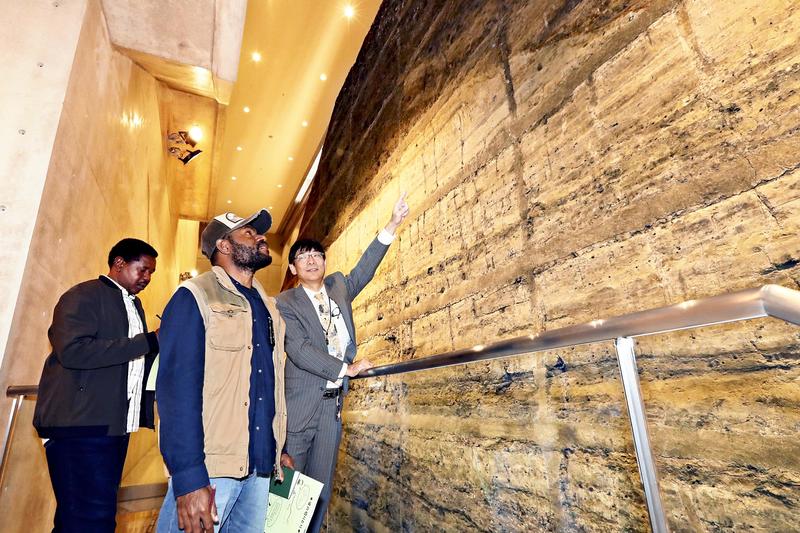
OSAKASAYAMA, Osaka -- A 15-meter-high clay wall. Just gazing up at it is an awesome experience. While some layers of the wall are made up of a fine grain that has a yellowish hue, there are also reddish layers into which stones are mixed.
The thickness of the layers varies greatly in size, ranging from a half-meter to more than 3 meters.
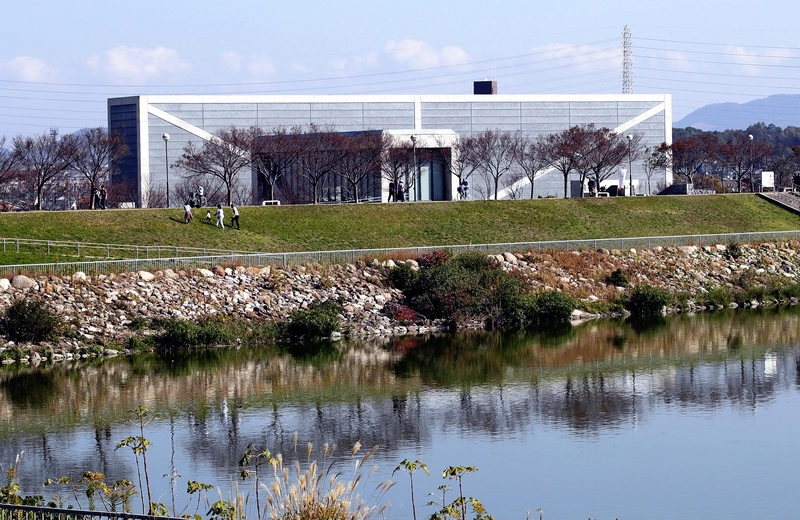
The wall is a cross-section surface of a dike of the Sayama-ike pond, which is on display at the Osaka Prefectural Sayamaike Museum in Osakasayama, Osaka Prefecture.
Standing in front of the wall, visitors can gain a sense of what people -- from ancient times to the present day -- have felt over the years as they have repeatedly refurbished the dike.
Refurbished by prominent priests
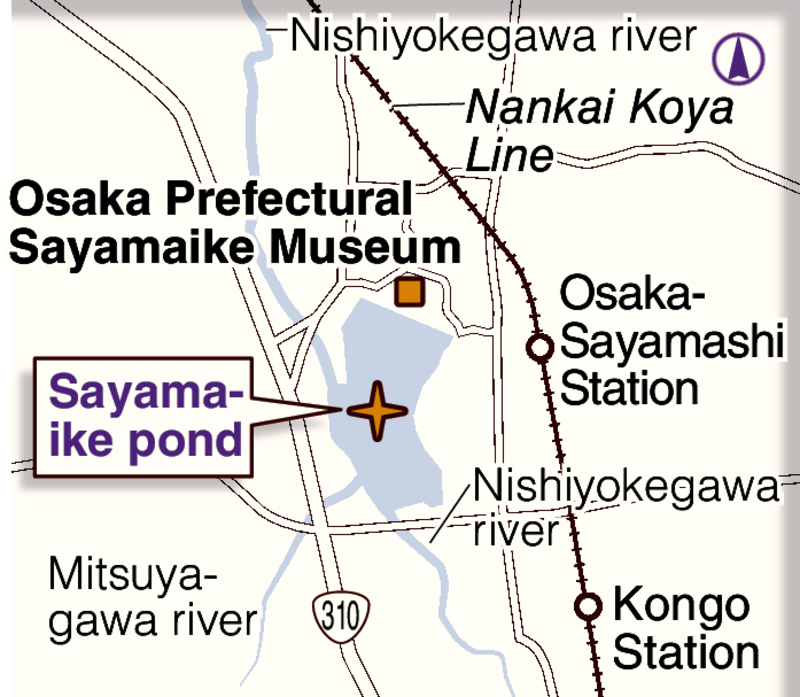
The Sayama-ike pond is located south of the museum, stretching 890 meters north to south and 430 meters east to west.
It is a dam-like reservoir that holds back water with a dike made of accumulated clay. The pond is capable of storing 2.8 million tons of water.
In ancient times, the pond was mentioned in Nihon Shoki (The Chronicles of Japan) and Kojiki (The Records of Ancient Matters). It is said to be the oldest dam in Japan, and it is believed that Gyoki, a high-ranking priest in the Nara period (710-784), and Chogen, another high priest in the Kamakura period (the late 12th century to 1333), took part in its refurbishments.
The history of the pond was evident in the refurbishment work that began in 1988. As torrential rains in 1982 caused tremendous damage across surrounding areas, plans began to construct the pond -- which served as a reservoir for agricultural use -- for flood control.
Under the plan, the height of the dike was raised 1.1 meters to 18.5 meters, and the bottom was made 3 meters deeper, with the aim of increasing its storage capacity by 1 million tons and preventing downstream rivers from flooding.
Wataru Kanamori, 80, a former Osaka vice governor, was the chief of the prefectural government's office in charge of river and sediment control when government officials drilled into the northern part of the dike for a survey conducted before the refurbishment work.
"We hit something incredible," he said.
They discovered the dike was formed by a large number of clay layers that are believed to be made by humans.
"If the work continues, we might be able to uncover the history of the creation of the dike, as far back as ancient times," he thought.
Subsequently, a large project kicked off with the aim to cut off and relocate the dike and construct a museum in which to display the clay wall. To carry out the dual purposes of refurbishing the pond and handing down the work by people in the past to future generations, 54.4 billion yen was spent on the project.
New discoveries were made one after another at work sites for the project.
A wooden pipe, which in Japanese is called "hi" and was used to take in water, was uncovered near the bottom of the northern part of the dike. It was later discovered to have come from a tree cut down in 616, based on the number of rings in its grain.
In a clay layer dating back to the same era, small tree branches -- that still had leaves on them -- were laid thickly among chunks of clay. It was a trace of the fact that a method called "shikiha koho," something used in China and the Korean Peninsula in ancient times, was incorporated to prevent the clay from collapsing.
Near a site where a hi pipe dating back to the Edo period (1603-1867) was unearthed, a stone monument bearing historical records about the pond was discovered. The records showed that Gyoki built the dike at the pond, and Chogen made repairs in 1202 because the dike had been leaking.
It was in 1995 that the whole cross-section surface of the clay wall could be seen. Kanamori stood in front of it, his body seemingly trembling with excitement.
Although the high cost of the project drew criticism, he said, "It was not wrong for the prefecture to engage in the relocation and preservation of the dike."
Dividing into 101 blocks
Preservation of the dike was also a difficult task. A consortium, led by the Tokyo-based general contractor Obayashi Corp., took on the task.
It was necessary to carefully remove portions of the clay wall without weakening the structure, while at the same time making sure the wall could last as part of a long-term exhibition.
After repeated experiments, the consortium came up with a method to remove the dike by dividing it into 101 blocks, each of which measured 1.5 meters by 3 meters, soaking them in resin for about two years to harden them, drying them for another two years, and then reassembling the pieces into their original formation.
Yoshitada Tsubaki, 74, who was involved in the disassembling and reassembling effort as chief of an office supervising the work sites, looked back at those years, saying: "Nothing [we did] had ever been attempted before by anyone. Every day was interesting."
The Osaka Prefectural Sayamaike Museum opened in 2001. More than 100,000 people visit the museum annually. In recent years, an increasing number of visitors come from overseas.
In early November, Elgazafi Yousif Ishag, 46, a senior curator at the National Corporation for Antiquities and Museums of Sudan, visited the area as part of a training session provided by the Japan International Cooperation Agency.
He praised the exhibition, saying: "I was able to follow the changes of the dam over 1,400 years. It's wonderful that the history is preserved in such a way and exhibited like that so that everybody can easily understand."
Outside the museum building, many people come and go, some enjoying walking or jogging.
The Sayama-ike pond, which has helped agricultural crops grow in abundance since ancient times, still holds water without making people feel the weight of the history that the dam has built up.
-- Access
The Sayama-ike pond is about a 10-minute walk from Osakasayamashi Station on the Nankai Electric Railway Line. The dam/pond was designated as a national historic site in 2015. There is a 2.85-kilometer circular walking trail at the dike. During the spring, the dike is popular as a cherry blossom viewing spot, featuring about 1,300 of the trees. There is also a butterfly garden, where visitors can observe about 40 species such as the Chinese windmill and the Indian red admiral. The Osaka Prefectural Sayamaike Museum was designed by architect Tadao Ando.
The museum is open from 10 a.m. to 5 p.m. and is closed on Mondays. For more information, call the museum at (072) 367-8891.
Read more from The Japan News at https://japannews.yomiuri.co.jp/