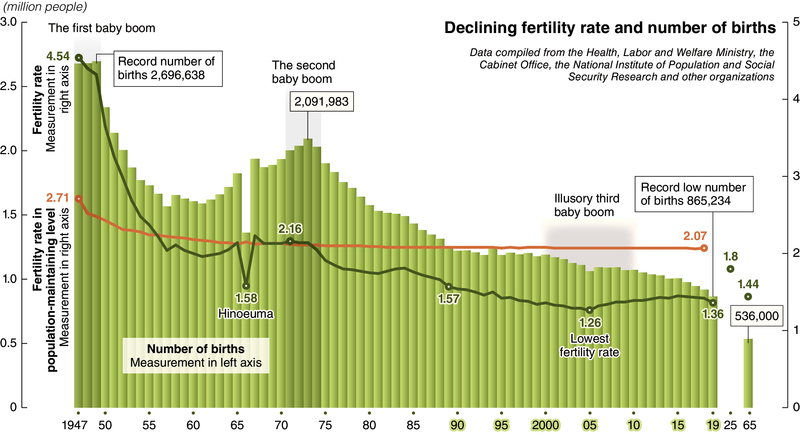
The drop in the number of births is not stopping. Last year saw a record low of 865,000 births, and the fertility rate stood at 1.36, far below the 2.07 figure needed to maintain the population, according to statistics released this month.
Thirty years have passed since the low birthrate attracted public attention. Why has the number of births dropped so much? Were the past efforts a failure? Now is the time to write a prescription that gives us hope.

-- 1.57 shock
"I was shocked when I saw that number. I was afraid that Japanese society would be in huge trouble."
This remark was made by Teijiro Furukawa, 85, who served five prime ministers as deputy chief cabinet secretary for eight years and seven months from 1995.
"That number" was 1.57, the total fertility rate (an estimate of the average number of children a woman will have in her lifetime) in 1989.
In fact, Furukawa's eldest son was born in the Hinoeuma year of 1966. In a Hinoeuma year, which comes around every 60 years, the fertility rate plunges abnormally due to superstition that causes people to hesitate over having children. The fertility rate in 1966 was 1.58.
After finding out the rate was expected to fall even lower than the 1989 level, Furukawa, who was then director of the Child and Family Policy Bureau at the Health and Welfare Ministry, warned the Prime Minister's Office.
The warning resulted in the addition of a phrase in then-Prime Minister Toshiki Kaifu's first policy speech: "Creating an environment in which children can be born and raised in a healthy manner." The following year, 1990, one of Kaifu's policy speeches included the phrase: "Children are the treasures of the society. Protecting and nurturing these treasures is an important task."
In response to the prime minister's speech, the government established in 1990 a conference held among relevant ministries and agencies on creating an environment for raising children. It can be said that Japan's measures to counter the low birthrate started from this point.
Still, the fertility rate has consistently been below the level required to maintain the population since the mid-1970s -- the rate required to maintain a population fluctuates over time but is currently set at 2.07.
Until the "1.57 shock," the declining fertility rate had not grabbed public attention for several reasons: There was a tendency to value population control out of concern about resource depletion due to the increase in the global population; the decline in the number of births was thought to be temporary; and there was a "population bonus" phenomenon in which the working generations comprised more of the population than children and the elderly.
In 1992, the White Paper on National Lifestyle took up the birthrate for the first time; in 1994, the "Angel Plan" (Basic policy toward childcare support measures) was announced for a five-year implementation from fiscal 1995 to 1999; and in 1999, the "New Angel Plan" was announced for the next five years. However, the sense of crisis was not widely shared among the public.
Why was that?
-- The 'third boom' that didn't come
Measures to deal with a declining number of births were reminiscent of the wartime "Give birth and multiply" policy, and there was strong criticism and rejection of government intervention in childbirth, especially among women. In the 1990s, the aging of the population became an issue, and budgets and human resources were allocated to the enhancement of welfare for the elderly, fueling people's sense that the low birthrate was not an imminent issue.
But by far the biggest factor was optimism. Because of the first baby boom (between 1947 and 1949) and the second baby boom (between 1971 and 1974), people were optimistic that a third baby boom would happen without doing anything.
However, the third peak, which had been expected in the 2000s, did not come, and the fertility rate in 2005 fell to a record low of 1.26. Faced with the need to strengthen measures to address this problem, the government has come up with a variety of steps, including comprehensive support for child-rearing starting during pregnancy, a review of working styles and the revival of community bonds, not to mention an increase in the number of nursery schools.
"Although options were presented, there were strict budget restrictions due to the influence of then-Prime Minister Junichiro Koizumi's reform in the 2000s, and economic support was almost impossible," said Masanobu Masuda, a professor at Tokyo Online University, who served as a counselor for measures to tackle the falling fertility rate in the Cabinet Office from 2004 to 2006.
He also said it was difficult to come up with approaches that drew consensus because people have different values. For example, in a discussion on strengthening nursery services, some politicians said: "Children should be brought up by their mothers. We cannot outsource child care." In another discussion on supporting childcare at home, some women said, "That will prevent women from building a career."
-- Analyzing the problem
In the Comprehensive Reform of Social Security and Tax in 2012, the government decided to put the increased amount of consumption tax to use not only for the elderly but also for children. The National Governors' Association declared a state of emergency over the declining fertility rate after a 2014 document compiled and released by experts and other people in the private sector showed that half of the country's municipalities could disappear.
In its outline on measures to cope with the low birthrate adopted at a Cabinet meeting in May, the government set a goal of achieving a fertility rate of 1.8, which is expected to be achieved if people who wish to get married or have children are able to. The outline also called for expanding fertility treatment and economic assistance.
Over the past 30 years, the government has made progress in steps to help workers balance jobs and child-rearing, including increasing nursery schools and encouraging parents to take childcare leave. But why has it not been effective in improving the declining fertility rate?
Books analyzing the causes have been published one after another. The titles of those books include: "Nihon no Shoshika Taisaku wa Naze Shippai Shitanoka?" (Why did Japan's measures against the declining fertility rate fail?) written by Masahiro Yamada; "Mushi Koureika" (No children aging society) written by Masako Maeda; and "Shoushikaron" (Theory of declining fertility rate) written by Shigeki Matsuda.
A common theme is that conventional measures did not fully reflect the mentality of young people and child-rearing generations and what their reality is. The authors wrote passages such as the following:
"Existing measures center around support for working married couples living in urban areas. Support for families with young children where mothers want to raise them at home was insufficient, and measures to deal with the main causes of the declining fertility rate, such as the rise in unmarried people and the deterioration of employment for young people, were insufficient."
"Past measures didn't consider young people's mind-set that they couldn't get married unless they were able to live a decent life."
"The declining fertility rate was not taken seriously as it was seen as a 'problem of children and women' and the selfishness of young people in not getting married. Childbirth and child-rearing was considered the individual responsibility of parents (rather than the responsibility of society). Although it was too late when the consequences manifested in the form of a labor shortage, there was a lack of political leadership to strongly promote the nurturing of the next generation."
All of these analyses are to the point and enlightening.
-- Changes
As the expectation of a third baby boom was revealed as an illusion, many people voiced their regret that the last chance had been lost. However, if the government takes no action for those who complain that they cannot get married or raise children because they are at the mercy of a rapidly changing economy and increasingly unstable employment, Japan will not only be unable to realize the 1.8 fertility rate, but it will also be a country where young people have no hope.
According to Miho Iwasawa of the National Institute of Population and Social Security Research, from the end of the 19th century to the middle of the 20th century, major developed countries went from "Many births, many deaths" through "Many births, few deaths" to "Few births, few deaths." From the 1960s, the fertility rate has continued to fall, and the declining number of births has emerged.
While this is because people's lives have become affluent and individualistic thinking has spread, there are countries with similar characteristics like France and Sweden that maintain a fertility rate of around 1.8. Those countries do not have a declining fertility rate because people there generally do not believe in traditional gender roles and are willing to seek partners. Also, the governments of those two countries provide support for flexible ways of working so that the child-rearing generation can lead stable lives.
The 1998 white paper on health and welfare stipulates that the significance of children to parents "has been shifting from 'productive goods' that are responsible for family businesses and supporting elderly parents, to 'consumer goods' that provide happiness to parents."
With overprotection, stress from raising children and child abuse becoming social problems, a growing number of people are trying to raise their children not only as "private property" but also as "public property." There is a growing sentiment that children should be raised by society.
Thirty years have passed since the declining fertility rate attracted attention. There is no instant remedy because it involves the economy and people's values. What is needed now is for each and every one of us to reconsider the value and role of children in the family and society. Although the coronavirus disaster has increased anxiety about people's lives and uncertainty about the future, 10 years from now, we do not want to call the past 40 years "40 years of failure."
Read more from The Japan News at https://japannews.yomiuri.co.jp/