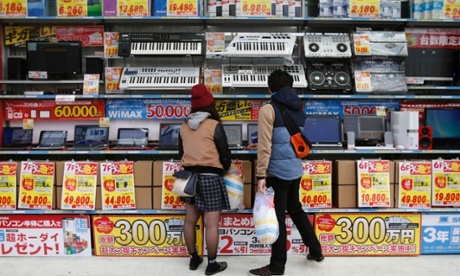
Japan pulled itself out of recession in the last three months of 2014, but the rebound was weaker than expected as household and corporate spending failed to move up a gear.
The preliminary reading for gross domestic product (GDP) showed a quarter-on-quarter increase of 0.6% in October to December, which Tokyo said translates into an annualised 2.2%.
The annualised figure was much smaller than a 3.7% increase forecast in a Reuters poll and underlines the challenge premier the prime minister, Shinzo Abe, faces in shaking off decades of stagnation.
Analysts said the fragile recovery was the hangover from last spring’s sales hike that shocked Japanese consumers and triggered a six-month spending freeze.
The economic minister, Akira Amari, said the economy was on track for a recovery with signs that consumer sentiment was finally picking up.
Société Générale analysts Takuji Aida and Kiyoko Katahira said Abe’s decision to push back a second sales tax hike by two years to 2017, would give the economy a strong boost.
“Given that PM Abe has decided to postpone the second tax hike to April 2017 from October 2015, the downside pressure in 2015 has largely been removed,” the analysts said. “The GDP growth rate for 2015 should be supported by robust consumption and trade, and we forecast growth of around 1.5% year on year. “Abe has announced he will not delay the second tax hike again. In other words, he has made a strong commitment to reflate the economy,.”
But some analysts warned that weak rebound in consumption and capital expenditure remained a worrying sign.
“These are somewhat disappointing figures,” said Takeshi Minami, chief economist at Norinchukin Research Institute. “The situation remains weak and companies are clearly postponing investments.”
However, the rebound from recession will allow the Bank of Japan to hold off on expanding monetary stimulus. The central bank has proved to be one of the most aggressive in printing money to make borrowing cheaper and to drive down the value of the yen.
Like most central banks, the Bank of Japan (BoJ) has seen inflation fall below its 2% target following the collapse in oil prices that has dramatically cut fuel costs and a slowdown in China that has reduced the price of other commodities.
Abe said he hoped the central bank continued with its bold monetary easing campaign to boost lending and inflation back to its target.
Speaking in parliament, Abe praised the BoJ’s aggressive stimulus programme for helping revive the economy and wipe out the public’s “sticky deflationary mindset”.
He acknowledged that some weakness in household spending, but added that he saw signs of recovery in the economy, such as improvements in consumer sentiment. “We’ll strive to ensure that wages keep rising this year and next, so that the warm breeze of recovery blows throughout the nation,” Abe said.