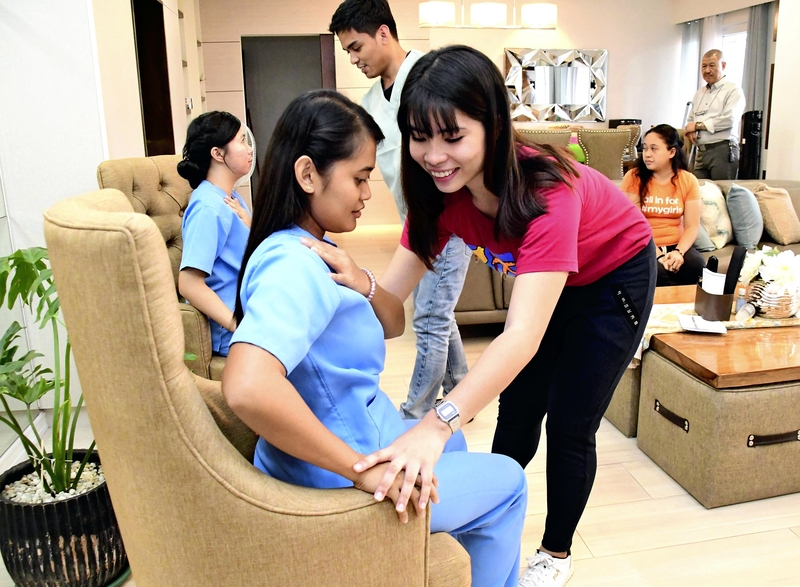
Mos Food Services, Inc., a Tokyo-based company that operates the Mos Burger hamburger chain, is planning to hire hundreds of Vietnamese students under the new residency status known as "specified skilled workers."
"Hiring capable foreigners will also stimulate our Japanese employees. We want to utilize them vigorously," stressed an official in charge of personnel management at the company. Mos Food Services intends to hire 350 Vietnamese students who have qualified as possessing "specified skills" by the year 2023.
Although the 17 members of the first group of Vietnamese hired have been forced to remain in Vietnam due to the new coronavirus, the company's plans will not change. They are waiting for the day when they will start working in Japan, while learning the Japanese language via an online program devised by Mos Food Services.
-- Troublesome paperwork
To cope with the worsening labor shortage, Prime Minister Shinzo Abe's administration sharply changed tack to increase the acceptance of foreign workers. Under the system for the new residency status known as "specified skilled workers," which started in April 2019, the government has widened the scope of residence status for working in this country -- previously limited to personnel in fields requiring professional or technical expertise -- to include areas involving simple labor.
The government had previously said it would "cautiously deal with the acceptance [of foreigners] into areas involving simple labor." It changed its approach by making a clear distinction that, as Abe put it, "this is not what is called an immigration policy."
Foreign workers with specified skills are now accepted in 14 industries, including construction work. During deliberation on the relevant bill at the Diet, Abe touted the significance of the legislation, saying, "We will accept foreign workers who have a certain level of expertise or skill and thus are work-ready, but only in truly needed, limited areas, and with a time limit set."
Yet actual utilization of the new system has fallen far short of the government's expectations. Initially, the government had expected to accept a total of 345,150 people over five years, with up to 47,550 entering in the initial year of fiscal 2019.
However, as of the end of March this year, only 3,987 people had entered under the program. Most of these were people who changed their status from technical intern trainees in Japan. Only 281 foreign nationals passed the qualifying exam, either at home or abroad.
Since the start of the new system, the half-hearted attitude of companies that would accept foreign workers has come under the spotlight.
One primary reason for their reluctance is the laborious paperwork involved. A company official said he was swamped with work to prepare such documents as health certificates, identification papers and resumes, grumbling that he "prepared documents for a dozen or so prospective workers, which turned out to fill two cardboard boxes."
Also burdensome is the livelihood support that companies must provide, in keeping with operational manuals prepared by the Justice Ministry. Companies must hold more than eight hours of briefings to explain things like how to use an ATM machine and how to sort and dispose of recyclables and other garbage.
When a foreign worker rents an apartment, the company must become a guarantor and ensure that the apartment has at least 7.5 square meters per occupant.
To avoid these matters, companies are tending to increase their use of the conventional system of technical intern trainees. A total of 188,872 such trainees came to Japan in 2019, up 38,711 from the previous year. The original purpose of the technical intern trainee program was to promote the transfer of technology to developing countries, but it has actually been used as a means to secure cheap labor.
-- The price of haste
It is also a challenge to create a "symbiotic society" in which Japan accepts foreigners. The Justice Ministry in July established the Foreign Resident Support Center in Yotsuya, Tokyo. The center provides consultations in 11 different languages, and also supports companies' in-house training but it has just started its activities.
About 1,500 foreigners move to Funabashi, Chiba Prefecture, every year. Traditionally home to many technical intern trainees and foreign students, the city has also seen 117 workers with specified skills come to live there by the end of June. However, residents have consulted the city government about problems related to garbage disposal and noise.
A city official said: "The number of foreign workers with families has been increasing rapidly. Local governments are heavily burdened with such tasks as improving Japanese language education."
-- Tripled in 10 years
Under the system of specified skills, Type 1 workers are permitted to stay for up to five years, while Type 2 workers can have family members accompany them and renew their residency status. Type 2 workers are required to pass exams for advanced skills, and thus they are presently limited to only two fields: the construction, and shipbuilding and shipboard industries.
The labor shortage stemming from Japan's low birthrate is becoming serious, and the nation's dependency on foreign personnel is rising.
There were about 1.658 million foreign workers in Japan as of October 2019, the highest number since it was made mandatory for them to be reported to relevant authorities in 2007. The number has almost tripled over 10 years.
Read more from The Japan News at https://japannews.yomiuri.co.jp/