KEY POINTS
- Japan's baby-related business market reaches ¥4.657 trillion in 2025, up 2.0% year-on-year
- Daycare sector and infant toys drive growth as government subsidies offset declining birth numbers
- Baby apparel, food, and goods segments contract; price hikes partially cushion volume losses across several categories
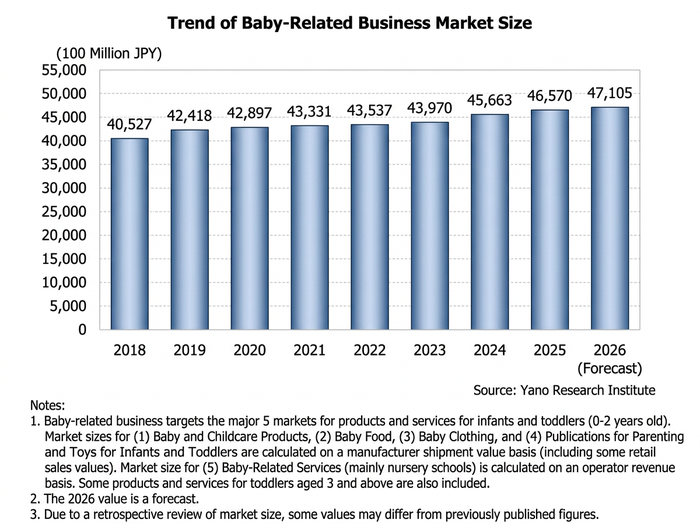
Japan's baby-related business market grew 2.0% in 2025 to ¥4.657 trillion (approximately $29.5 billion), as sustained public funding for daycare services offset the drag from a shrinking pool of infant consumers, according to a survey released May 14 by Yano Research Institute.
The Tokyo-based research firm estimated the combined size of five major segments — baby goods and childcare products, baby food, baby apparel, parenting publications and infant toys, and baby-related services primarily comprising licensed daycare centers — covering products and services targeting children aged zero to two. The daycare segment, which accounts for the bulk of the overall market, continued to expand on the back of government subsidies directed at childcare support and measures to address Japan's declining birthrate, the release said.
Of the five segments, baby-related services and the combined parenting publications and infant toys category recorded year-on-year growth, while baby goods and childcare products, baby food, and baby apparel declined, reflecting the impact of fewer births. Japan's Ministry of Health, Labour and Welfare has documented a sustained decline in the country's annual birth count, and that shrinkage is gradually thinning the consumer base that underpins infant-focused commerce.
The daycare segment's expansion rate, however, is moderating. Enrollment numbers are falling as fewer children enter the system, creating uncertainty over the segment's longer-term trajectory even as near-term subsidy flows remain supportive, the company said.
Within the contracting segments, price revisions are providing a partial offset. Baby disposable diapers had been in decline on a volume basis since 2020, according to production data from the Ministry of Economy, Trade and Industry, but monetary-value sales turned positive in 2024 as manufacturers implemented price increases to counter rising raw material costs. That trend continued into 2025 with a marginal gain. Similarly, baby bottles and nipples — while facing headwinds from lower birth volumes — benefited from premiumization, as higher unit prices on functional, value-added products and price adjustments by major manufacturers supported modest revenue expansion.
The infant and educational toy category has remained resilient. Growing parental awareness of early childhood cognitive development has sustained demand for educational toys, including products designed for parents and children to use together, while publishers of long-selling picture books and perennial bestsellers continued to draw consistent readership, Yano Research said.
The broader challenge facing the market is structural. Japan's total fertility rate has remained well below the population-replacement threshold for decades, and annual births have continued to fall. As a result, the baby-related business market faces persistent demand erosion across most physical product categories, a trend that may be difficult to reverse without a meaningful demographic shift.
Industry participants are focusing on high-value-added products and, particularly among larger operators, strengthening efforts to tap overseas demand, according to Yano Research.
Looking ahead, the near-term outlook depends heavily on the government maintaining its commitment to childcare funding, which has so far kept daycare revenues on a positive trajectory. Rising raw material prices alongside potentially higher manufacturing and logistics costs in 2026 are expected to prompt further price revisions across several segments, and some categories may continue to post gains as a result, the company said.
Yano Research Institute conducted the survey between January and March 2026, gathering data through direct interviews, telephone and email inquiries, and document research with companies active in the baby, maternity, and childcare support sectors.
(Exchange rate used: USD/JPY 158)
Originally published on ibtimes.co.jp