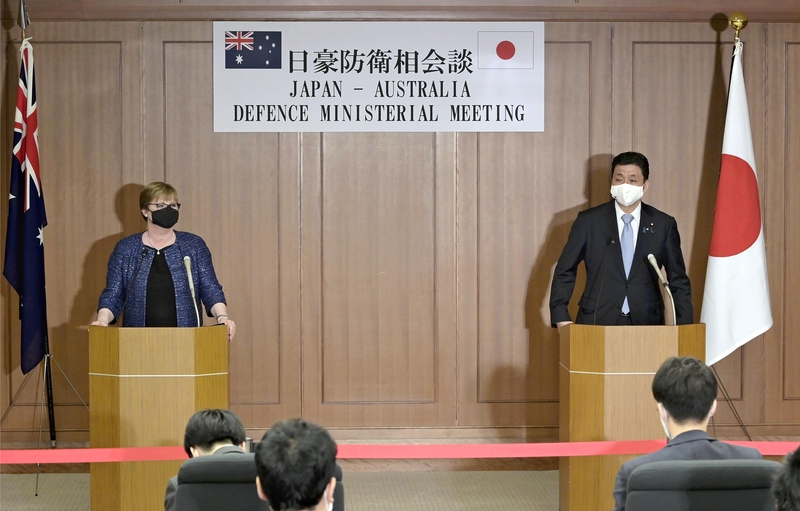
Defense Minister Nobuo Kishi and his Australian counterpart, Linda Reynolds, agreed Monday to begin working on the implementation of provisions that will enable the Japan Self-Defense Forces to protect military assets of Australian forces, including ships and aircraft, with the use of weapons.
If implemented, it will be the second case after the United States that these provisions are applied to foreign military forces.
After the meeting at the Defense Ministry in Tokyo, Kishi stressed to reporters that the protection of the Australian military is "of great significance for the peace and security of our country and for Japan-Australia defense cooperation."
The provisions for the protection of weapons and other equipment are stipulated in Article 95 of the Self-Defense Forces Law, whereby the SDF can use weapons to protect its military assets that include weapons, ammunition, ships if there is a risk that they may be destroyed. Although the scope of the protection was previously limited to those of the SDF's, it was expanded by a security-related law enacted in 2015 to include United States and other nations' vessels operating to protect Japan. So far, the provisions were exercised to protect the U.S. military on two occasions in 2017, 16 in 2018 and 14 in 2019.
Under the latest agreement, Japan and Australia envisage the protection of Australia's military assets during joint training exercises with the SDF and during peacetime surveillance in waters near Japan. Japan's defense minister will make a decision on the implementation in response to a request from Australia. Officials at the level of director-general, among others, will discuss the details of the specific measures to be taken as well as case studies in which protection will be provided.
In response to China's aggressive maritime expansion, the SDF has been stepping up defense cooperation with the Australian military, and in 2017 Tokyo and Canberra signed the Acquisition and Cross Servicing Agreement for mutual provision of fuel, food and other supplies. The two countries have conducted joint drills regularly, with two destroyers from the Maritime Self-Defense Force and two destroyers from the Royal Australian Navy participating in a drill in the South China Sea in September to confirm their cooperation.
After the meeting, Kishi and Reynolds expressed "strong concern" over North Korea's repeated short-range ballistic missile launches and issued a joint statement calling for cooperation in the space and cyber domains.
Read more from The Japan News at https://japannews.yomiuri.co.jp/