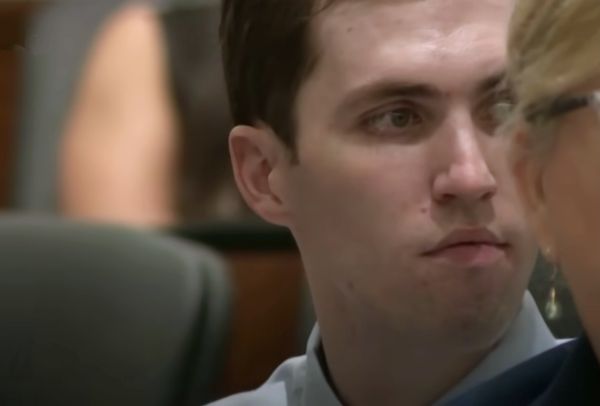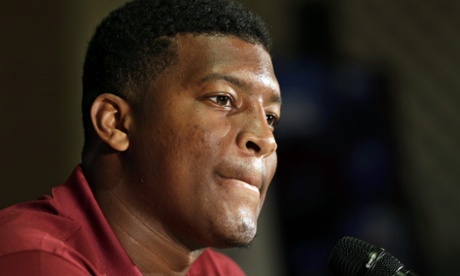
A year after learning he would not face prosecution for the alleged rape of a fellow student, the star quarterback of college football’s national champions came face to face with his accuser on Tuesday at a disciplinary inquiry into still swirling claims of sexual misconduct.
The lawyer for Jameis Winston welcomed the code of conduct hearing at Florida State University as an opportunity for his client to “confront the lie with the truth”, insisting that Winston engaged only in consensual sex with the woman during the December 2012 incident at a campus party.
“We intend to end this process today,” said Winston’s attorney, David Cornwell, who had previously likened the proceedings to “a honey trap”. “Jameis will tell the truth today, and we are confident that Justice Harding, when he hears her multiple lies and Jameis’ truth, will find as every other entity has to this point, that she is lying.”
But the attorney for the athlete’s alleged victim said on Tuesday that “neither Jameis Winston nor his lawyer can stop what is coming.”
In an emailed statement to reporters, John Clune said: “This is the day that Mr Winston has been desperately trying to avoid for two years. This courageous young woman finally gets the chance to stand up for herself against Mr Winston and big time college sports which has long run over the rights and protection of women on campus.”
Winston, the Heisman Trophy winner who is currently trying to lead the unbeaten FSU Seminoles to back-to-back national titles, will speak at the inquiry in Tallahassee, which is being conducted by the retired chief justice of the Florida Supreme Court, Judge Major Harding.
The hearing is the latest development in a controversial case that polarised public opinion in Tallahassee and prompted claims of favouritism by police towards star athletes. Winston was interviewed but never arrested after the woman claimed he assaulted her in a bedroom, with several others present. In announcing his decision a year ago not to charge Winston on the grounds of insufficient evidence, state attorney Willie Meggs was critical of detectives who withheld details of the case from prosecutors for 11 months.
“Obviously it would have been better if we had all gotten involved a little earlier,” Meggs said. “It certainly would have been nice to know all the things we know now back in December.”
Meanwhile, the alleged victim, who has since left the university, said that during the investigation police advised her “to think long and hard before proceeding against him” in what was “a big football town”. She said detectives warned her lawyer to drop the case or have her life “made miserable and raked over the coals”.
The apparent inaction by the university has also prompted a separate investigation by the US Department of Education into a possible breach of Title IX obligations, which require a school to conduct a prompt hearing into a sexual assault allegation against any of its students.
Florida State officials said they concluded in February this year that there was “insufficient evidence” to conduct a Title IX hearing, and cited the alleged victim’s privacy as a reason why information was not initially shared within the university, an argument rejected by Clune.
Instead, he said, the university allowed Winston’s camp to stall proceedings until the point at which any disciplinary action that Judge Harding might recommend, including suspension or expulsion, could not take effect until after the national championship game, which takes place in Texas on 12 January.
“The Department of Education says these cases should be resolved within 60 days of them learning of the harassment,” he said in response to the university’s explanation. “The school needs to be bigger than the football program for the moment and just get this hearing done. It’s not rocket science. They do these all the time for students that haven’t won the Heisman Trophy.”
Despite his team’s success in becoming the only one of the four top-ranked colleges to carry an unbeaten record into the season’s final stages, Winston has endured personal struggles this year. He was suspended for one game in September for shouting an obscenity in the university’s student union, and has generally not been the dominant player he was during the Seminoles’ march to the national championship a year ago.
The hearing is expected to last several days, after which Judge Harding will decide if Winston committed any of four code-of-conduct violations, including sexual activity without consent and creating a hostile environment.
Harding will send his written recommendation to FSU president John Thrasher, “the ultimate authority for student discipline,” according to a university spokeswoman.