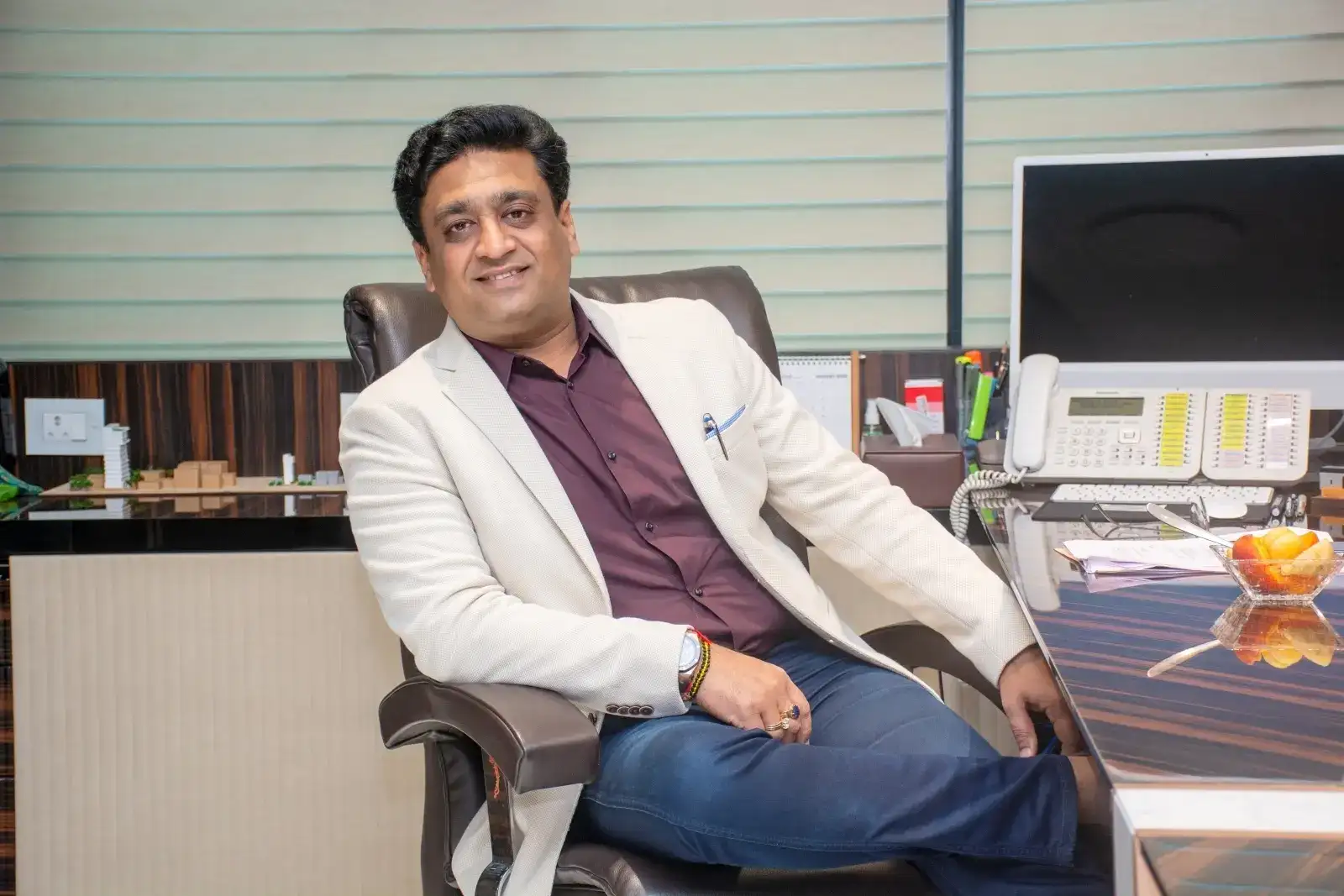
The intense urban development in India means that the attention is now on completing projects rather than just announcing them. Turning infrastructure vision into reality involves tunnelling under crowded cities and building intricate metro lines with little impact on people's lives. In this conversation with ET Digital, Dr. Nalin Gupta, Managing Director of J. Kumar Infraproject Ltd, talks about the company's role in shaping India's urban mobility landscape, managing large-scale underground projects, navigating cost pressures, and identifying the next wave of opportunities in metros, tunnels, coastal roads, and beyond. Edited excerpts.
The Economic Times (ET): India's metro rail expansion has become one of the world's largest urban infrastructure programmes, but execution beneath dense, live cities is a different challenge altogether. What does running concurrent underground metro construction across Mumbai, Delhi, and Pune actually look like on a day-to-day operational level for J. Kumar Infraprojects?
Nalin Gupta (NG): Running three cities simultaneously means we are never truly off, at any point, one city is in night shift while another is in planning review and a third is managing a critical excavation sequence. The practical reality is that our teams are dealing with ground conditions, live utilities, traffic diversions, client interfaces, and safety compliance all at the same time, across geographies with very different soil profiles and urban densities. What keeps this manageable is a centralised programme oversight system that flags deviations early, so issues at one site do not cascade into delays at another.
What makes underground work fundamentally different from surface construction is that you cannot see the problem coming. You rely on instrumentation, experienced judgement, and pre-planned response protocols. Over four decades, we have built that institutional capability, our site teams know how to read ground behaviour, adapt face sequences, and keep progress on track without waiting for instructions from the top. That is what daily operations actually look like at J. Kumar Infraprojects.
ET: Much of metro construction now happens beneath some of India's busiest urban corridors. How do you balance aggressive project timelines with the need to minimise disruption to traffic movement, utilities, businesses, and daily city life?
NG: The honest answer is that disruption is unavoidable, what we can control is how much, for how long, and whether it was anticipated or not. We invest heavily in pre-construction planning: mapping every utility that crosses our alignment, running traffic simulations before proposing diversions, and consulting with local businesses and residents before we break ground. The effort we put in before the first excavation directly determines how smoothly the construction phase runs.
On the ground, we limit our most disruptive activities, road closures, crane operations, concrete pours, to night windows wherever possible. We also keep the public and civic agencies informed in real time. When something unexpected happens, and underground it often does, our response is faster because we have already thought through the contingencies.
Timelines and community sensitivity are not opposing goals; they both improve when the planning is honest and thorough.
ET: India's metro network has expanded rapidly over the past decade, but industry experts often argue that execution capability has not scaled at the same pace as project announcements. Do you believe India currently has enough engineering talent, contractor depth, and project management capacity to sustain the infrastructure pipeline through FY27 and beyond?
NG: Yes, and I say that with conviction, not optimism. India today has a generation of engineers and contractors who have built metro systems from scratch, driven TBMs through some of the most challenging urban geology in the world, and delivered projects of a scale and complexity that were entirely new to this country twenty years ago. That accumulated capability is real, and it is growing. The pipeline through FY27 is large, but so is the capacity that has been built to meet it.
What we do need to continue investing in is the middle layer the project managers and site engineers who translate vision into daily execution. But that investment is happening, across companies like ours and across the industry. At J. Kumar Infraprojects, we have been building that talent pipeline deliberately for years, through structured training and mentorship embedded into every project. India has what it takes to sustain this infrastructure programme, and the track record of the last decade is the clearest proof of that.
ET: J Kumar Infraprojects has spent over four decades building urban infrastructure. How has the company institutionalised execution knowledge so that project delivery depends on systems and processes rather than only on individual leadership or experience?
NG: This is something we have worked on deliberately, because the risk of relying on individuals is very real in a company of our scale and complexity. What we have built over the years is a set of systems that carry forward the lessons from every project, what worked, what did not, how we handled specific ground conditions or client situations, what the early warning signs of a delay look like. A new project manager joining a metro contract today has access to the accumulated experience of dozens of projects before theirs.
Beyond documentation, we have focused on how we structure leadership on projects. Senior professionals are expected to mentor, not just deliver. Our project directors are evaluated partly on the capability of the team they leave behind. The result is that when a senior person moves on, the project does not lose its institutional memory, because that memory has been embedded in the systems and the people around them. That is what forty years actually means in practice.
ET: Underground metro projects are highly capital-intensive and technically demanding. Could you share the company's current order book position, the contribution of metro and tunnelling projects to the overall pipeline, and how you see this evolving over the next 2–3 years?
NG: Our order book as of March 2026 stands at approximately Rs 18,554 crore, which gives us strong visibility for the next several years. Underground metro and tunnelling have become the strategic heart of that portfolio, not just by value but by the kind of work it represents. These are technically complex contracts that require genuine specialisation, and we have built that capability over many years including all the TBM breakthroughs completed under our execution across multiple cities.
Over the next two to three years, we expect this segment to grow further. Several large corridors are in advanced stages of tendering, and urban road tunnels are emerging as a new category with significant opportunity. Our focus is on winning work that plays to our strengths, technically demanding, long-duration contracts where execution track record matters more than price. That is where we see the most meaningful growth, both in revenue and in the quality of our order book.
ET: As metro projects become more complex, margins and cost management become critical. How is J Kumar Infraprojects managing inflation in raw materials, labour costs, equipment deployment, and financing while maintaining profitability and execution
quality?
NG: The single most important thing we do is own our equipment. When you own your TBMs, your batching plants, your heavy lifting fleet, you are insulated from the hire rate volatility that can severely impact margins on long-cycle projects. It also means you control maintenance standards and deployment scheduling in ways that third-party hire simply does not allow. That ownership model is expensive upfront but pays back significantly over the life of complex projects.
Beyond equipment, our approach is about building stability into our supply chain before costs move. We maintain procurement partnerships with key material suppliers, concrete, steel, precast segments, with advance commitments that provide price predictability. We also manage our billing cycles tightly to avoid working capital gaps that eat into margins quietly.
Profitability in infrastructure is not something you recover at the end of a project; it is built or lost in the day-to-day execution decisions. That is the discipline we have tried to embed at every level.
ET: Could you provide some insight into the company's recent financial performance, including revenue growth, EBITDA margins, and the share of urban infrastructure projects in overall revenues? Which segments are emerging as the biggest growth drivers for the business?
NG: FY26 was a steady year in a difficult environment. Revenue was broadly stable, and we maintained EBITDA margins of around 14.50%. I would say that holding those margins through a period of significant input cost pressure is a more meaningful achievement than headline revenue growth. It reflects the quality of our project mix and the discipline of our execution, not just market conditions. Urban infrastructure, metro, tunnelling, elevated corridors, coastal roads, now makes up the dominant share of our revenues, which is exactly where we want to be.
The segments we expect to drive the next phase of growth are underground metro and coastal infrastructure. The metro pipeline across Indian cities is very large and the number of contractors who can credibly execute underground packages is limited, that is a structural advantage for us. Coastal road infrastructure is also an emerging growth vector where our Mumbai experience gives us a strong foundation. The strategic direction is clear: deeper focus on technically differentiated work, where we are not competing purely on price.
ET: Looking ahead, where do you see the next wave of opportunities for J Kumar Infraprojects, underground metros, elevated corridors, coastal roads, multimodal transport systems, or other urban infrastructure categories? What kind of project mix would you ideally like the company to have over the next five years?
NG: The biggest opportunity over the next five years is in underground metro expansion. Multiple cities are moving into new corridors, and the scale of that pipeline both in terms of tunnelling and underground station construction, is very large. Alongside that, urban road tunnels are emerging as a serious category as cities run out of surface-level options, and coastal road infrastructure continues to grow as the Mumbai Coastal Road model gets replicated elsewhere. We are also closely watching the bullet train programme the Mumbai-Ahmedabad corridor is just the beginning, and the civil packages it generates, particularly the underground and viaduct sections, require precisely the kind of specialised capability we have built. Beyond India, we are actively exploring overseas opportunities, where Indian infrastructure contractors are increasingly competitive and where urban mobility investment is growing rapidly.
In terms of the mix we are working towards, we would like underground and tunnelling work to account for over half our portfolio by value within five years. These projects have higher technical barriers, stronger client relationships, and better long-term margin quality than standard civil work. Elevated construction will remain part of our portfolio, but our competitive edge lies underground, and that is where we intend to concentrate. The next decade of Indian urban infrastructure will reward contractors who can execute the complex work and we intend to be at the front of that.