Davide Cerato will play a major role in skiing and snowboarding events at the upcoming 2026 Milan Cortina Winter Olympics, though he won't be competing for a medal.
The Italian snowmaking expert is instead responsible for perfecting several of the courses that will feature in the Games, a task he approaches with utmost seriousness.
"It’s the most important race of their life," Cerato said. "Our duty is to give them the best, to deliver the best courses where they can perform their best after training so hard."
Cerato oversees operations at venues where new snowmaking systems have been installed. This includes Bormio, which will host Alpine ski racing and ski mountaineering, and Livigno, set to stage freestyle skiing and snowboarding events.
His extensive experience in the field dates back to the 2014 Sochi Olympics, having worked consistently with both the International Ski and Snowboard Federation and the International Olympic Committee.
These days, manufactured snow – which Cerato refers to as "technical snow" – has become a fundamental aspect of ski racing. It is so prevalent that Olympic athletes no longer give a second thought to competing on it.
Their primary concern is a course that will endure multiple training runs and the races themselves without deteriorating into a mushy or rutted surface.
Mother Nature can no longer be relied upon to consistently provide such conditions. With climate change having a particularly pronounced impact on winter sports, the ability to produce artificial snow has become absolutely essential for major competitions.
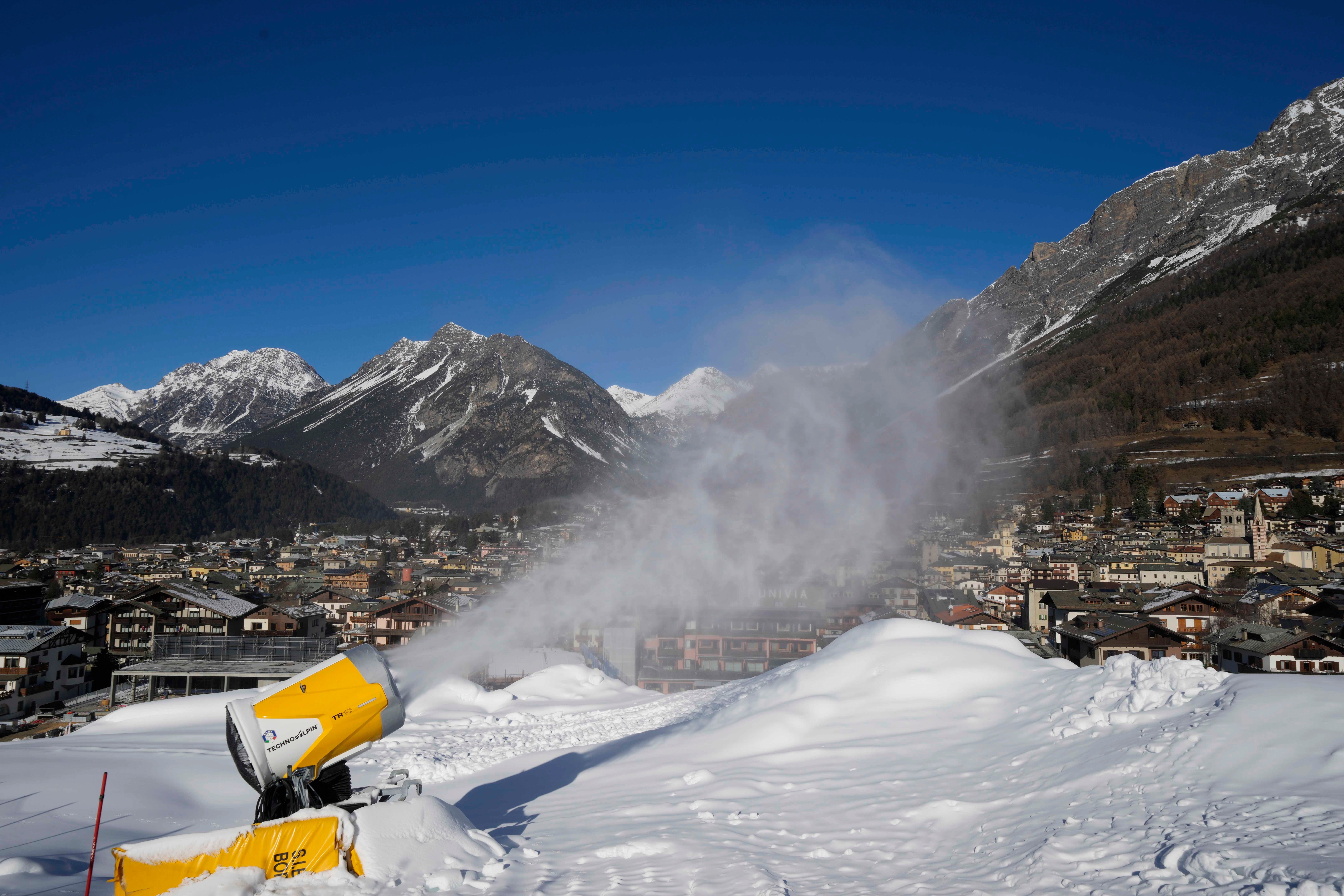
The organising committee estimates that the Games will require approximately 946 million litres (250 million gallons) of water for snowmaking. This vast quantity is equivalent to nearly 380 Olympic swimming pools.
Cerato has personally overseen the significant work involved in carving out new high-elevation water reservoirs specifically designed to store this crucial resource.
At the Livigno Snow Park, a substantial basin has been constructed, capable of holding about 200 million litres (53 million gallons) of water.
Cerato notes that this is now one of the biggest reservoirs on the Italian side of the Alps. More than 50 snow guns have been added there, with the capacity to produce approximately 800 million litres (211 million gallons) of snow in roughly 300 hours.
In Bormio, Cerato confirmed the construction of a lake at an elevation of 2,300 metres (2,515 yards), designed to hold 88 million litres (23 million gallons) of water.
Additionally, 75 snow guns have been installed specifically for the Alpine skiing and ski mountaineering courses. "We brought the Bormio slope to a new level," he stated, vividly comparing the transformation to a "Ferrari with new gears."
By manufacturing snow, organisers gain precise control over a slope's quality and hardness. This allows them to prepare the courses meticulously according to International Ski Federation (FIS) requirements, ensuring consistent conditions for all competitors, Cerato explained.
He highlighted that working with technical snow is inherently easier because of its compact nature, and it offers enhanced safety as it does not deteriorate as quickly as natural snow. The process allows for water to be injected deep into the snowpack, which then freezes to create a far more stable and durable race surface.
"We can deliver better, safer and fair courses," he asserted. "That is the difference — a fair course from bib No. 1 to bib No. 50."
Cerato and his team are also leveraging state-of-the-art sensor technology to continuously monitor snow depth across the courses. If a gap in coverage is detected, snow guns are automatically activated. Conversely, if there is an excess of snow, they are promptly turned off.
"It automatically adjusts everything, each snow gun, so you can control with just one person sitting in the office, all the mountain," Cerato explained, underscoring the efficiency of the system.
Furthermore, in Bormio, snow groomers have been equipped with advanced GPS systems. These systems are instrumental in monitoring snow quality and levels, leading to significant savings in time, energy, and water.
The GPS-enabled snow groomer precisely identifies where to push snow and the exact quantity required. This ensures that "you produce the minimum amount of snow that you need," Cerato said, describing the technology as "a powerful tool."
While his professional focus is on preparing slopes for elite competition, Cerato acknowledges that this differs significantly from commercial use, where natural snow is often considered precious. Despite his dedication to technical snow, he personally prefers skiing in powder.
"I was born on the mountain," he said. "I love snow."
‘Heated Rivalry’ stars joining Winter Olympics opening ceremony in Milan
US hockey star hailed as ‘future of the sport’ ready to make history at Olympics
Team GB target record Winter Olympics medal haul as sliding team announced
Team USA Winter Olympics ski and snowboard squads revealed
Winter Olympics venues still not completed ahead of next month’s Games
How Leonardo Da Vinci will be honoured at Milan Cortina Winter Olympics