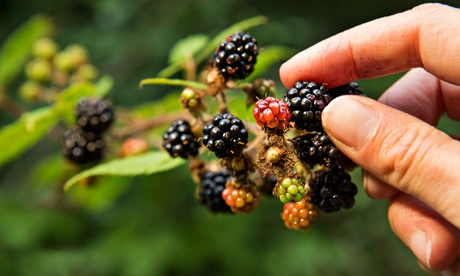
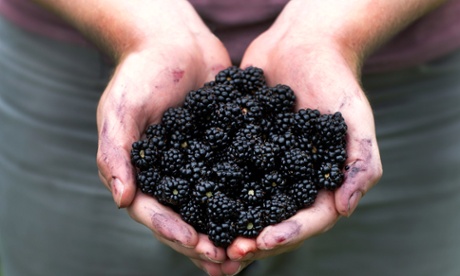
They’re here. Sirens offering you something so sweet but luring you into certain danger. Hanging like a million dark temptations from treacherous boughs that wrestle with you as you steal their fruit, pricking you if they can. When you succumb fully to their seduction, you walk away from the scene of the crime with your murderous fingers stained purple.
That purple blackberry-picking stain on your fingers – so difficult to shift, persisting in the crevice between nail and nail fold, like ink from a leaking fountain pen – is the plant pigment anthocyanin (flower-blue in Greek). We’re attracted to the colour and that is its primary function in the blackberry – to mammals, this fruit looks good enough to eat. One taste confirms it, keeping you coming back for more. But it’s not the anthocyanin you taste – that compound is almost completely flavourless. There are about 150 other volatile compounds that give blackberries their flavour and they are also packed with fructose, to make sure they’re irresistible, to make sure they get eaten up. We’re not the only mammals who are partial to blackberries, far from it. Foxes and badgers will also gobble them up, helping to distribute the seeds, which survive the transit through the gut.
As well as tasting fantastic, blackberries are good for you. Anthocyanin isn’t just a pigment, it’s a flavonoid, a heroic antioxidant! The stuff of superfoods! Antioxidants have acquired an almost mythical status, but unfortunately very little anthocyanin actually reaches your bloodstream when you eat blackberries. Like other flavonoids, it’s not well absorbed from the gut and it’s attacked by enzymes in the intestines and liver. Although it may be fundamentally true, at the level of atoms and basic molecules, that you are what you eat, we shouldn’t expect particular compounds to enter our bodies, unchanged in form and function. In fact, your guts and liver are designed to make that impossible for many compounds.
This doesn’t mean that blackberries and other flavonoid-rich foods aren’t beneficial. They seem to affect antioxidant levels in an unusual and unexpected way. After eating fruit, there’s an upsurge of urate-linked antioxidant capacity in the blood. This is odd because blackberries don’t contain urate or anything your body could convert into urate. Instead, the increased urate levels seem to be triggered by eating fructose. Along with that fructose, blackberries are also high in fibre, and full of good, old fashioned vitamin C, also an antioxidant, but one that is absorbed much more readily than flavonoids.
It seems that humans have been enjoying the taste and health benefits of blackberries for thousands of years. Gathered blackberries have been found at Neolithic sites, while a preserved iron age bog body, known as Haraldskaer Woman, provides definite evidence of blackberry ingestion. The body, dating to the 5th century BC, was discovered in 1835 by peat workers in Jutland and is that of a middle-aged woman. Speculation over whether the body was that of Queen Gunnhild of Norway, said to have been drowned in a bog in the 10th century AD, were put to rest when radiocarbon dating produced the iron age date. Forensic analysis of the bog body in 2000, including examination of the preserved gut contents, revealed that Haraldskaer Woman, who may have been the victim of a ritual sacrifice, had eaten a last supper of millet and blackberries.
It seems reasonable to suspect that humans have been eating blackberries for as long as humans and blackberries have coexisted. So when did blackberries originate?
Blackberries belong to the genus Rubus, a particularly abundant branch of the Rosaceae – the rose family. Rubus as a genus includes hundreds of species, including blackberries, dewberries, raspberries and cloudberries. The blackberries themselves are overwhelmingly diverse. In Europe alone, there are 748 different species. This incredible diversity has come about through the tendency of these plants to hybridise and to double up their sets of chromosomes, often as part of asexual reproduction. This makes it very difficult to work out when they first evolved.
Some researchers, comparing European and North American blackberries, have suggested a very ancient origin, going back even earlier than the Pleistocene epoch, which started about 2.6m years ago. Other researchers are more cautious, but still agree that blackberries probably originated well before the peak of the last ice age, about 20,000 years ago. Indeed, the repeated glaciations of the Pleistocene could have played a key role in blackberry evolution in Europe. But then, plenty of new blackberry species have appeared since the end of the ice age.
As the ice melted, plants and animals began to recolonise a corner of north-western Europe that would eventually become an island as the sea levels rose. Among those colonising plants were brambles and among the animals were humans. Those hunter-gatherers must have quickly realised that there was a redeeming feature of brambles, as the nights began to draw in and the leaves to turn.
So it’s time to relive your stone age ancestry. Get out there and brave the brambles! Gorge yourself on those beautiful, bountiful blackberries. They’re wild, they’re free and they’re good for you.